Year 4 Science · AC9S4I05

Compare findings and draw conclusions

Use evidence, check fairness and choose a useful further question.

Ready to project and teach

What students learn in AC9S4I05Start here

Learning intention: Compare findings with other people, check whether methods were fair, draw a conclusion from evidence and choose a useful further question.

A finding is what the records show. A conclusion explains what those findings mean for the investigation question. Different results are a reason to look closely, not an automatic sign that somebody is wrong.

  • Compare both groups’ recorded evidence and conditions.
  • Identify an accidental change that could affect a comparison.
  • Judge a designed solution against its stated purpose.
  • Write a conclusion that fits the tested conditions and propose a focused follow-up.

Year-level boundary: Use observed values, simple comparisons and repeated patterns. Formal averages, uncertainty calculations and statistical significance are not required. Use familiar water, materials and forces contexts.
Key vocabularyExplore
Finding
A result or pattern identified from recorded evidence.
Fair test
A comparison that changes the factor being investigated while keeping other relevant conditions consistent.
Variation
Differences between observations or trials.
Conclusion
An answer to the investigation question supported by evidence.
Fitness for purpose
How well a design or material meets the needs of its intended use.
Further question
A testable question arising from findings, an unexpected result or a limit.
Concept models and worked thinkingExplore

Compare group findings

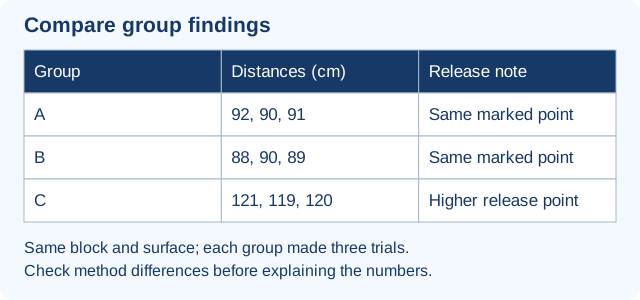
Compare group findings. Group: A, Distances (cm): 92, 90, 91, Release note: Same marked point. Group: B, Distances (cm): 88, 90, 89, Release note: Same marked point. Group: C, Distances (cm): 121, 119, 120, Release note: Higher release point. Same block and surface; each group made three trials. Check method differences before explaining the numbers.
Compare group findings. Invented classroom data.

Teacher models: “A recorded 90–92 cm and B recorded 88–90 cm. Their findings are similar. C recorded longer distances, but its release mark was higher. All groups used the same surface; the changed release point may explain C’s farther motion.”

Ask: What would you check before combining C’s results? Expected: Confirm the release point and repeat with the same mark. Retain and label the original records.

Compare water-use surveys

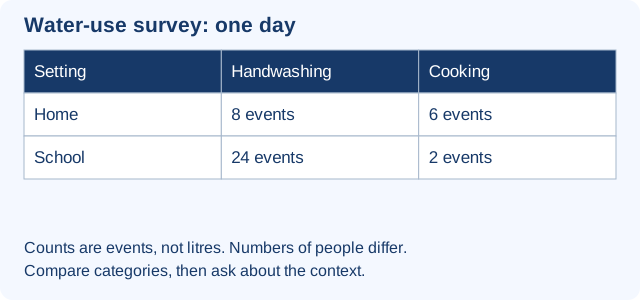
Water-use survey: one day. Setting: Home, Handwashing: 8 events, Cooking: 6 events. Setting: School, Handwashing: 24 events, Cooking: 2 events. Counts are events, not litres. Numbers of people differ. Compare categories, then ask about the context.
Water-use survey: one day. Invented classroom data.

Home recorded six cooking events compared with two at school; school recorded more handwashing events. These are counts, not litres. Ask how many people were present, what activities occurred and how long taps ran. Do not label a family wasteful from a total alone.

Choose a roof for its purpose

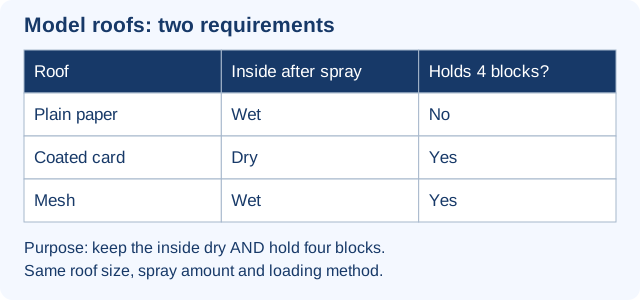
Model roofs: two requirements. Roof: Plain paper, Inside after spray: Wet, Holds 4 blocks?: No. Roof: Coated card, Inside after spray: Dry, Holds 4 blocks?: Yes. Roof: Mesh, Inside after spray: Wet, Holds 4 blocks?: Yes. Purpose: keep the inside dry AND hold four blocks. Same roof size, spray amount and loading method.
Model roofs: two requirements. Invented classroom data.

Coated card meets both needs in this model test. Mesh holds the load but lets water through; plain paper meets neither recorded need. This comparison supports a decision about these samples and conditions, not every roof made of those materials.

Distinction: Comparing complete designs can involve several intentional differences. To investigate the effect of material alone, keep size, shape and relevant test conditions the same.

Curriculum coverage and elaborationsExplore

Official content description: compare findings with those of others, consider if investigations were fair, identify questions for further investigation and draw conclusions

  1. E1: identifying instances during investigations where elements may have been changed in error, resulting in an unfair test. Inspect a log showing that one strip had two layers by mistake. Name the extra changed condition, retain its record, and repeat with equal layers. Matching outcomes do not establish fairness.
  2. E2: comparing findings of water use surveys and discussing differences between home and school, or between each other’s homes. Use the survey model. Compare matching categories and periods; ask about people, activities, duration and volume. Event counts alone do not measure litres or prove waste.
  3. E3: comparing designed solutions, such as toys, lunchboxes or structures, to determine fitness for purpose of selected materials. Use the roof model to check dry-inside and load requirements. Extend to a lunchbox whose handle breaks despite good cooling: it meets one need but not another.
  4. E4: comparing findings from investigations with peers and asking questions about factors that may have led to any differences in findings. Use the group model. Ask neutral questions about release marks, units and surfaces; compare repeated patterns as well as individual values.
  5. E5: identifying unexpected findings and posing questions for further investigation. A model roof stays dry in a short spray but leaks later. Keep both observations and ask how spray duration affects leaking, holding other relevant conditions consistent.
  6. E6: drawing conclusions that reflect their data and information. Write: “The tested coated-card roof stayed dry and held four blocks, meeting both needs.” Add a limit: the short model test does not establish performance in all weather.
Guided learning activitiesExplore

We do: method detective

Teacher gives two logs: same block and surface, but different release marks. Teacher and class highlight the difference and explain how it might matter. Partners then draft a repeat plan. Look for “may explain”, not certainty without another test.

Conclusion ladder

Improve “It always works” to “This roof stayed dry during our short spray test.” Add recorded load evidence and the intended purpose. Partners check whether each claim can be traced to a record.

Next-question workshop

Notice an uncertainty → name a possible factor → write a focused question → plan what to compare and keep consistent. Example: “Does a longer spray cause this roof to leak?”

Quick checkpoint: Can five repeats repair a changed layer number? No. Repeats reveal patterns, while the layer difference must be repaired separately.

Common misconceptions and quick fixesExplore
  • Different findings mean cheating: Compare methods and measurements before judging; genuine variation is possible.
  • Equal outcomes prove fairness: Fairness concerns relevant conditions, not identical numbers.
  • The largest total shows the most waste: Water-use totals depend on people, activities, periods and measurement units.
  • Best at one property means best product: Check every relevant purpose requirement.
  • A conclusion repeats the procedure: Answer the question with evidence, not just equipment or steps.
  • An unexpected reading should disappear: Keep it, check it and explain the findings honestly.
Support, Core and ExtendExplore

Support: Provide two short records and sentence frames: “Both groups…”, “One difference is…”, “We should check…”. Read the units aloud.

Core: Compare repeat sets and methods, judge two product criteria, write a conclusion and a further question.

Extend: Explain the difference between choosing a whole design and isolating one material property. Suggest a follow-up that distinguishes two possible explanations without requiring formal statistics.

Important questions and answersExplore
Why ask another group about its method?
A different release point, unit or test duration could explain different findings.
Does twice as many tap events mean twice as many litres?
No. Duration and flow can differ; the survey counted events.
Can a complete-design comparison have several intentional differences?
Yes, to judge overall fitness for purpose. It cannot then identify the effect of one feature alone.
What makes a useful conclusion?
It answers the question with recorded evidence and stays within the tested conditions.
Assessment-style questions and review hintsExplore

Prompt: Equal cloth pieces receive equal water amounts. A absorbs 18 mL and B 12 mL. Write a conclusion. Expected: A absorbed more in this matched test, 18 mL compared with 12 mL. Review: Do not infer every other use or size.

Prompt: A roof stays dry but fails the required load. Is it fit for both needs? Expected: No; explain the success and the unmet load requirement. Review: Check each criterion.

Prompt: One drying trial takes much longer. What next? Expected: Retain the result, check conditions and ask a focused question about a possible factor such as airflow. Review: Do not delete a result simply for being unexpected.

Exit ticket and mastery evidenceExplore

Two groups use the same method. A records 30, 32 and 31 cm; B records 31, 30 and 32 cm. Write one comparison, one method question and one cautious conclusion.

Expected evidence: Both sets contain distances from 30 to 32 cm. Ask whether the same surface and release mark were used. Conclude that both groups found similar distances under these conditions.

Continue when: the pupil compares both records, asks a relevant neutral question and avoids universal claims. Reteach if: they use only the largest number, confuse a count with a volume or judge fairness only from matching outcomes.

Teach & ExplainTeaching slides and samples

Teach this topic step by step

Explore optional teaching slide packs for classroom lessons and explanations at home.

Browse Teach & Explain · Browse Print & Go

Teachers: follow SkillrHub on TPT, then email us to request a free sample before buying. Include the year, subject and topic or curriculum code.

Request a free sample

After trying the sample, honest feedback is welcome. A TPT review is optional, where available, and does not need to be positive.