Important questions and answers
- What makes a comparison fair?
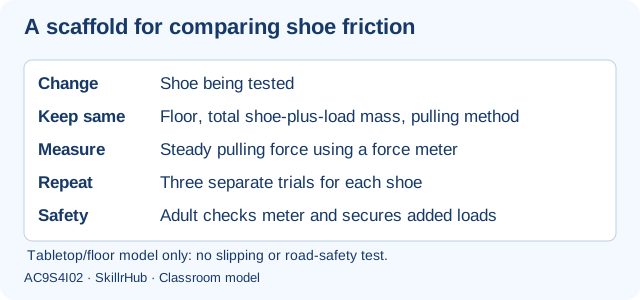
- Compare the chosen factor while keeping other relevant conditions consistent.
- What counts as a repeat?
- Reset, do the method again and record a new observation.
- Why pilot a plan?
- To find unclear steps, unsuitable tools or safety problems before the main investigation.
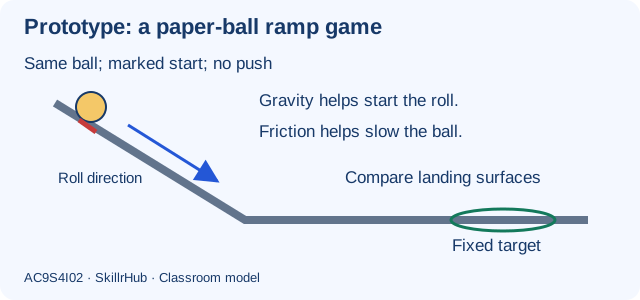
- What does a prototype investigation require?
- A prediction, built trial version, actual test evidence and a reasoned improvement.
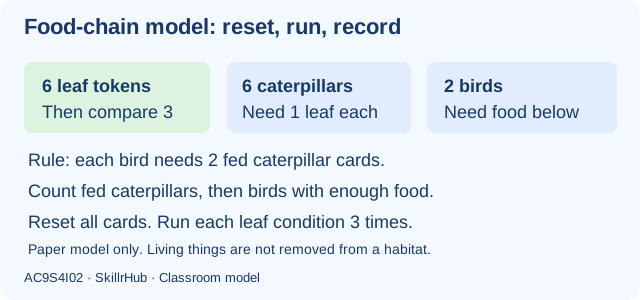
- Why reset a simulation?
- Each repeat must start with the stated conditions and use the same rules.
- Why is “be careful” insufficient?
- It needs a named hazard and a specific action that reduces the risk.
Assessment-style questions and review hints
Question: A paper-towel test uses a larger sample and more water for one brand. What should improve? Answer: Use equal sample areas and starting volumes, plus the same contact time and measuring method. Review hint: Separate the brand being compared from the conditions kept the same.
Question: A group writes the same number into three rows without repeating its simulation. Is that three runs? Answer: No; the process must actually be reset and run three times. Genuine runs may still produce identical outcomes.
Support, Core and Extend
Support: Provide labelled “change / measure / keep the same / safety” boxes and model one step. Core: Complete the scaffold and conduct repeated safe trials with actual records. Extend: Identify a method limit, revise one part and explain why the change improves the evidence without changing the investigation’s goal.
Exit ticket
- Name the changed factor and one controlled condition in your investigation.
- Show an actual trial record or label the plan untested.
- State one hazard and the specific control you followed.
Expected evidence: A matched question and method, an honest record and a useful safety action. Reteach if results are copied instead of repeated, several factors change together, or a drawing is described as a conducted test.
Year-level boundary
Use provided scaffolds, familiar units and qualitative force and food-chain relationships. Do not require friction coefficients, equations of motion, statistical tests or exact ecological forecasts. A teacher checks every practical method. Untested planning can be assessed separately but does not establish mastery of conducting investigations.