AC9S4U01 • Year 4 Science

AC9S4U01: Explain the roles and interactions of consumers, producers and decomposers within a habitat and how food chains represent feeding relationships

explain the roles and interactions of consumers, producers and decomposers within a habitat and how food chains represent feeding relationships

What students learn in AC9S4U01

Students explain how producers make food, consumers obtain energy by eating and decomposers break down dead material. They read food-chain arrows as showing the direction of food and energy transfer.

Learning routine: Observe → Model → Investigate → Record → Explain → Evaluate

Success looks like

  • Classify organism roles
  • Construct and read food chains
  • Explain arrow direction
  • Predict habitat interactions
  • Use evidence and acknowledge complexity
Key vocabulary
producer
an organism that makes its own food
consumer
an organism that obtains energy by eating
decomposer
an organism that breaks down dead material
Concept models and worked thinking

Read a feeding arrow

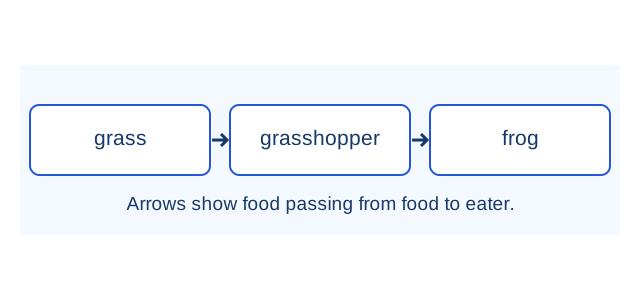
Grass is eaten by a grasshopper, which is eaten by a frog.
  1. Grass makes food using sunlight: label it producer. The Sun supplies energy but is not a living producer.
  2. The grasshopper eats grass: follow the arrow from grass to grasshopper.
  3. The frog eats the grasshopper: the next arrow points towards the frog.

Say: “The arrow means this food is eaten by this organism; energy passes to the eater.”

Checkpoint: Which organism receives food at the second arrow? Answer: the frog. If a child says grasshopper, trace from the food to the eater again.

Decomposers connect to every feeding level

Fungi and bacteria can break down dead grass, dead insects and dead frogs. They do not act only after the last predator. Breakdown returns nutrients to the habitat; energy does not cycle back as fresh sunlight. Worms and termites help break dead material into smaller pieces; scientists often call these animals detritivores.

Compare two habitats

Herbivores eat plants, carnivores eat animals, and omnivores eat both. These are all animal consumers. Phytoplankton are tiny drifting aquatic organisms that make food using light; they are producers.

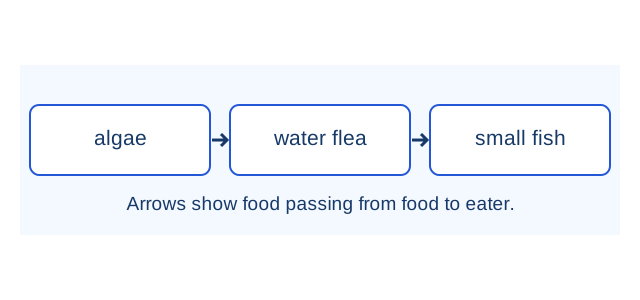
Algae is eaten by a water flea, which is eaten by a small fish.

Both models begin with a producer and show two animal consumers. The organisms differ because the habitats differ. A chain shows one feeding path; a food web joins several paths. Building a large food web or learning trophic-level percentages is not the target of this Year 4 lesson.

Curriculum coverage and elaborations

The content description and elaborations below show the curriculum ideas taught in this unit. Items marked as teaching context support lesson planning.

  • Content description: explain the roles and interactions of consumers, producers and decomposers within a habitat and how food chains represent feeding relationships
  • E1: describing how animals, including humans, obtain their food from plants and other animals
  • E2: observing living things in a local habitat and categorising them as producers, consumers or decomposers
  • E3: researching the different types of decomposers and their importance within a habitat
  • E4: representing feeding relationships of producers and consumers as a food chain and comparing food chains across different habitats
  • E5: recognising how First Nations Australians perceive themselves as being an integral part of the environment (teaching context)
  • E6: investigating the impact of introduced predators such as foxes on small mammal species in Australia
  • E7: researching how the removal of a food source from within a habitat, such as through an insect or rodent infestation, affected other living things within that habitat
Teaching every curriculum elaboration

E1: Trace food to a source

A person eats oats and an egg. Oats come from a plant; an egg is animal food. People, like other animals, obtain food from plants, animals or both. Ask students to trace two familiar foods to their living sources rather than only naming a shop.

E2: Observe a local habitat

With adult supervision, observe a garden without handling unknown organisms. Record an organism, what it is doing and evidence for its role. A leaf-eating snail is an animal consumer; a green grass plant is a producer; fungus breaking down dead wood is a decomposer. If identity or feeding is uncertain, record “needs more evidence” instead of guessing from appearance.

E3: Research decomposers

Use a reliable book or science source to compare fungi and bacteria. Both include decomposers, but not every fungus or bacterium has the same role. Draw arrows from dead plant and animal material to decomposers and explain nutrient return. Observe photographs of decay; do not grow or handle mould.

E4: Compare feeding relationships

Build grass → grasshopper → frog and algae → water flea → small fish. Label the producer and consumers in each. Explain one shared role pattern and one habitat difference; read each arrow aloud as “is eaten by”.

E5: People belong within Country/Place

ACARA’s teacher background describes First Nations Australians as integral to the environment. It draws on Noonuccal scholar Karen Martin-Booran Mirraboopa’s account of connected relationships among people, land, waters and other entities. Discuss how people depend on living things and have responsibilities within these relationships. Specific knowledge belongs to particular Peoples and communities; do not invent a single practice for all First Nations Australians.

E6: Investigate introduced predators

Australian Government information identifies fox predation as a threat to native animals. Use a teacher-selected report or camera observation of a fox taking a small native mammal. Ask: what interaction is recorded, and what effect could repeated predation have? More prey may be eaten, but one observation cannot establish the cause of every population change. Do not approach foxes or handle remains.

E7: Investigate loss of a food source

In a model habitat, introduced mice eat most seeds also used by seed-eating native birds. Predict that birds may have less food, then propose checking seed supply and feeding observations. The Australian Government describes how introduced grazers can reduce vegetation used by native animals. Distinguish the model prediction from a recorded real-world result; food, shelter and weather may also influence populations.
Cultural safety for First Nations elaborations

Use reliable, community-approved sources and identify the specific Nation, People or community where the source does. Do not present diverse First Nations knowledges as one generic tradition. Follow local cultural and intellectual property protocols before reproducing cultural material or inviting community participation.

Guided learning activities

Warm-up: what was lunch made from?

Trace a fruit, grain and animal food to their sources. A teacher checks that “shop” is replaced by a plant or animal source.

Core: role cards and arrows

Use cards for grass, grasshopper, frog, dead leaves and fungi. Build the feeding chain, then show a separate dead-material link to fungi. Explain why decomposers are not restricted to the last consumer.

Investigation: change one food supply

Use counters to represent available seeds shared by mice and native birds. Remove some seeds to model mouse feeding; describe the possible effect on birds. This is a model, not evidence that the same-sized change occurs outdoors.

Support: Provide three labelled cards and rehearse “food → eater”. Core: Explain each organism’s role using its action. Extend: Compare a second habitat and explain why a population prediction is uncertain.

Revision Notes

Important questions and answers

What role does grass have?
Producer: it makes food using sunlight.
What does grasshopper → frog mean?
The frog eats the grasshopper and receives food and energy.
Where do decomposers act?
On dead material from producers and consumers at different feeding levels.
What could happen after a food source declines?
Consumers relying on it may have less food; gather observations before claiming a definite population change.
How do people fit within a habitat?
People depend on plants, animals and their surroundings. First Nations accounts of Country/Place describe connected relationships, with community-specific knowledge and responsibilities.

Assessment-style question

Possums eat many berries on bushes also used by fruit-eating birds. Predict one direct effect on the birds and explain the feeding link.

Answer: Birds may have fewer berries to eat because possums removed a shared food source. Review hint: Name the lost food, the affected consumer and a cautious prediction.

Exit ticket and adult evidence check

  1. Draw grass → grasshopper → frog and explain both arrows. Check two correct food-to-eater arrows.
  2. Name a decomposer and what it breaks down. Accept fungi or bacteria acting on dead material; ask for the material, not only a name.
  3. Explain how fewer seeds could affect seed-eating birds. Require less available food and “may” rather than a guaranteed outcome.

Reteach arrow direction if an arrow points to the food; reteach organism roles if soil or sunlight is called a producer. Continue when the learner explains the relationships, not only memorised labels.

How to use this unit

Read the topic guide and use the teacher slide for instruction. Students can then use the worksheet for written work, open Practice for supported feedback, or take the Test when they are ready.

AC9S4U01 teacher slide

Teacher resource

Open the Classroom View to teach the same models, worked explanations and review questions from this guide.

Open Classroom View
Common misconceptions
  • Food-chain arrows point to the food — Arrows point from the food source toward the organism receiving energy.
  • Decomposers are only at the end — They break down dead material from organisms at every feeding level.
  • One food chain represents the whole habitat — Real habitats contain interconnected food webs.
  • Every consumer is a predator — Herbivores and omnivores are also consumers.
International curriculum mapping

This table gives closest-topic mapping for search and planning. The Australian Curriculum code is exact; overseas entries are broad equivalents because each jurisdiction structures outcomes differently.

RegionCurriculumClosest mapping
AustraliaAustralian Curriculum v9.0AC9S4U01 — explain the roles and interactions of consumers, producers and decomposers within a habitat and how food chains represent feeding relationships
VictoriaVictorian Curriculum F-10Year 4 Science: closest match in Biological sciences. Use this page as a VIC-aligned practice and worksheet reference.
NSWNSW CurriculumStage 2 Science: closest content focus for Explain the roles and interactions of consumers, producers and decomposers within a habitat and how food chains represent feeding relationships and related outcomes.
United StatesCommon Core / NGSSGrade 4 NGSS science closest topic match for Explain the roles and interactions of consumers, producers and decomposers within a habitat and how food chains represent feeding relationships.
England / UKNational CurriculumKey Stage 2 / Year 4: closest programme-of-study match for Explain the roles and interactions of consumers, producers and decomposers within a habitat and how food chains represent feeding relationships.
CanadaProvincial and territory curriculaGrade 4 closest topic match. Canada varies by province, so use this as a broad Ontario/BC-style learning outcome reference.
New ZealandNew Zealand CurriculumLevel 2 Science: closest achievement-objective topic for Explain the roles and interactions of consumers, producers and decomposers within a habitat and how food chains represent feeding relationships.
IndiaNCERT / CBSEClass 4 closest NCERT/CBSE topic match for Explain the roles and interactions of consumers, producers and decomposers within a habitat and how food chains represent feeding relationships.
🎥 Optional Video Lesson

The SkillrHub lesson remains the primary learning resource. This optional video reinforces the explanation; you can complete the lesson and practice without watching.

Back to the lesson

Before you watch:

  • Pause after each worked example.
  • Try the examples yourself.
  • Return to the SkillrHub lesson before continuing.
Recommended: Fabulous Food Chains: Crash Course Kids #7.1

Crash Course Kids — Trace feeding relationships from producers to consumers.

As you watch: What do the arrows in a food chain tell you?

Load video player Loads YouTube in this lesson. See the video notice below.

Try it: Draw a simple food chain from a habitat you know. Label the producer and consumers.

Video unavailable, inaccurate or unsuitable for this year? Report a video problem to SkillrHub by email. You can continue with the written lesson and practice resources.

Another explanation: The Dirt on Decomposers: Crash Course Kids #7.2

Crash Course Kids — Find out how decomposers contribute to a habitat.

As you watch: Why are decomposers important even when they are hard to see?

Load video player Loads YouTube in this lesson. See the video notice below.

Try it: Add a decomposer to your habitat diagram and explain what it breaks down.

Video unavailable, inaccurate or unsuitable for this year? Report a video problem to SkillrHub by email. You can continue with the written lesson and practice resources.

About these videos

Videos are curated from trusted independent educational creators and played through YouTube. Rights remain with their respective owners. Inclusion does not imply that a creator or YouTube endorses SkillrHub.

YouTube’s terms and privacy policy apply to its player. Advertising, recommendations and external links may appear, and videos may change or become unavailable. SkillrHub’s written lessons and practice resources remain available separately.

To report a content, suitability or rights concern, email skillrhublearning@gmail.com with the lesson code and video link. Please do not include personal student information.

Curriculum equivalents: Victoria, NSW and international

Curriculum equivalents for Explain the roles and interactions of consumers, producers and decomposers...

Mapped skill: explain the roles and interactions of consumers, producers and decomposers within a habitat and how food chains represent feeding relationships

These references identify matching or closely related learning. Curriculum sequence, terminology and depth vary, so teachers should use the mapped skill and lesson difficulty to confirm suitability.

RegionCurriculum frameworkClosest level or code
AustraliaAustralian Curriculum v9.0AC9S4U01 · Year 4
VictoriaVictorian Curriculum F–10 Version 2.0 — ScienceVC2S4U03 · Levels 3–4
New South WalesNSW Science and Technology K–6 Syllabus (2024)ST2-SCI-01 · Stage 2
United States (USA)Next Generation Science Standards (NGSS)Grade 4
Canada (Ontario)Ontario Curriculum — ScienceGrade 4
United Kingdom (England)National Curriculum in England — ScienceYear 5, Key Stage 2
IndiaNCERT / CBSE — ScienceClass 4

Australian Curriculum v9.0 is the canonical source for this SkillrHub lesson. Victoria and NSW entries name the closest published state codes or outcomes; international entries are planning references rather than claims of identical curricula.

Help improve SkillrHub

Questions or feedback?

Ask about this lesson, suggest an improvement or report an error. Facebook opens only when you choose an option below.

Topic reference: AC9S4U01 — AC9S4U01: Explain the roles and interactions of consumers, producers and decomposers within a habitat and how food chains represent feeding relationships

💬 Ask a question 💡 Suggest an improvement ⚠️ Report an error

Privacy: Please don’t share personal student or school information. Younger students should ask a parent, guardian or teacher to post on their behalf.

Official curriculum references
Related Year 4 Science topics