AC9S4U03: Identify how forces can be exerted by one object on another and investigate the effect of frictional, gravitational and magnetic forces on the motion of objects
identify how forces can be exerted by one object on another and investigate the effect of frictional, gravitational and magnetic forces on the motion of objects
Students describe forces as pushes or pulls between objects, distinguish contact from non-contact forces and use fair tests to investigate how friction, gravity and magnetism change motion.
Learning routine: Observe → Model → Investigate → Record → Explain → Evaluate
Success looks like
Identify pushes and pulls
Distinguish force types
Use force directions
Plan fair investigations
Interpret repeated evidence
Key vocabulary
force
a push or pull between objects
friction
a contact force opposing relative motion
gravity
an attractive force between masses
Concept models and worked thinking
Compare three forces acting on motion
frictioncontact force opposing sliding or rolling
gravitynon-contact attraction toward Earth
magnetic forcenon-contact attraction or repulsion between suitable magnets/materials
Forces can start, stop, speed up, slow down or change direction. A force has both a direction and an effect; several forces may act at once.
Identify which object exerts each force and which object experiences it.
Classify whether contact is needed, then name a possible effect on motion.
Check that gravity is included even when the object is supported.
Plan fair force investigations
QuestionChangeMeasureKeep sameDoes surface affect slide distance?surface materialdistance travelledobject, slope, start pointDoes magnet distance affect attraction?gapwhether the clip moves at each gapmagnets, objectDoes ramp height affect travel distance?heightdistance travelled after the rampcar, surface, release
A fair comparison changes one tested factor, measures an effect consistently and controls other relevant conditions. Repeat trials because motion can vary.
For a surface test, changing the car as well as the surface would make the cause of any difference unclear.
Curriculum coverage and elaborations
The content description and elaborations below show the curriculum ideas taught in this unit. Items marked as teaching context support lesson planning.
Content description: identify how forces can be exerted by one object on another and investigate the effect of frictional, gravitational and magnetic forces on the motion of objects
E1: exploring the effect of magnets on other magnets and how magnetic forces can pull objects from a distance
E2: exploring the positive and negative effects of friction on their everyday experiences, such as how friction causes objects to slow down and stop
E3: recognising that gravity is the force that pulls all objects to towards the centre of Earth and that gravitational force acts on an object regardless of whether it is moving or not moving
E4: observing how the pushing force of a liquid enables an object to float
E5: investigating the effect of forces on the movement of objects in traditional First Nations Australians’ children’s instructive toys and games (teaching context)
E6: examining shoe sole design and identifying patterns in sole design and use related to friction
E7: watching a video of astronauts walking on the moon or dropping objects on its surface, and discussing the force they are observing
E8: exploring how force arrows can be used to represent the direction and magnitude of forces acting on an object
Explore all eight curriculum ideas
E1 · Magnets pull and push
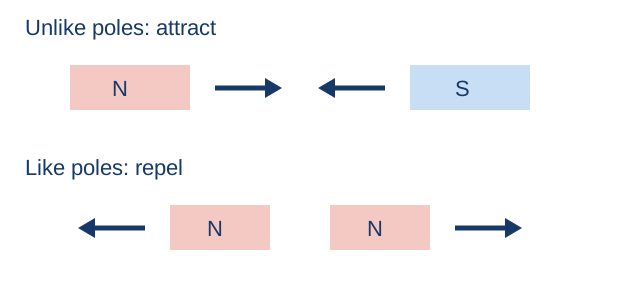
The arrows show the magnetic forces. The magnets do not need to touch.
Bring two large classroom bar magnets near each other. Turn one around and compare. Unlike poles attract; like poles repel. Then test a steel paperclip across a small gap. Keep the same magnet, clip and tabletop, reset the clip each trial and record whether it moves at each tested distance.
Check: A clip moves before contact. Is touching essential? Answer: No; magnetic attraction can act across a gap. Do not conclude that every metal is attracted.
E2 · Helpful and unwanted friction
Slide the same block from the same low ramp point onto two level surfaces. Measure from the ramp end to the stopping point and repeat three times per surface. A shorter travel distance suggests more resistance under those conditions. Friction can help brake a bicycle but can also wear the brake pads. Roughness alone does not predict every pair of materials.
Worked evidence: A block travels 44, 46 and 45 cm on mat A and 81, 79 and 80 cm on board B. Every A trial is shorter than every B trial, supporting greater resistance on A in this test. No calculated average is needed.
E3 · Gravity acts on still objects
Hold a soft ball over a low tray, then release it. Earth pulls the ball towards its centre both before and after release. Before release, the hand supports it; afterwards, that support is gone. On a table, a book can remain still because the table pushes up while gravity pulls down.
20-second check: Draw gravity on a held ball and a falling ball. Both arrows point towards Earth. Reteach if a learner draws no gravity on the held ball.
E4 · Water can support an object
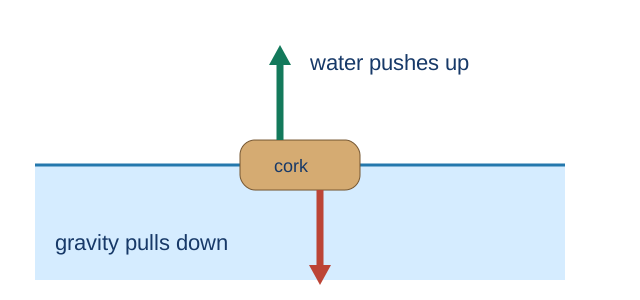
At a steady floating height, the upward and downward forces balance.
Place a cork or sealed toy boat in a shallow tray of water. Observe that it stays afloat without a hand holding it. Water pushes upward while gravity still pulls downward. Draw and label both forces; equal lengths represent balanced strengths in this still example.
Check: Does floating switch gravity off? Answer: No. Water supports the object against gravity. We describe the pushes and pulls without density calculations.
E5 · Learn from a specific instructive game
ACARA’s teacher background describes Pitjantjatjara children using a rolling bark disc as a target. Identify the initial applied push and later resistance from contact with the ground. This is one documented context, not a description of all First Nations games.
Safe classroom investigation: Roll a foam disc along a clear lane, without any thrown implement. Compare how far it travels on two surfaces using the same release. Record the actual motion and explain how contact resistance changes it. This classroom model explores forces; it is not presented as an authentic recreation of a cultural game. Respect the source and follow local protocols for cultural participation.
E6 · Shoe soles and grip
Inspect clean shoe soles placed on a table. Sketch grooves, raised patterns and worn smooth patches. Predict which might grip a chosen surface, then explain why appearance alone is insufficient evidence: material, load and wetness also matter.
Adult demonstration: Pull two equally loaded shoes across the same tile using the same method. Compare the pull needed to start sliding. Keep children off slippery surfaces. A stronger starting pull indicates greater grip in this setup; do not claim one pattern is safest everywhere.
E7 · Gravity on the Moon
Watch NASA’s Apollo 15 hammer-and-feather demonstration. Pause before release and predict what each object will do. Both reach the lunar surface together in the demonstration, where air resistance is negligible. The Moon has gravity: both objects fall after the astronaut lets go.
Check: Why is “there is no gravity on the Moon” inconsistent with this observation? Answer: The released objects fall to its surface. Keep discussion qualitative; do not require acceleration formulae or assume a feather falls the same way in Earth’s air.
E8 · Draw the force, not the journey
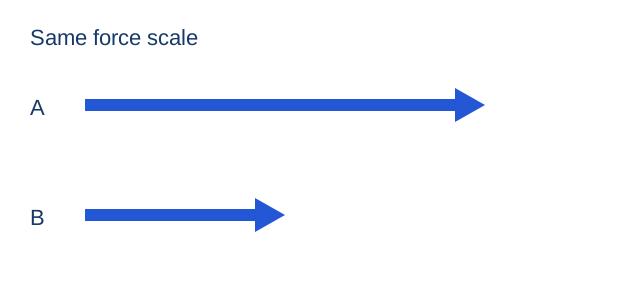
Arrowheads show direction; longer arrows show stronger forces when the scale is the same.
A force arrow labels a push or pull acting on an object. Its length represents relative strength, not time or distance travelled. Draw a sliding block with a friction arrow opposite the slide. A separate motion arrow, if used, must be labelled “motion” so it is not mistaken for a force.
Check: A points right and is longer than right-pointing B. Answer: A represents a stronger force in the same direction. Revisit the key if a learner answers “longer journey”.
Cultural safety for First Nations elaborations
Use reliable, community-approved sources and identify the specific Nation, People or community where the source does. Do not present diverse First Nations knowledges as one generic tradition. Follow local cultural and intellectual property protocols before reproducing cultural material or inviting community participation.
Guided learning activities
1. Surface-friction test
Release the same block or toy from the same point onto different surfaces and compare travel distance.
surfacetrial 1trial 2trial 3smoothrough
2. Magnetic-distance test
Increase the gap between a magnet and a paperclip, record the greatest attraction distance and repeat.
same magnet→change distance→observe attraction→repeat→compare
3. Force-arrow diagrams
Draw arrows showing direction and relative size of forces in a falling, sliding or stationary situation.
falling objectgravity downward
sliding blockmotion forward, friction backward
opposite magnet polesattraction toward each other
Revision Notes
Core idea: Students describe forces as pushes or pulls between objects, distinguish contact from non-contact forces and use fair tests to investigate how friction, gravity and magnetism change motion.
Remember
Identify pushes and pulls
Distinguish force types
Use force directions
Plan fair investigations
Interpret repeated evidence
Important questions and answers
Is friction a contact force?
Yes. The interacting surfaces must be in contact.
Give two effects of a force.
A force can slow an object or change its direction; starting, stopping and speeding up are also valid.
Why does gravity act on a supported book?
Earth still attracts it. The desk provides an opposing upward push.
Name a control in the surface investigation.
Keep the block and its release point the same so only the surface changes.
What do unlike and like magnet poles do?
Unlike poles attract; like poles repel. Both interactions can occur across a gap.
Apply, check and explain
Assessment-style questions and review hints
Question: The same block travels farther on B than A in every repeated fair trial. Which surface appears to offer more resistance? Answer: A. Review hint: Compare stopping distances under the same starting conditions.
Question: Draw both vertical forces on a boat floating steadily. Answer: Water pushes up; gravity pulls down, represented by equal arrows. Review hint: Stillness does not mean forces are absent.
Support, Core and Extend
Support: Sort picture examples into touching and across-a-gap forces and use “___ pushes/pulls ___”. Core: Run a controlled surface or magnet test and explain the observed pattern. Extend: Identify a limitation and plan a repeat that checks it, staying with qualitative forces.
Exit ticket
Name one contact and one non-contact force.
Explain why a floating boat still experiences gravity.
Explain what a longer force arrow means when the scale is unchanged.
Expected evidence: Friction and magnetism/gravity; water supports against gravity; stronger force. If any is missing, revisit the corresponding model and ask the learner to redraw or explain it before moving on.
Year 4 boundary and safe materials
Use familiar pushes, pulls, contact, gaps and relative strengths. Prior knowledge is describing motion and measuring lengths. Formal vector sums, acceleration equations, coefficients of friction, magnetic field calculations and density calculations are not required. Use large classroom magnets, small drop heights, a clear rolling lane and adult supervision; keep magnets away from mouths and wipe water spills.
How to use this unit
Read the topic guide and use the teacher slide for instruction. Students can then use the worksheet for written work, open Practice for supported feedback, or take the Test when they are ready.
AC9S4U03 teacher slide
Teacher resource
Use the Classroom View to project the same authored explanations, models and checks before students begin the activities.
A moving object must have a forward force — An object can continue moving while forces are balanced or after a push ends, although friction may slow it.
Gravity only acts while falling — Gravity acts on objects whether they are falling, supported or moving sideways.
All metals are magnetic — Only some materials, such as iron and many steels, respond strongly to common magnets.
A fair test changes several things — Change one tested factor and control the others.
International curriculum mapping
This table gives closest-topic mapping for search and planning. The Australian Curriculum code is exact; overseas entries are broad equivalents because each jurisdiction structures outcomes differently.
Region
Curriculum
Closest mapping
Australia
Australian Curriculum v9.0
AC9S4U03 — identify how forces can be exerted by one object on another and investigate the effect of frictional, gravitational and magnetic forces on the motion of objects
Victoria
Victorian Curriculum F-10
Year 4 Science: closest match in Physical sciences. Use this page as a VIC-aligned practice and worksheet reference.
NSW
NSW Curriculum
Stage 2 Science: closest content focus for Identify how forces can be exerted by one object on another and investigate the effect of frictional, gravitational and magnetic forces on the motion of objects and related outcomes.
United States
Common Core / NGSS
Grade 4 NGSS science closest topic match for Identify how forces can be exerted by one object on another and investigate the effect of frictional, gravitational and magnetic forces on the motion of objects.
England / UK
National Curriculum
Key Stage 2 / Year 4: closest programme-of-study match for Identify how forces can be exerted by one object on another and investigate the effect of frictional, gravitational and magnetic forces on the motion of objects.
Canada
Provincial and territory curricula
Grade 4 closest topic match. Canada varies by province, so use this as a broad Ontario/BC-style learning outcome reference.
New Zealand
New Zealand Curriculum
Level 2 Science: closest achievement-objective topic for Identify how forces can be exerted by one object on another and investigate the effect of frictional, gravitational and magnetic forces on the motion of objects.
India
NCERT / CBSE
Class 4 closest NCERT/CBSE topic match for Identify how forces can be exerted by one object on another and investigate the effect of frictional, gravitational and magnetic forces on the motion of objects.
🎥 Optional Video Lesson
The SkillrHub lesson remains the primary learning resource. This optional video reinforces the explanation; you can complete the lesson and practice without watching.
Crash Course Kids — Understand gravity as a force that acts on objects.
As you watch: Can gravity act without one object touching another?
Load video playerLoads YouTube in this lesson. See the video notice below.
Try it: Compare a ball resting on the ground with a ball falling. Explain where gravity acts in each case.
Video unavailable, inaccurate or unsuitable for this year? Report a video problem to SkillrHub by email. You can continue with the written lesson and practice resources.
About these videos
Videos are curated from trusted independent educational creators and played through YouTube. Rights remain with their respective owners. Inclusion does not imply that a creator or YouTube endorses SkillrHub.
YouTube’s terms and privacy policy apply to its player. Advertising, recommendations and external links may appear, and videos may change or become unavailable. SkillrHub’s written lessons and practice resources remain available separately.
To report a content, suitability or rights concern, email skillrhublearning@gmail.com with the lesson code and video link. Please do not include personal student information.
Curriculum equivalents: Victoria, NSW and international
Curriculum equivalents for How forces can be exerted by one object on another...
Mapped skill: identify how forces can be exerted by one object on another and investigate the effect of frictional, gravitational and magnetic forces on the motion of objects
These references identify matching or closely related learning. Curriculum sequence, terminology and depth vary, so teachers should use the mapped skill and lesson difficulty to confirm suitability.
Australian Curriculum v9.0 is the canonical source for this SkillrHub lesson. Victoria and NSW entries name the closest published state codes or outcomes; international entries are planning references rather than claims of identical curricula.
Help improve SkillrHub
Questions or feedback?
Ask about this lesson, suggest an improvement or report an error. Facebook opens only when you choose an option below.
Topic reference: AC9S4U03 — AC9S4U03: Identify how forces can be exerted by one object on another and investigate the effect of frictional, gravitational and magnetic forces on the motion of objects