AC9S4U02: Identify sources of water and describe key processes in the water cycle, including movement of water through the sky, landscape and ocean; precipitation; evaporation; and condensation
identify sources of water and describe key processes in the water cycle, including movement of water through the sky, landscape and ocean; precipitation; evaporation; and condensation
Students identify water in oceans, rivers, lakes, soil, ice, groundwater and the atmosphere, then explain how solar energy and gravity drive continuous movement through the water cycle.
Learning routine: Observe → Model → Investigate → Record → Explain → Evaluate
Success looks like
Identify water stores
Explain key phase changes
Connect Sun and gravity
Interpret observations
Trace multiple cycle pathways
Key vocabulary
evaporation
liquid water changing to water vapour
condensation
water vapour cooling into liquid droplets
precipitation
water falling from clouds
Concept models and worked thinking
Follow one water particle through the cycle
1ocean or lake
2evaporation
3condensation in clouds
4precipitation
5runoff / infiltration
6collection
Evaporation changes liquid water to water vapour. Cooling causes condensation into tiny droplets. Precipitation returns water to the surface, and gravity moves it downhill or into the ground.
Begin with liquid ocean water and name evaporation as it enters the air as vapour.
Describe condensation into cloud droplets, then precipitation returning water to land.
Show runoff and infiltration as different possible routes. Explain that this model shows one journey, not a compulsory route for every drop.
Connect processes to observations
ObservationProcess or sourceEvidencepuddle shrinksevaporationliquid water enters air as vapourdroplets outside cold glasscondensationwater vapour cools on surfacerain runs to creekrunoffgravity moves water downhillwell supplies watergroundwaterwater stored below surface
The water cycle has no single starting point. Local weather and landscapes change the pathways and rates, but the processes remain connected.
Explain a new observation: a wet cloth dries because liquid water evaporates; dew on a cool leaf forms when vapour condenses. State where the water goes or comes from.
Curriculum coverage and elaborations
The content description and elaborations below show the curriculum ideas taught in this unit. Items marked as teaching context support lesson planning.
Content description: identify sources of water and describe key processes in the water cycle, including movement of water through the sky, landscape and ocean; precipitation; evaporation; and condensation
E1: identifying everyday examples of precipitation (rain or snow), evaporation (wet washing or paint drying) and condensation of water (water droplets on a cold water bottle)
E2: identifying local water sources and exploring how they change over time, such as rain puddles that evaporate or a local creek that flows faster after rain
E3: exploring where tap water comes from and predicting what happens to water that goes down the drain
E4: exploring a game or simulation of the water cycle, identifying key processes and creating their own representation of the water cycle
E5: recognising that clouds are tiny water droplets suspended in air, observing a ‘cloud in a bottle’ demonstrated by a teacher and discussing what conditions are needed for clouds to form and for rain or snow to fall
E6: exploring First Nations Australians’ connections with and valuing of water and water resource management (teaching context)
E7: recognising First Nations Australians’ knowledges and understandings of evaporation and how the effect of evaporation can be reduced to conserve water, such as by covering surfaces (teaching context)
E8: considering why we are encouraged to save and recycle water, and actions people can take to reduce water consumption and waste
Water in our place: source, supply and drain (E2–E3)
Observe a puddle from a safe dry place on two days. Sketch its boundary and record rain, warmth and wind. A smaller puddle may show evaporation, but also consider water soaking into the ground. A creek may rise after rain because rain and runoff add water.
Investigate your local water provider with an adult: does tap water begin in a reservoir, groundwater bore, rainwater tank or another source? Treatment and checks make supplied drinking water suitable to drink; clear-looking water is not proof of safety.
Worked example: A town map shows reservoir → treatment → pipes → tap. In a town with separate sewer and stormwater pipes, water from a shower goes through a sewer to wastewater treatment; street runoff goes into stormwater drains. These are different pathways. Trace your own local system rather than assuming every place is the same.
Check: Is a tap the original natural source? Answer: No. It is a delivery point; trace its supply upstream.
Make and test a water-cycle model (E4–E5)
Make station cards for ocean, river, soil, groundwater and cloud droplets. Move a counter between possible stores, naming each process. Allow more than one route and different waiting times. Then draw your own labelled representation. A neat circle is only a simplified model, not a route every drop must follow.
Teacher demonstration: Use a school-approved cloud-in-a-bottle method and follow its equipment and safety instructions. Students observe rather than handle hot water, pressure equipment or any ignition source. Record the appearance of a mist after moist air cools. Cooling can cause invisible water vapour to condense into tiny liquid droplets suspended in air.
Real clouds may contain liquid droplets, ice crystals or both. Droplets that join and grow can fall as rain; snow involves ice crystals in cold clouds. Condensation means gas changing to liquid, not gas changing directly to ice.
Model limit: Water drops on a bag or bottle wall are on a surface. Cloud droplets are suspended in air. The model helps show changes but is not a miniature copy of every cloud process.
Caring for water and reducing evaporation (E6–E8)
First Nations Australians have continuing connections with water and responsibilities for Country/Place. ACARA explains that water management considers connected waterways, living things and people downstream. Changing water flow in one place can affect another. Use a locally approved account to investigate whose Country the waterway is on, what the account says and how water is cared for; do not invent or generalise cultural stories.
ACARA documents Baiyungu People covering water held in rock cavities with limestone lids. A cover reduces exposure of the water surface and can slow evaporation. This is one specific example of knowledge used to conserve water, not a claim that all communities use the same practice.
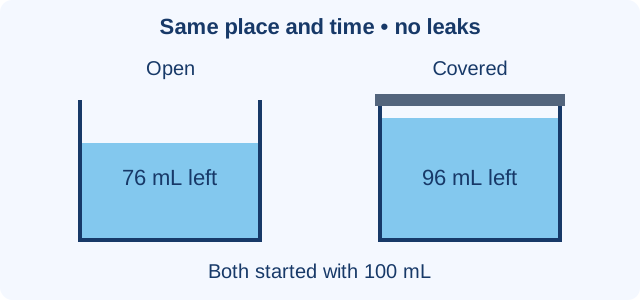
Compare the amount lost under matching conditions.
Worked comparison: Matching containers begin with 100 mL in the same place. The open one finishes with 76 mL and the covered one with 96 mL. Losses are 24 mL and 4 mL. The cover reduced loss in this test; it did not prove that evaporation always stops. Keep container, starting amount, location and duration alike when testing a cover.
The water cycle continues, but safe local water is limited by rainfall, storage, treatment and delivery. Repair leaks, turn off taps when unnecessary and use water efficiently. Water recycled and treated for garden irrigation or toilet flushing can reduce use of drinking supplies. Do not assume water approved for one use is safe for every use.
Name three water stores. Oceans, rivers and groundwater are examples; also accept lakes, ice, soil water and water in the atmosphere. Groundwater may be fresh or salty.
How do evaporation and condensation differ? Evaporation changes liquid water into invisible vapour. Condensation changes vapour into liquid droplets.
What drives runoff? Gravity moves water downhill over land. The Sun supplies energy for evaporation.
Why can we see clouds? They contain tiny liquid droplets or ice crystals, rather than only invisible vapour.
Trace ocean water to groundwater. One possible route is evaporation → condensation into cloud droplets → precipitation on land → infiltration into the ground.
Assessment-style questions and review hints
A cold sealed can becomes wet outside. Explain the source of the drops. Water vapour in the surrounding air cools and condenses on the can. If a learner says it leaked, compare dry cold and room-temperature sealed cans.
A diagram labels liquid water changing to vapour as condensation. Correct it. Replace the label with evaporation; condensation is the reverse change.
A creek rises after rain. Does this show all the rain ran off? No. Some rain may collect, infiltrate or evaporate. Ask the learner to draw two possible pathways.
Why reduce water waste if water cycles? Usable local supplies are not unlimited; water needs collection, treatment and delivery. Review the difference between water existing and safe water being available.
Support, Core, Extend and curriculum boundary
Prerequisites: recognise liquid water and ice, describe wet/dry changes and read simple arrows. Must teach: sources and movement through sky, land and ocean; evaporation, condensation and precipitation; local supply and care for water.
Support: match pictures of wet cloth, cold can and rain to process words; explain orally. Core: draw and explain two connected water pathways. Extend: compare measured evaporation losses and explain a model limitation within this topic.
Use Sun energy, gravity, runoff and infiltration to support explanations. Do not require molecular kinetic theory, vapour-pressure calculations or formal cloud microphysics as Year 4 content.
Exit ticket and adult review
Draw a store in the sky, one on land and the ocean, with labelled arrows linking them.
Explain a real evaporation or condensation observation and identify where the water went or came from.
Suggest one way to conserve water and explain why it helps.
Evidence to inspect: correctly directed arrows and named processes; liquid/vapour distinction; a conservation reason connected to evaporation or useful local supply. Ask the student to explain the drawing. A finished page alone is not evidence of understanding. Reteach the specific process that has been reversed before retrying.
Cultural safety for First Nations elaborations
Use reliable, community-approved sources and identify the specific Nation, People or community where the source does. Do not present diverse First Nations knowledges as one generic tradition. Follow local cultural and intellectual property protocols before reproducing cultural material or inviting community participation.
Guided learning activities
1. Bag water-cycle model
Observe sealed water warming, evaporating and condensing; label what the model represents and what it cannot show.
1warm liquid
2vapour
3cool surface
4droplets
5return
2. Water-source map
Classify visible and hidden sources of fresh and salt water in a landscape diagram.
surface waterriver, lake, ice
groundwateraquifer, well
atmospherevapour, cloud droplets
oceanlargest saltwater store
3. Process evidence stations
Use a cold container, wet cloth and sloped tray to observe condensation, evaporation and runoff.
Core idea: Students identify water in oceans, rivers, lakes, soil, ice, groundwater and the atmosphere, then explain how solar energy and gravity drive continuous movement through the water cycle.
Remember
Identify water stores
Explain key phase changes
Connect Sun and gravity
Interpret observations
Trace multiple cycle pathways
Use the Important questions and answers section for worked responses and the Exit ticket to inspect understanding.
How to use this unit
Read the topic guide and use the teacher slide for instruction. Students can then use the worksheet for written work, open Practice for supported feedback, or take the Test when they are ready.
AC9S4U02 teacher slide
Teacher resource
Open the matching Classroom View to display the key ideas, examples and review questions before students begin the activities.
Clouds are water vapour — Visible clouds contain tiny liquid droplets or ice crystals; water vapour is invisible.
Evaporation only happens when boiling — Liquid water evaporates from its surface below boiling point.
Droplets on a cold glass leak through — They form when water vapour in air condenses on the cool surface.
The water cycle follows one fixed circle — Water can take many pathways and remain stored for different times.
International curriculum mapping
This table gives closest-topic mapping for search and planning. The Australian Curriculum code is exact; overseas entries are broad equivalents because each jurisdiction structures outcomes differently.
Region
Curriculum
Closest mapping
Australia
Australian Curriculum v9.0
AC9S4U02 — identify sources of water and describe key processes in the water cycle, including movement of water through the sky, landscape and ocean; precipitation; evaporation; and condensation
Victoria
Victorian Curriculum F-10
Year 4 Science: closest match in Earth and space sciences. Use this page as a VIC-aligned practice and worksheet reference.
NSW
NSW Curriculum
Stage 2 Science: closest content focus for Identify sources of water and describe key processes in the water cycle, including movement of water through the sky, landscape and ocean; precipitation; evaporation; and condensation and related outcomes.
United States
Common Core / NGSS
Grade 4 NGSS science closest topic match for Identify sources of water and describe key processes in the water cycle, including movement of water through the sky, landscape and ocean; precipitation; evaporation; and condensation.
England / UK
National Curriculum
Key Stage 2 / Year 4: closest programme-of-study match for Identify sources of water and describe key processes in the water cycle, including movement of water through the sky, landscape and ocean; precipitation; evaporation; and condensation.
Canada
Provincial and territory curricula
Grade 4 closest topic match. Canada varies by province, so use this as a broad Ontario/BC-style learning outcome reference.
New Zealand
New Zealand Curriculum
Level 2 Science: closest achievement-objective topic for Identify sources of water and describe key processes in the water cycle, including movement of water through the sky, landscape and ocean; precipitation; evaporation; and condensation.
India
NCERT / CBSE
Class 4 closest NCERT/CBSE topic match for Identify sources of water and describe key processes in the water cycle, including movement of water through the sky, landscape and ocean; precipitation; evaporation; and condensation.
🎥 Optional Video Lesson
The SkillrHub lesson remains the primary learning resource. This optional video reinforces the explanation; you can complete the lesson and practice without watching.
Recommended: The Great Aqua Adventure: Crash Course Kids #24.1
Crash Course Kids — Follow water through evaporation, condensation and precipitation.
As you watch: Where does the water go when it evaporates?
Load video playerLoads YouTube in this lesson. See the video notice below.
Try it: Draw and label water moving between ocean, air and land. Include three changes or movements.
Video unavailable, inaccurate or unsuitable for this year? Report a video problem to SkillrHub by email. You can continue with the written lesson and practice resources.
About these videos
Videos are curated from trusted independent educational creators and played through YouTube. Rights remain with their respective owners. Inclusion does not imply that a creator or YouTube endorses SkillrHub.
YouTube’s terms and privacy policy apply to its player. Advertising, recommendations and external links may appear, and videos may change or become unavailable. SkillrHub’s written lessons and practice resources remain available separately.
To report a content, suitability or rights concern, email skillrhublearning@gmail.com with the lesson code and video link. Please do not include personal student information.
Curriculum equivalents: Victoria, NSW and international
Curriculum equivalents for Sources of water and describe key processes in the water...
Mapped skill: identify sources of water and describe key processes in the water cycle, including movement of water through the sky, landscape and ocean; precipitation; evaporation; and condensation
These references identify matching or closely related learning. Curriculum sequence, terminology and depth vary, so teachers should use the mapped skill and lesson difficulty to confirm suitability.
Australian Curriculum v9.0 is the canonical source for this SkillrHub lesson. Victoria and NSW entries name the closest published state codes or outcomes; international entries are planning references rather than claims of identical curricula.
Help improve SkillrHub
Questions or feedback?
Ask about this lesson, suggest an improvement or report an error. Facebook opens only when you choose an option below.
Topic reference: AC9S4U02 — AC9S4U02: Identify sources of water and describe key processes in the water cycle, including movement of water through the sky, landscape and ocean; precipitation; evaporation; and condensation