AC9S4I03 • Year 4 Science

AC9S4I03: Follow procedures to make and record observations, including making formal measurements using familiar scaled instruments and using digital tools as appropriate

follow procedures to make and record observations, including making formal measurements using familiar scaled instruments and using digital tools as appropriate

What students learn in AC9S4I03

Follow an ordered procedure to observe, measure and record accurately. Choose familiar scaled instruments or digital tools for the evidence needed, read their intervals and keep useful records.

Success looks like

  • I record what I actually see, hear or measure and distinguish a possible identification from an observation.
  • I identify the quantity, unit and size of each scale interval before reading.
  • I round up or down as instructed and explain what a coarse scale can show.
  • I construct a labelled table or organiser and keep observations attached to the correct sample and time.
Key vocabulary
Observation
Information gathered by watching, listening, measuring or another suitable method.
Qualitative
A description of qualities, such as colour or texture.
Quantitative
A count or measurement expressed as a number. Measurements also need a unit.
Scale interval
The value of one space between neighbouring marks.
Approximate
Close to a value; useful when a reading is rounded or estimated.
Accuracy
How close a measurement is to the actual value. Careful setup still matters with small scale intervals.
Concept models and worked thinking

Read, record and check formal measurements

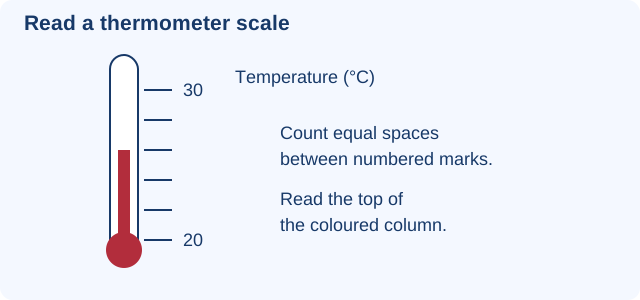
Thermometer labelled 20 and 30 degrees Celsius with five equal spaces. Coloured column reaches the third small step above 20.
Original classroom model; use the labels and scale shown.
  1. Read the unit: temperature is in degrees Celsius.
  2. The labelled difference is 30 − 20 = 10°C. Five equal spaces make each interval 2°C.
  3. The coloured column is three spaces above 20°C: 22, 24, 26. Record 26°C.
  4. Add the time and sample name to the record; check the probe or thermometer placement before accepting the value.

Teacher asks: Why is counting three spaces not a reading of 23°C? Expected: Each space is worth two degrees, not one. If incorrect, count the labelled difference into five equal jumps.

Choose instruments and digital tools by purpose

Quantity or evidenceSuitable toolRecording detail
lengthruler or tapezero/start point; mm or cm
massbalancezero/tare; g or kg
liquid volumemarked jug or cylinderlevel container; mL or L
temperaturethermometer or probecorrect placement; °C
durationtimerstart/stop events; s or min
appearance or motioncamera or videodate, subject and consistent view
animal callaudio recordertime, location and reference used

Digital tools can preserve observations and help with repeated recording. They still need correct placement, labels, units and sensible checks. A photo without a usable scale cannot supply an exact length.

Round a reading and account for the starting point

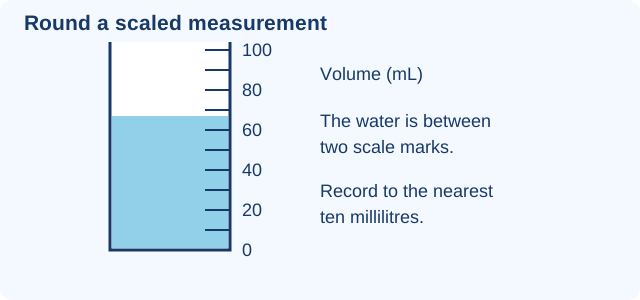
Measuring container marked every ten millilitres, with labels zero, twenty, forty, sixty, eighty and one hundred. Water level is between sixty and seventy, closer to seventy.
Original classroom model; use the labels and scale shown.

The container has 10 mL divisions. The level is between 60 and 70 mL, closer to 70. To the nearest 10 mL, record about 70 mL. A value nearer 60 would round down to about 60 mL. Follow the stated rounding instruction; when exactly halfway, the usual school convention rounds up.

Smaller divisions can show a finer difference when used carefully. They do not guarantee accuracy: a tilted jug or badly placed probe can still give a poor reading. Do not write extra decimal places that the scale does not support.

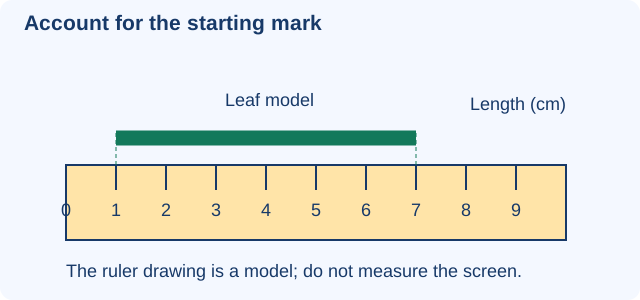
A leaf model begins at the one centimetre mark and ends at the seven centimetre mark on a ruler with equal one-centimetre intervals.
Original classroom model; use the labels and scale shown.

The leaf begins at 1 cm and ends at 7 cm. Its length is 7 − 1 = 6 cm. Normally align the object with zero; if the start is different, subtract it.

Curriculum coverage and elaborations

Content description: follow procedures to make and record observations, including making formal measurements using familiar scaled instruments and using digital tools as appropriate

E1: identifying animals in field locations using procedures such as direct or virtual observation, call or scat identification or pitfall traps

Use a fixed-place, timed wildlife watch or a teacher-selected wildlife-camera clip. Record the source, date/time, location and features seen or heard. Compare calls or teacher-provided scat photographs with a suitable guide, retaining “possible” when features are not unique. Explain that scientists may use pitfall traps to sample some ground-moving animals; this does not count all animals. Students do not handle scat, disturb wildlife or set traps.

Modelled example: A repeated call is heard but the bird is hidden. Record “heard a repeated call; possible species A from the reference”, not “saw A” or “three calls means three birds”.

E2: using appropriate equipment to make and record observations, such as digital cameras, video, voice recorders and familiar scaled instruments with appropriate increments

Match the tool to the evidence, using the table above. Measure a safe object with a ruler, view fast movement with replayable video or compare calls with audio. Label each record and use consistent views or timing. Check zero, placement and units where appropriate.

Modelled example: To track a seedling, use dated photographs for appearance and a ruler for height. A camera alone does not directly measure mass or supply length without a scale.

E3: describing how to use rounding up or down when reading scaled instruments, and the effect of the scale size on the accuracy of the measurement

Work through the jug and ruler models above. Practise readings nearer the lower mark and nearer the upper mark, clearly stating the required nearest unit. Compare 1 cm and 1 mm divisions on familiar rulers; finer marks support finer readings when setup is correct.

Modelled example: A point between 42 and 43 mm, nearer 42, rounds down to about 42 mm. A point between 6 and 7 cm, nearer 7, rounds up to about 7 cm. Keep units and avoid invented precision.

E4: constructing tables or graphic organisers to record observations

Before observing, construct headings for sample/animal, time, quantity with unit, and relevant descriptive features. Keep each sample in one row. Use “not recorded” for missing data; use zero only when none was actually counted during the observation.

Modelled example: Construct Leaf ID | Length (cm) | Colour, then enter A | 7 | dark green and B | 5 | pale green. A blank length is not the same as a measured length of zero.
Guided learning activities

1. Instrument-reading circuit

Use labelled rulers, jugs and safe thermometers or the fixed models above. Students state quantity, unit and interval, then record a reading. Ask a partner to check the start point and explain a rounded value.

Checkpoint: A 20-to-30 scale has five equal spaces. Expect “two per space”. If a learner says one, return to the labelled difference before moving on.

2. Observe, identify and record

Provide a teacher-selected wildlife image, clip or call and a suitable reference. Students construct an organiser: source/time/place → feature seen or heard → possible identification → what remains uncertain. A direct safe observation is an alternative.

Look for: a source-based record and honest uncertainty. Reteach if an inferred animal is reported as directly seen or if repeated calls are treated as separate animals.

3. Observation upgrade

Retain the useful measured statement “temperature rose from 22°C to 33°C” when those readings were actually taken. Rewrite vague notes into specific descriptions without inventing numbers. Make a table with Time (min), Temperature (°C) and Appearance, using each real reading immediately.

Teacher action: Show a blank cell and a recorded zero. Students explain why they are different before collecting their own results.

Revision Notes

Important questions and answers

  • How do I find a scale interval? Subtract the two labelled values and divide by the number of equal spaces between them.
  • Why read a jug at eye level? Looking from above or below can make the level appear at the wrong mark; place the jug level first.
  • Why use number and unit? A measured value such as 45 is unclear without mm, cm or another correct unit. Counts should say what was counted.
  • Does a digital display guarantee accuracy? No. Check units, zero/setup and where the sensor is placed.
  • How should I identify an animal? Compare observed features or calls with a reference, state how evidence was obtained and retain uncertainty when needed.

Assessment-style questions and review hints

  • A ruler endpoint lies between 8 cm and 9 cm, closer to 9 cm. Record to the nearest centimetre. Answer: About 9 cm. Review: Find the nearer mark and keep the unit.
  • A record says “leaf B, 12” with no heading. Improve it without inventing data. Answer: Confirm the measured quantity/unit from the method before labelling it; do not guess cm or mm.
  • Construct headings for observing two seedlings every morning. Expected: Date/time, Seedling ID, Height (cm) and a relevant appearance column.

Exit ticket

Read one scale model, state its interval and record the value with unit. Then write one observation and one possible interpretation from a safe animal image or call. Mastery evidence: Correct interval and reading, an identifiable record, and a clear evidence/inference distinction. If these are missing, revisit the matching worked model before Test.

How to use this unit

Read the topic guide and use the teacher slide for instruction. Students can then use the worksheet for written work, open Practice for supported feedback, or take the Test when they are ready.

AC9S4I03 teacher slide

Teacher resource

Open the Classroom View to display the same worked examples, teaching prompts and checks from this Topic Guide.

Open Classroom View
Common misconceptions

Common misconceptions and corrections

  • Every mark is one unit. Work out the labelled difference and the number of spaces.
  • A ruler starts at its physical edge. Use the zero mark; subtract a nonzero starting reading.
  • Extra digits make a coarse reading accurate. Match the recorded detail to the scale and rounding instruction.
  • A likely animal identification is certain. Describe the feature or call and say when more evidence is needed.
  • Zero and no record are identical. A zero is an observed count of none; missing data need their own label.

Support, Core and Extend

  • Support: Start with fully labelled scales and an organiser with headings; use teacher-provided images instead of fieldwork.
  • Core: Read equal intervals, round as instructed, choose a suitable tool and construct a labelled record.
  • Extend: Compare coarse and fine scales and explain uncertainty in an identification using the same Year 4 ideas.

Year 4 boundary: Use familiar scaled instruments and simple units. Formal error calculations, significant figures, averages and animal-trapping procedures are not required.

International curriculum mapping

This table gives closest-topic mapping for search and planning. The Australian Curriculum code is exact; overseas entries are broad equivalents because each jurisdiction structures outcomes differently.

RegionCurriculumClosest mapping
AustraliaAustralian Curriculum v9.0AC9S4I03 — follow procedures to make and record observations, including making formal measurements using familiar scaled instruments and using digital tools as appropriate
VictoriaVictorian Curriculum F-10Year 4 Science: closest match in Planning and conducting. Use this page as a VIC-aligned practice and worksheet reference.
NSWNSW CurriculumStage 2 Science: closest content focus for Follow procedures to make and record observations, including making formal measurements using familiar scaled instruments and using digital tools as appropriate and related outcomes.
United StatesCommon Core / NGSSGrade 4 NGSS science closest topic match for Follow procedures to make and record observations, including making formal measurements using familiar scaled instruments and using digital tools as appropriate.
England / UKNational CurriculumKey Stage 2 / Year 4: closest programme-of-study match for Follow procedures to make and record observations, including making formal measurements using familiar scaled instruments and using digital tools as appropriate.
CanadaProvincial and territory curriculaGrade 4 closest topic match. Canada varies by province, so use this as a broad Ontario/BC-style learning outcome reference.
New ZealandNew Zealand CurriculumLevel 2 Science: closest achievement-objective topic for Follow procedures to make and record observations, including making formal measurements using familiar scaled instruments and using digital tools as appropriate.
IndiaNCERT / CBSEClass 4 closest NCERT/CBSE topic match for Follow procedures to make and record observations, including making formal measurements using familiar scaled instruments and using digital tools as appropriate.
🎥 Optional Video Lesson

The SkillrHub lesson remains the primary learning resource. This optional video reinforces the explanation; you can complete the lesson and practice without watching.

Back to the lesson

Before you watch:

  • Pause after each worked example.
  • Try the examples yourself.
  • Return to the SkillrHub lesson before continuing.
Recommended: Math Antics - Measuring Distance

Math Antics — Practise reading metric ruler divisions when recording observations.

As you watch: Why does the starting point of a measurement matter?

Load video player Loads YouTube in this lesson. See the video notice below.

Try it: Measure three safe classroom objects. Record each length and its unit in a table.

Video unavailable, inaccurate or unsuitable for this year? Report a video problem to SkillrHub by email. You can continue with the written lesson and practice resources.

About these videos

Videos are curated from trusted independent educational creators and played through YouTube. Rights remain with their respective owners. Inclusion does not imply that a creator or YouTube endorses SkillrHub.

YouTube’s terms and privacy policy apply to its player. Advertising, recommendations and external links may appear, and videos may change or become unavailable. SkillrHub’s written lessons and practice resources remain available separately.

To report a content, suitability or rights concern, email skillrhublearning@gmail.com with the lesson code and video link. Please do not include personal student information.

Curriculum equivalents: Victoria, NSW and international

Curriculum equivalents for Follow procedures to make and record observations, including making formal...

Mapped skill: follow procedures to make and record observations, including making formal measurements using familiar scaled instruments and using digital tools as appropriate

These references identify matching or closely related learning. Curriculum sequence, terminology and depth vary, so teachers should use the mapped skill and lesson difficulty to confirm suitability.

RegionCurriculum frameworkClosest level or code
AustraliaAustralian Curriculum v9.0AC9S4I03 · Year 4
VictoriaVictorian Curriculum F–10 Version 2.0 — ScienceVC2S4I03 · Levels 3–4
New South WalesNSW Science and Technology K–6 Syllabus (2024)ST2-DAT-01 + ST2-PQU-01 · Stage 2
United States (USA)Next Generation Science Standards (NGSS)Grade 4
Canada (Ontario)Ontario Curriculum — ScienceGrade 4
United Kingdom (England)National Curriculum in England — ScienceYear 5, Key Stage 2
IndiaNCERT / CBSE — ScienceClass 4

Australian Curriculum v9.0 is the canonical source for this SkillrHub lesson. Victoria and NSW entries name the closest published state codes or outcomes; international entries are planning references rather than claims of identical curricula.

Help improve SkillrHub

Questions or feedback?

Ask about this lesson, suggest an improvement or report an error. Facebook opens only when you choose an option below.

Topic reference: AC9S4I03 — AC9S4I03: Follow procedures to make and record observations, including making formal measurements using familiar scaled instruments and using digital tools as appropriate

💬 Ask a question 💡 Suggest an improvement ⚠️ Report an error

Privacy: Please don’t share personal student or school information. Younger students should ask a parent, guardian or teacher to post on their behalf.

Official curriculum references
Related Year 4 Science topics