Important questions and answers
- Can a yes-or-no question be testable?
- Yes, if a clear observation under stated conditions could answer it.
- Must every inquiry change a variable?
- No; careful observations can investigate patterns without changing a habitat.
- What supports a prediction?
- A relevant recorded observation or scientific idea, linked to the expected outcome.
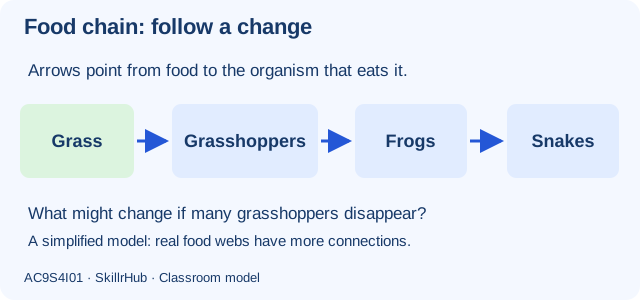
- Why might fewer grasshoppers affect frogs?
- The chain shows grasshoppers as food for frogs.
- Why consult local knowledge holders?
- They can guide the meaning, attribution and appropriate sharing of local knowledge.
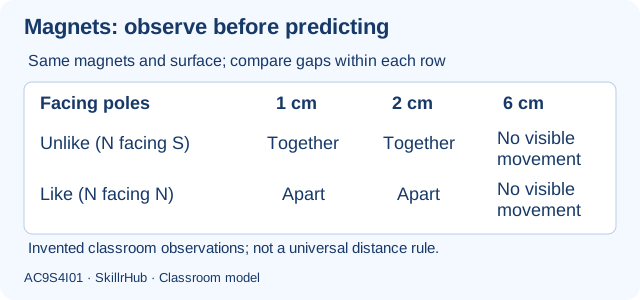
- How do facing magnetic poles matter?
- Unlike poles attract; like poles repel. Distance and resistance affect visible movement.
Assessment-style questions and review hints
Question: Yesterday, one wet cloth dried sooner in sun than another in shade. Give a question and a cautious prediction. Answer: How does location affect drying time for comparable wet cloths? A similar cloth may dry sooner in sun again because that was the observed pattern. Review hint: State which sentence reports the observation and which predicts.
Question: The food-chain picture contains no population counts. Can it justify “exactly ten fewer frogs”? Answer: No; it can support a possible direction, but exact numbers require evidence.
Support, Core and Extend
Support: Provide “I noticed ___; I wonder ___; I expect ___ because ___.” Core: Connect a clear question and prediction to relevant evidence. Extend: Give an alternative prediction and identify what further observation could help decide, within familiar Year 4 contexts.
Exit ticket
- Write one observation from a lesson model.
- Ask a question that evidence could answer.
- Write a prediction with a reason and one limit.
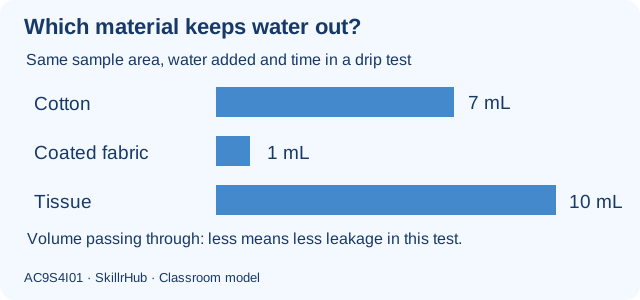
Expected evidence: Distinct observation, question and expectation; a relevant link; no invented certainty. For example, coated fabric let less water through; ask whether this repeats after bending; predict possible continued resistance while acknowledging it needs testing. Reteach if the student simply copies the question as a prediction.
Year-level boundary
Use familiar observations, qualitative food-chain effects and visible magnetic interactions. Do not require statistical inference, formal hypotheses, field mapping of cultural sites or force equations. Preparation for consultation must be honestly labelled and followed by appropriate teacher-led engagement when available.