E1: Trace food to a source
A person eats oats and an egg. Oats come from a plant; an egg is animal food. People, like other animals, obtain food from plants, animals or both. Ask students to trace two familiar foods to their living sources rather than only naming a shop.
E2: Observe a local habitat
With adult supervision, observe a garden without handling unknown organisms. Record an organism, what it is doing and evidence for its role. A leaf-eating snail is an animal consumer; a green grass plant is a producer; fungus breaking down dead wood is a decomposer. If identity or feeding is uncertain, record “needs more evidence” instead of guessing from appearance.
E3: Research decomposers
Use a reliable book or science source to compare fungi and bacteria. Both include decomposers, but not every fungus or bacterium has the same role. Draw arrows from dead plant and animal material to decomposers and explain nutrient return. Observe photographs of decay; do not grow or handle mould.
E4: Compare feeding relationships
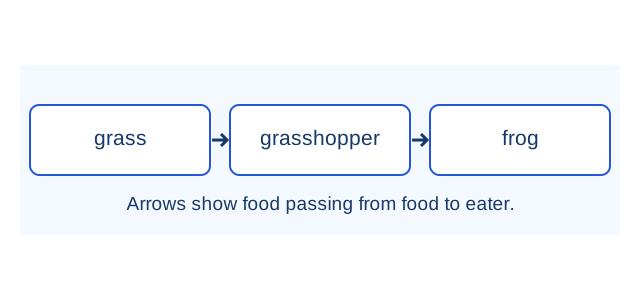
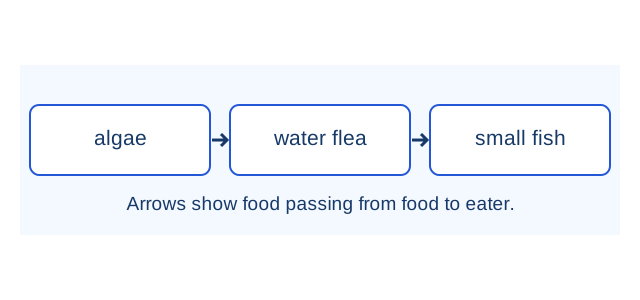
Build grass → grasshopper → frog and algae → water flea → small fish. Label the producer and consumers in each. Explain one shared role pattern and one habitat difference; read each arrow aloud as “is eaten by”.
E5: People belong within Country/Place
ACARA’s teacher background describes First Nations Australians as integral to the environment. It draws on Noonuccal scholar Karen Martin-Booran Mirraboopa’s account of connected relationships among people, land, waters and other entities. Discuss how people depend on living things and have responsibilities within these relationships. Specific knowledge belongs to particular Peoples and communities; do not invent a single practice for all First Nations Australians.
E6: Investigate introduced predators
Australian Government information identifies fox predation as a threat to native animals. Use a teacher-selected report or camera observation of a fox taking a small native mammal. Ask: what interaction is recorded, and what effect could repeated predation have? More prey may be eaten, but one observation cannot establish the cause of every population change. Do not approach foxes or handle remains.
E7: Investigate loss of a food source
In a model habitat, introduced mice eat most seeds also used by seed-eating native birds. Predict that birds may have less food, then propose checking seed supply and feeding observations. The Australian Government describes how introduced grazers can reduce vegetation used by native animals. Distinguish the model prediction from a recorded real-world result; food, shelter and weather may also influence populations.