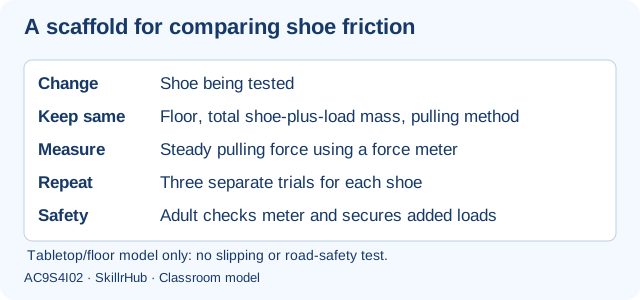
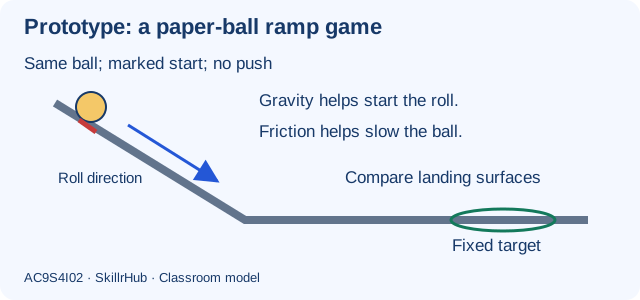
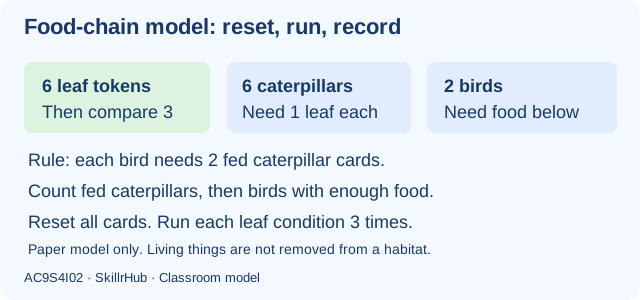
Students use a provided scaffold to plan and conduct investigations that answer a question or test a prediction. They identify fair-test elements, record actual repeated trials and follow safety instructions for the equipment, materials and site.
Learning intention: I can use a plan to investigate safely, keep a comparison fair and record what actually happened.
- Name what changes, what is measured and what stays the same.
- Use a scaffold to compare friction or magnetic attraction.
- Predict, build and test a toy or game prototype.
- Reset and run a food-chain simulation multiple times.
- Match safety controls to equipment, field sites and biological specimens.
Lesson guide: Allow thirty to forty minutes for one practical task, plus planning and review. Use paper, card and teacher-approved materials. An adult checks all practical setups; a plan must be labelled untested until actual observations are collected.
- Scaffold
- Prompts that help organise a question, prediction, materials, variables, procedure, results and safety.
- Changed factor
- The factor deliberately compared, such as a surface or material.
- Measured outcome
- The result observed or measured to answer the question.
- Controlled condition
- A relevant condition kept the same for a fair comparison.
- Prototype
- A trial version built so a design can be tested and improved.
- Simulation
- A model using stated rules to explore possible outcomes.
- Hazard and control
- A possible source of harm, and an action used to reduce the risk.