Year 4 Science · AC9S4I06

Communicate scientific findings and ideas

Create clear texts, models and messages for a purpose and audience.

Ready to project and teach

What students learn in AC9S4I06Start here

Learning intention: Write and create scientific texts for a clear purpose and audience. Use accurate evidence, scientific vocabulary and useful visuals; choose digital tools when they help the audience understand.

A scientific text may be a report, labelled model, poster, spoken explanation, song or slideshow. The format can change, but the underlying evidence and scientific meaning must remain accurate.

  • Name who the text is for and what it should explain or encourage.
  • Write an informative explanation or recommendation with relevant evidence.
  • Create and label a model that communicates a relationship.
  • Acknowledge the source of information and respect the knowledge holders.
  • Use feedback to improve accuracy and readability.

Year-level boundary: Use familiar water, materials and feeding relationships. Explain terms in everyday language. Formal scientific publishing, advanced food-web calculations and professional media production are not required; paper, voice or simple digital tools are all suitable.
Key vocabularyExplore
Purpose
Why a text is being made: for example, to inform, explain or encourage a useful action.
Audience
The intended readers, viewers or listeners.
Scientific vocabulary
Precise terms that help explain the topic, such as evaporation, consumer, predator, flexibility or insulation.
Caption
A short explanation of what a visual shows.
Attribution
Acknowledging whose work or knowledge is used and where it was learned.
Introduced predator
An animal brought outside its natural range that hunts and eats other animals.
Prey
An animal that a predator eats.
Concept models and worked thinkingExplore

Write a material recommendation

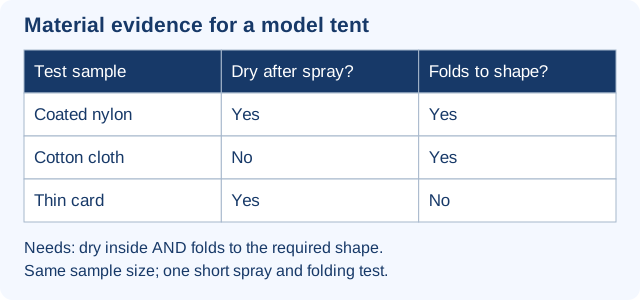
Material evidence for a model tent. Test sample: Coated nylon, Dry after spray?: Yes, Folds to shape?: Yes. Test sample: Cotton cloth, Dry after spray?: No, Folds to shape?: Yes. Test sample: Thin card, Dry after spray?: Yes, Folds to shape?: No. Needs: dry inside AND folds to the required shape. Same sample size; one short spray and folding test.
Material evidence for a model tent. Invented classroom data.

Audience: Classmates choosing a model tent cover. Purpose: Explain which tested sample meets two needs.

Model report: “Our model tent needs a cover that keeps the inside dry and folds into shape. Coated nylon met both requirements in our short test. Cotton folded but let water through. Thin card stayed dry but did not fold as required. We recommend the tested coated nylon; this does not show that every nylon fabric or tent works in every storm.”

Teacher asks: Where does each sentence’s evidence appear? Expected: Pupils point to both requirement columns and each named sample. The coating and short test belong in the report.

Explain a feeding model

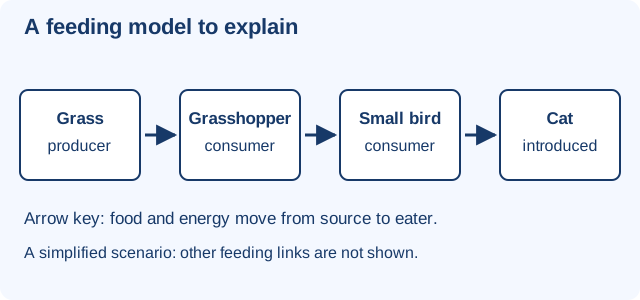
Grass is eaten by grasshopper; grasshopper is eaten by small bird; small bird is eaten by introduced cat. Arrows show food and energy from source to eater. Other feeding links are not shown.
A simplified feeding scenario, not a measured local population survey.

Model explanation for classmates: “Grass is a producer. The grasshopper eats grass, and the small bird eats the grasshopper. In this scenario, the introduced cat is a predator of the bird. Hunting can reduce bird survival. Fewer birds could leave more grasshoppers uneaten, but other factors can also affect the numbers.”

The arrow key explains food and energy moving to the eater. The model shows selected links, not measured local population counts or every possible food source.

Build a clear water-saving message

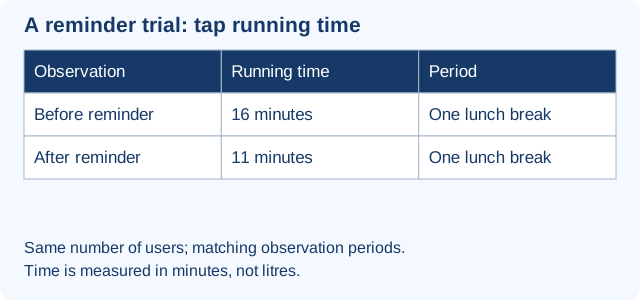
A reminder trial: tap running time. Observation: Before reminder, Running time: 16 minutes, Period: One lunch break. Observation: After reminder, Running time: 11 minutes, Period: One lunch break. Same number of users; matching observation periods. Time is measured in minutes, not litres.
A reminder trial: tap running time. Invented classroom data.

Audience: The school community. Purpose: Share the example findings and encourage sensible water use.

Model message: “In this invented example, tap running time was sixteen minutes before the reminder and eleven after it in matching lunch breaks. Turn taps off while soaping, then rinse. Tell an adult about leaks.” The chart measures minutes, not litres; it does not prove the reminder alone caused the difference.

A large labelled visual and a short spoken explanation suit assembly. A printed poster can serve the same purpose. Keep necessary drinking and hygiene practices.

Curriculum coverage and elaborationsExplore

Official content description: write and create texts to communicate findings and ideas for identified purposes and audiences, using scientific vocabulary and digital tools as appropriate

  1. E1: discussing the purpose of a text and identifying vocabulary appropriate to the topic and audience. Compare a teacher report with a younger-class explanation. Keep data exact while defining terms, changing sentence length and selecting relevant detail.
  2. E2: acknowledging and learning about First Nations Australians’ ways of representing and sharing information about water sources. Read the attributed Ngurrara I example below. Write a source acknowledgement and explain how the named work shares knowledge about Country, including water sources. Learn from its public account without inventing or copying cultural meanings.
  3. E3: sharing ideas about ways to represent feeding relationships including using drawings, labels, images or models. Create the feeding model as a drawing or labelled cards. Explain arrow direction, organism identities and one simplification to a partner.
  4. E4: producing an informative text using scientific vocabulary to explain the impact of introduced predators on food chains. Write a short paragraph using predator, prey and consumer. Explain a direct effect and a possible indirect effect in the cat–bird–grasshopper scenario; do not claim exact number changes.
  5. E5: constructing a report using scientific vocabulary to explain which materials are best suited to be used for making particular products, such as nylon for tents, rubber for shoes or wool for warm clothing. Use the tent model to write a recommendation. Explain rubber grip and flexibility for a sole, or wool fibres trapping air to help slow heat loss in clothing. Material properties must connect to the particular product’s needs.
  6. E6: creating posters, a song, slideshow or performance to encourage the school community to save water. Create a real message with a specific audience, achievable action and accurate reason or evidence. A digital tool is useful when it makes labels or spoken explanations clearer, not when it covers the evidence.
Learning from a water-knowledge representationExplore

Ngurrara I: a publicly explained example

The National Museum of Australia describes Ngurrara I as a collaborative painting made by nineteen Traditional Owners. Its view of the Great Sandy Desert includes waterholes. The museum connects the work with Walmajarri and Wangkajunga peoples and their enduring relationships with Country. This is a specific example of artwork communicating place-based knowledge, including water sources, rather than just a list of current water measurements.

Source: National Museum of Australia, Australian Journey: Travelling Country, opening transcript account of Ngurrara I. The short account above is enough for this task; the full historical video is not required.

Teacher does: Read the note, name the work and knowledge holders, and ask how information can be communicated visually. Follow local guidance when seeking local examples; communities and works can share knowledge differently.

Student creates: Write an acknowledgement and a two-sentence explanation based on the supplied public account. Do not copy the artwork, guess unshared meanings or claim one symbol system applies everywhere.

Expected: An attributed explanation recognising that the named artwork conveys knowledge of Country and waterholes. Reteach if the response treats First Nations knowledge as one generic tradition or presents guessed meanings as facts.

Guided learning activitiesExplore

We do: report reconstruction

Teacher and class work together to order question and purpose → method → results table or model → finding → conclusion and limit. Explain how each part lets the reader follow and check the evidence. Then write a new short report using the tent records rather than merely naming sections.

Audience rewrite

Evidence: water warmed from 21°C to 29°C in ten minutes. For a poster: “Water warmed from 21°C to 29°C in ten minutes.” For a spoken explanation: “The temperature increased by eight degrees Celsius during our ten-minute test.” Both preserve the same evidence. Do not add “largest rise” without comparison data.

Visual audit and peer feedback

Purpose → choose a useful visual → label names and units → write a caption → explain the finding → check readability. Ask a partner to tell you the message in their own words, then revise one unclear part without changing the data.

Quick checkpoint: Does a colourful chart become a measured field survey? No. Label invented data or a model honestly; format does not change evidence type.

Common misconceptions and quick fixesExplore
  • Adapt the audience by changing the facts: Change vocabulary support and layout while preserving values and meaning.
  • A model shows everything: Name the selected relationship and one limitation.
  • Scientific language means the longest word: Choose a precise relevant term and explain it when needed.
  • Insulation generates heat: Wool can trap air and help slow heat loss; it is not a heat source.
  • Fewer birds guarantees exactly twice as many insects: Explain a possible relationship and acknowledge other influences.
  • Public cultural knowledge needs no acknowledgement: Credit the knowledge holders and source, and stay within what is publicly explained.
  • A water campaign should stop every use: Target avoidable waste while preserving necessary drinking and hygiene.
Support, Core and ExtendExplore

Support: Offer a word bank, labelled evidence table and sentence frames: “This text is for…”, “The evidence shows…”, “We recommend…because…”. An adult can read the public source note aloud.

Core: Create a labelled model, write an informative explanation and a material report, and develop a school water-saving message.

Extend: Present the same findings in a report and an oral or digital format, explain why each audience needs different support, and revise after feedback while keeping every claim accurate.

Important questions and answersExplore
What changes when a report becomes a poster?
Layout, sentence length and amount of detail may change; evidence and scientific meaning do not.
How do feeding arrows help an audience?
A key explains food and energy moving from source to eater.
Why does a recommendation need properties and evidence?
The reader needs to see how the tested material meets the product’s particular requirements.
How can a text acknowledge the water-knowledge example?
Name Ngurrara I, its Traditional Owner creators and the museum account, then explain only the publicly supported information.
When is a digital tool appropriate?
When it helps the intended audience understand, for example by enlarging labels or combining a readable diagram with spoken explanation.
Assessment-style questions and review hintsExplore

Prompt: Explain evaporation to a younger pupil. Expected: “Liquid water changes into water vapour in the air; this is evaporation.” Review: Do not say the water is destroyed.

Prompt: Write a sentence recommending a flexible material for a shoe sole that also needs grip. Expected: Link both flexibility and grip to the use and refer to tested evidence where provided. Review: One useful property does not establish every requirement.

Prompt: Create a school water-saving slogan with a safe action. Expected: A clear action such as reporting a leak or turning taps off while soaping, with necessary water use preserved. Review: A rhyme or digital effect does not justify a false savings claim.

Exit ticket and mastery evidenceExplore

Create a mini-report for classmates choosing a model container. The container must bend without breaking and stay dry inside. Sample A bends and stays dry; B bends but leaks in the same short test. Write three sentences and add a labelled evidence sketch or table.

Expected: Identify the audience and two needs; compare both samples accurately; recommend A for these tested conditions and avoid claims about every future use. The created visual must show both labels and both results.

Continue when: the pupil actually creates the text and visual, uses relevant vocabulary and links the choice to evidence. Reteach if: they only describe what they would create, omit a requirement, change a value or confuse the model with measured real-world population data.

Teach & ExplainTeaching slides and samples

Teach this topic step by step

Explore optional teaching slide packs for classroom lessons and explanations at home.

Browse Teach & Explain · Browse Print & Go

Teachers: follow SkillrHub on TPT, then email us to request a free sample before buying. Include the year, subject and topic or curriculum code.

Request a free sample

After trying the sample, honest feedback is welcome. A TPT review is optional, where available, and does not need to be positive.