Consider how people use scientific explanations to meet a need or solve a problem
Explain how knowledge of living things, materials and forces helps people meet needs, then judge benefits and limits using evidence.
Ready to project and teach
Learning goalsSay it simply
Students explain how knowledge of living things, materials and forces helps people meet needs, then use evidence to judge benefits and limits of a solution.
Learning routine: Observe → Model → Investigate → Record → Explain → Evaluate
Success looks like
Define needs
Use science in design
Set criteria/constraints
Test and compare solutions
Justify improvements with evidence
Clean visual examplesOne-page board
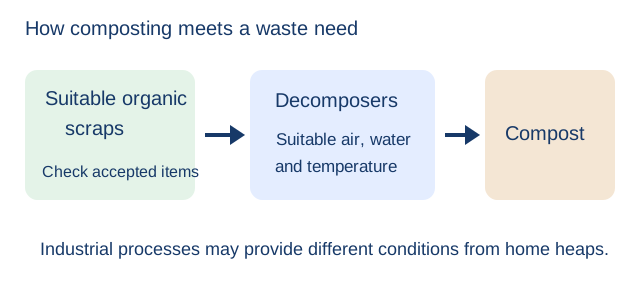
E1 · Decomposers solve a waste problem
The scientific explanation guides the conditions, sorting and checks.
Food businesses and councils need ways to manage suitable plant and animal waste. Decomposers break down organic material. Industrial systems manage air, moisture and temperature to support the process and check the output. Their accepted materials and controlled conditions may differ from a home heap.
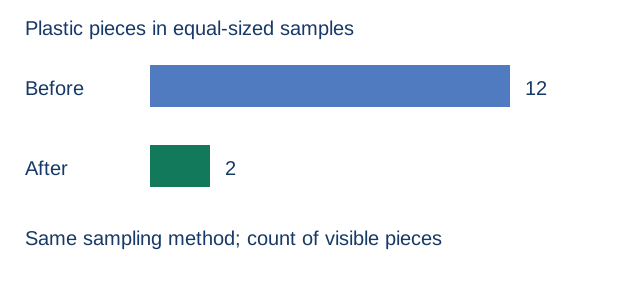
Worked example: A facility finds ordinary plastic fragments in its output. Improve sorting rather than assuming extra time will compost all plastic. Check the facility’s accepted list; do not copy industrial processing of animal waste in a classroom.
Check: Why add ventilation? Answer: Many useful decomposers need air. A scientific explanation identifies how the action helps, not merely that a machine is “better”.
E2 · Community-led water solutions
ACARA’s account describes Arrernte Elders in Central Australia investigating solar-powered water treatment to address water-quality needs. This is a documented example, not a claim about the project’s current operating status.
Science-to-need link: Test the source water, choose treatment for the identified problem and monitor the treated water. Dissolved substances can remain when water looks clear; removing visible dirt alone does not establish drinking safety. Community choices, local training and maintenance help the solution continue meeting actual needs.
Check: Does a tank create more rain during a dry season? Answer: No. Storage planning must consider supply and use. Study the account; do not drink classroom filtered water.
E3 · Plant knowledge and useful materials
ACARA describes Yolŋu Peoples at Yirrkala using knowledge of stringybark and seasonal conditions to obtain a painting surface while protecting the tree’s survival. This named example shows how plant knowledge supports a useful material and continuing access to it.
Across the varied examples in the curriculum, plants provide materials for tools, weapons, sound instruments, clothing, cosmetics and artworks. Knowledge of growth, suitable plant parts and recovery matters alongside properties such as strength and flexibility. These are diverse, place-connected knowledges; one example does not stand for every community.
Classroom response: Read a reliable attributed example and draw a need–plant knowledge–use–future supply map. Do not remove bark, collect protected material or copy cultural designs. Check: Why is “natural means unlimited” wrong? Answer: Plants can be damaged or harvested faster than they recover.
E4 · Plastic properties change decisions
Plastic’s durability can be helpful in a reusable box and problematic in litter that persists. Flexibility, strength and resistance to water vary between products. These properties help explain choices about purchasing fewer unnecessary items, caring for reusable products and disposing of them through suitable local systems.
Worked example: A sturdy box already owned can remain useful for repeated storage. Its durability is a reason to care for it, not to discard it after one use. A “compostable” product may need particular industrial conditions; check collection instructions. Breaking into tiny pieces is not proof of harmless decomposition.
Check: Does every recycling symbol guarantee local acceptance? Answer: No; the material, product form and available process matter.
E5 · Friction helps people stop
Bicycle brakes use friction between contacting surfaces to slow a wheel. Tyre-road grip also depends on friction. Wet or icy conditions can reduce grip, affecting braking and steering, so safety decisions must consider the surface and conditions.
Safe model: An adult compares a small sliding block on two tabletop surfaces with identical starting conditions. A longer stopping distance can suggest less resistance in this setup. This illustrates a scientific link, not a complete test of road or helmet safety. Do not test by riding on slippery surfaces.
Check: Is one dry-surface result proof of the safest tyre everywhere? Answer: No. Relevant conditions and repeated evidence are needed.
E6 · Magnetic sorting meets different needs
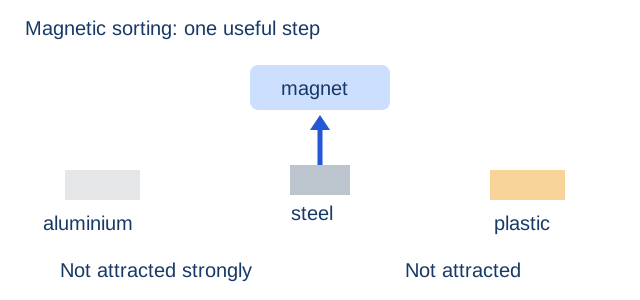
Magnetic separation is selective, not a method that removes every metal or hazard.
In recycling, a magnet can help lift suitable iron or steel from mixed materials. In mining, different magnetic responses may help separate minerals. In food processing, magnetic separators can remove suitable unwanted iron or steel fragments. Each application uses the same force for a different need.
Worked example: A separator lifts steel but leaves aluminium. That does not make aluminium a non-metal; common magnets do not strongly attract it. Another process may be needed. In a food line, other contamination still requires other checks.
Check: What evidence should a separator claim include? Answer: Tests with the actual mixture and an account of what remains.
Curriculum examplesCopied content
The content description and elaborations below show the curriculum ideas taught in this unit. Items marked as teaching context support lesson planning.
Content description: consider how people use scientific explanations to meet a need or solve a problem
E1: investigating how knowledge of the role of decomposers has helped people design industrial composting systems to manage plant and animal waste
E2: investigating how First Nations Australians of arid regions of Australia use scientific knowledge to manage precious water resources (teaching context)
E3: considering how knowledges of plant biology enable First Nations Australians to sustainably harvest and use plants to make tools and weapons, musical instruments, clothing, cosmetics and artworks (teaching context)
E4: exploring how knowledge of the properties of plastic has influenced people to change how they purchase, use and dispose of plastic products
E5: examining how people use knowledge of friction to improve car or bicycle safety on slippery surfaces such as wet or icy roads
E6: investigating how knowledge of magnetic force is used to sort metals in recycling, mining and food processing
Questions and answersWith answers
Important questions and answers
How does composting use science?
It provides suitable conditions for decomposers to process accepted organic material.
Why test source water?
The identified problem guides suitable treatment and later checks.
How can plant knowledge protect future resources?
Understanding survival and recovery helps guide sustainable harvesting.
Why does plastic durability affect disposal?
A durable product can last through reuse but may persist if littered.
How do friction and magnetism meet different needs?
Friction supports braking and grip; magnetism helps separate suitable magnetic materials.
Why test a proposed solution?
Evidence shows whether it meets the need and what limitations remain.
Practice and reviewReady for practice
Use equal sample sizes and the same method to compare the result.
Assessment-style questions and review hints
Question: What does the sorting evidence show? Answer: Fewer plastic pieces after the change, with some still present. Review hint: Do not turn improvement into a claim of perfection.
Question: Explain why a magnet leaving aluminium behind is not proof that it failed to collect steel. Answer: The separator’s intended job and different materials’ magnetic responses matter.
Support, Core and Extend
Support: Use “People need ___. Because ___, they use ___.” Core: Explain a solution with a correct causal science link and relevant evidence. Extend: Identify a limitation and an additional check without assuming success everywhere.
Exit ticket
Name one practical need from the lesson.
Explain the science behind a response to it.
State evidence that would show success and one limit.
Expected evidence: For example, organic waste management; decomposers under suitable conditions; reduced suitable scraps with contamination checks. Accept other accurate lesson examples. Reteach if the answer merely names a product or uses “scientific” without explaining how it works.
Year-level boundary
Use qualitative explanations about decomposition, plant survival, material properties, friction and magnetic attraction. Engineering vocabulary can help planning but is not the learning goal. Do not require force equations, microbiology, treatment chemistry or professional safety certification. Use paper models and clean household materials; adults supervise magnets and water, and no test water is consumed.
Curriculum alignmentStart here
Students explain how knowledge of living things, materials and forces helps people meet needs, then use evidence to judge benefits and limits of a solution.
Learning routine: Observe → Model → Investigate → Record → Explain → Evaluate