Year 4 Mathematics · AC9M4SP01

Represent and approximate composite shapes and objects in the environment, using combinations of familiar shapes and objects

Complex shapes and objects can be represented by combining familiar shapes. A useful approximation preserves the important structure and proportions without copying every…

Ready to project and teach

Learning goalsSay it simply

Complex shapes and objects can be represented by combining familiar shapes. A useful approximation preserves the important structure and proportions without copying every detail.

Learning routine: Observe whole → Identify familiar components → Decompose → Represent → Approximate dimensions/position → Check resemblance

Success looks like

  • Identify components
  • Decompose composite forms
  • Combine familiar shapes/objects
  • Use proportion/position
  • Evaluate approximations
Clean visual examplesOne-page board

Clean one-page examples

AC9M4SP01 - Represent and approximate composite shapes and objects in the environment, using combinations of familiar shapes and objects
Example 1

cube rectangular prism cylinder cone triangular prism

Example 2

few large components more detailed components different proportions

Example 3

1. Shape photograph markup Trace familiar component shapes over a photograph of a building, vehicle or playground object. identify and label components

Example 4

2. Block-model challenge Use cubes, prisms, cylinders and cones to approximate a chosen environmental object, then justify each component. cube rectangular prism cylinder cone triangular prism

Curriculum examplesCopied content

The content description and elaborations below show the curriculum ideas taught in this unit. Items marked as teaching context support lesson planning.

  • Content description: represent and approximate composite shapes and objects in the environment, using combinations of familiar shapes and objects
  • E1: identifying common shapes that form part of a composite shape by re-creating these shapes using physical or virtual materials
  • E2: physically or virtually using cubes to make three-dimensional models that approximate real objects; for example, building a virtual environment by using a computer software program to construct objects out of cubes
  • E3: approximating complex shapes and objects in the environment with familiar shapes and objects; for example, drawing cartoon animals by combining familiar shapes
  • E4: recognising how familiar shapes and objects are used in logos and other graphics to represent more complex shapes and creating logos using graphic design software
Questions and answersWith answers

Core idea: Complex shapes and objects can be represented by combining familiar shapes. A useful approximation preserves the important structure and proportions without copying every detail.

Remember

  • Identify components
  • Decompose composite forms
  • Combine familiar shapes/objects
  • Use proportion/position
  • Evaluate approximations

Important questions

  • Decompose a house into familiar shapes/objects. Explain using the model or evidence above.
  • Explain approximation versus exact copy. Explain using the model or evidence above.
  • Name components of a water tower. Explain using the model or evidence above.
  • Why do proportions matter? Explain using the model or evidence above.
  • Compare two decompositions. Explain using the model or evidence above.
Practice and reviewReady for practice
  • Naming only the outline — Identify internal components and how they combine.
  • 2D and 3D objects confused — A drawing may use 2D shapes to represent a 3D object, but name both appropriately.
  • Proportions ignored — Relative size and position help the model resemble the object.
  • Approximation treated as exact copy — A model intentionally simplifies while preserving important features.

Read the topic guide and use the teacher slide for instruction. Students can then use the worksheet for written work, open Practice for supported feedback, or take the Test when they are ready.

Curriculum alignmentStart here

Complex shapes and objects can be represented by combining familiar shapes. A useful approximation preserves the important structure and proportions without copying every detail.

Learning routine: Observe whole → Identify familiar components → Decompose → Represent → Approximate dimensions/position → Check resemblance

Success looks like

  • Identify components
  • Decompose composite forms
  • Combine familiar shapes/objects
  • Use proportion/position
  • Evaluate approximations
Teach & ExplainTeaching slides and samples

Teach this topic step by step

Explore optional teaching slide packs for classroom lessons and explanations at home.

Browse Teach & Explain · Browse Print & Go

Teachers: follow SkillrHub on TPT, then email us to request a free sample before buying. Include the year, subject and topic or curriculum code.

Request a free sample

After trying the sample, honest feedback is welcome. A TPT review is optional, where available, and does not need to be positive.

Complete learning sequence and evidence

E1: Recreate the component arrangement

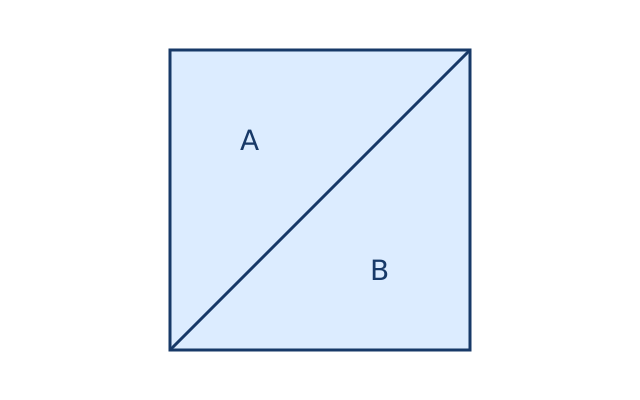
Make two equal paper squares, cut both along a diagonal and use the four triangles to recreate a larger square. Put the four right-angle corners at the centre and join the long outside edges. Trace and label all four pieces. The pieces must cover the target with no gap or overlap. Ask: Which edges meet, and how do you know the outside is a square? Evidence is the actual reconstruction, not only naming triangles.

E2: Build with cubes

Use interlocking cubes or virtual cubes to model a bench: connect a row of six cubes as a seat and put supports below both ends. Show a front and side view. Then build a small environment with a low building, taller tower and open path. Ask students to point to height, width and empty space in their model. Ordinary loose cubes need a supported base; do not balance a span that can fall. Curved outlines will look stepped: that is a useful approximation, not a claim of exact copying.

E3: Approximate animals and environmental objects

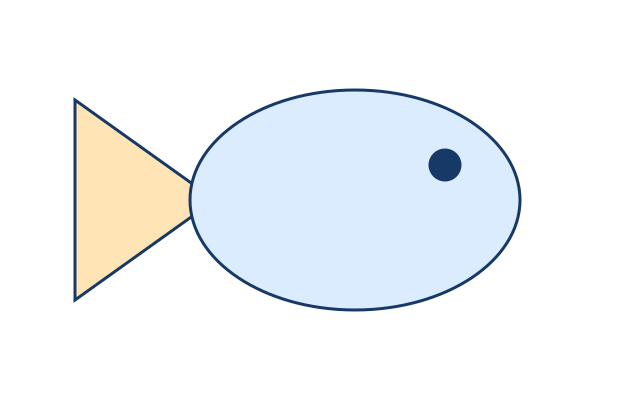
Draw an oval fish body, triangle tail on the left and circle eye near the right. Label each component and explain why the tail and eye belong at opposite ends. A pencil may be modelled with a cylinder and cone; its flat sketch uses different shape names from its solid model. Compare two drawings of the same object and judge important shape, size and position, rather than decoration.

E4: Create an original graphic

Inspect a permitted logo and identify familiar shapes without copying its branding. Then use drawing software to make an original garden-club symbol: oval leaves, circular flower centre and rectangular stem are one possibility. Save the actual graphic, label component roles and record a revision to improve proportion or position. A list of planned shapes alone does not demonstrate creating the logo.

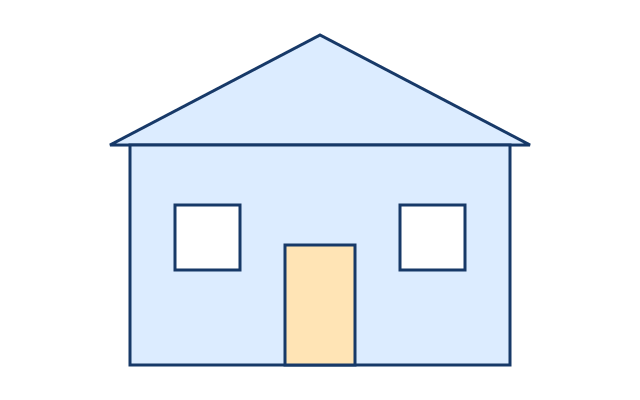
house mathematical model
Use this model to identify components, positions or matching parts and explain your check.
fish mathematical model
Use this model to identify components, positions or matching parts and explain your check.
tangram mathematical model
Use this model to identify components, positions or matching parts and explain your check.

Year-level boundary

Must teach combining and recreating familiar flat shapes and solids, cube modelling, approximation and original graphics. Prerequisites are familiar shape names and position words. Support informal size comparison; do not make cross-sections, solid volume formulae or formal perspective drawing core requirements.

Support / Core / Extend

Support: place a triangular roof above a rectangular wall together. Core: independently recreate and label a composite animal. Extend: compare two cube models of the same object and justify a proportion change.

Exit ticket and adult checks

Recreate a recognisable object using familiar components, then label and explain their size and arrangement.

Expected evidence and reteaching: Accept different useful decompositions when actual parts, key features and relative positions match the explanation. Reteach by placing just the two largest components first if a model is an unrelated pile.

Important questions, answers and assessment review

How can a cylinder and cone represent a pencil?

The cylinder represents its long rounded body and the cone its pointed end. Position and relative size matter.

Is a circle the same as a sphere?

No. A circle is flat; a sphere is a solid. A circle in a drawing can represent a ball’s round outline.

Must two useful models have the same components?

No. Different decompositions are useful when they preserve important form and arrangement.

Assessment: make a recognisable cube model and explain an omitted detail.

Inspect the actual physical or virtual construction. Review the position of the main components if it looks like an unrelated pile.