Complex shapes and objects can be represented by combining familiar shapes. A useful approximation preserves the important structure and proportions without copying every detail.
Choose components based on observable faces, edges, curved surfaces and arrangement. More components are not automatically better if they add irrelevant detail.
Transfer the relationship to the new situation and justify the result using precise vocabulary and evidence.
Curriculum coverage and elaborations
The content description and elaborations below show the curriculum ideas taught in this unit. Items marked as teaching context support lesson planning.
Content description: represent and approximate composite shapes and objects in the environment, using combinations of familiar shapes and objects
E1: identifying common shapes that form part of a composite shape by re-creating these shapes using physical or virtual materials
E2: physically or virtually using cubes to make three-dimensional models that approximate real objects; for example, building a virtual environment by using a computer software program to construct objects out of cubes
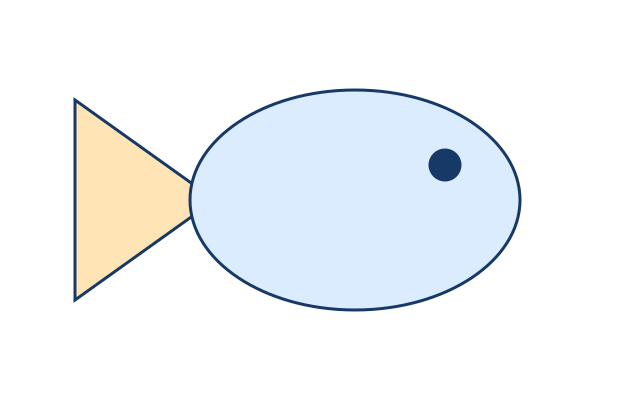
E3: approximating complex shapes and objects in the environment with familiar shapes and objects; for example, drawing cartoon animals by combining familiar shapes
E4: recognising how familiar shapes and objects are used in logos and other graphics to represent more complex shapes and creating logos using graphic design software
Guided learning activities
1. Shape photograph markup
Trace familiar component shapes over a photograph of a building, vehicle or playground object.
identify and label components
2. Block-model challenge
Use cubes, prisms, cylinders and cones to approximate a chosen environmental object, then justify each component.
cuberectangular prismcylinderconetriangular prism
3. Different decompositions
Compare two ways to decompose the same object and evaluate which communicates its structure more clearly.
few large componentsmore detailed componentsdifferent proportions
Revision Notes
Core idea: Complex shapes and objects can be represented by combining familiar shapes. A useful approximation preserves the important structure and proportions without copying every detail.
Remember
Identify components
Decompose composite forms
Combine familiar shapes/objects
Use proportion/position
Evaluate approximations
Important questions
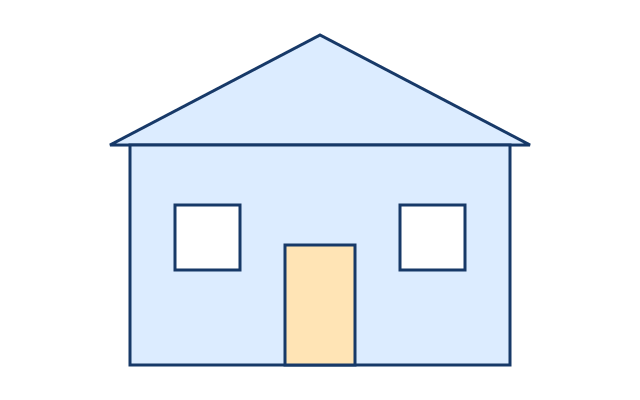
Decompose a house into familiar shapes/objects. Explain using the model or evidence above.
Explain approximation versus exact copy. Explain using the model or evidence above.
Name components of a water tower. Explain using the model or evidence above.
Why do proportions matter? Explain using the model or evidence above.
Compare two decompositions. Explain using the model or evidence above.
How to use this unit
Read the topic guide and use the teacher slide for instruction. Students can then use the worksheet for written work, open Practice for supported feedback, or take the Test when they are ready.
AC9M4SP01 teacher slide
Teacher resource
Open this fixed classroom slide deck to introduce the key idea, vocabulary and teaching sequence before students begin the activities.
Naming only the outline — Identify internal components and how they combine.
2D and 3D objects confused — A drawing may use 2D shapes to represent a 3D object, but name both appropriately.
Proportions ignored — Relative size and position help the model resemble the object.
Approximation treated as exact copy — A model intentionally simplifies while preserving important features.
International curriculum mapping
This table gives closest-topic mapping for search and planning. The Australian Curriculum code is exact; overseas entries are broad equivalents because each jurisdiction structures outcomes differently.
Region
Curriculum
Closest mapping
Australia
Australian Curriculum v9.0
AC9M4SP01 — represent and approximate composite shapes and objects in the environment, using combinations of familiar shapes and objects
Victoria
Victorian Curriculum F-10
Year 4 Maths: closest match in Space. Use this page as a VIC-aligned practice and worksheet reference.
NSW
NSW Curriculum
Stage 2 Maths: closest content focus for Represent and approximate composite shapes and objects in the environment, using combinations of familiar shapes and objects and related outcomes.
United States
Common Core / NGSS
Grade 4 Common Core Mathematics/ELA closest topic match for Represent and approximate composite shapes and objects in the environment, using combinations of familiar shapes and objects.
England / UK
National Curriculum
Key Stage 2 / Year 4: closest programme-of-study match for Represent and approximate composite shapes and objects in the environment, using combinations of familiar shapes and objects.
Canada
Provincial and territory curricula
Grade 4 closest topic match. Canada varies by province, so use this as a broad Ontario/BC-style learning outcome reference.
New Zealand
New Zealand Curriculum
Level 2 Maths: closest achievement-objective topic for Represent and approximate composite shapes and objects in the environment, using combinations of familiar shapes and objects.
India
NCERT / CBSE
Class 4 closest NCERT/CBSE topic match for Represent and approximate composite shapes and objects in the environment, using combinations of familiar shapes and objects.
Complete learning sequence and evidence
E1: Recreate the component arrangement
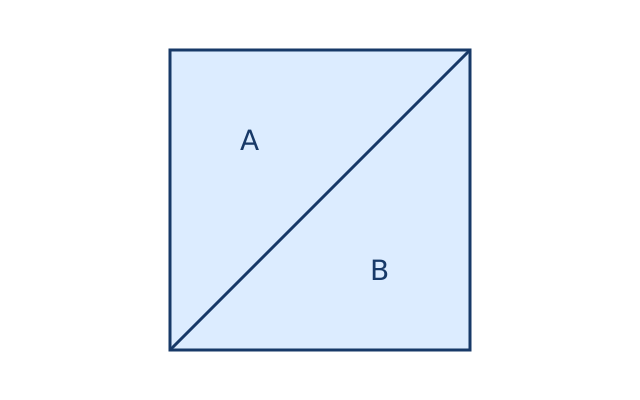
Make two equal paper squares, cut both along a diagonal and use the four triangles to recreate a larger square. Put the four right-angle corners at the centre and join the long outside edges. Trace and label all four pieces. The pieces must cover the target with no gap or overlap. Ask: Which edges meet, and how do you know the outside is a square? Evidence is the actual reconstruction, not only naming triangles.
E2: Build with cubes
Use interlocking cubes or virtual cubes to model a bench: connect a row of six cubes as a seat and put supports below both ends. Show a front and side view. Then build a small environment with a low building, taller tower and open path. Ask students to point to height, width and empty space in their model. Ordinary loose cubes need a supported base; do not balance a span that can fall. Curved outlines will look stepped: that is a useful approximation, not a claim of exact copying.
E3: Approximate animals and environmental objects
Draw an oval fish body, triangle tail on the left and circle eye near the right. Label each component and explain why the tail and eye belong at opposite ends. A pencil may be modelled with a cylinder and cone; its flat sketch uses different shape names from its solid model. Compare two drawings of the same object and judge important shape, size and position, rather than decoration.
E4: Create an original graphic
Inspect a permitted logo and identify familiar shapes without copying its branding. Then use drawing software to make an original garden-club symbol: oval leaves, circular flower centre and rectangular stem are one possibility. Save the actual graphic, label component roles and record a revision to improve proportion or position. A list of planned shapes alone does not demonstrate creating the logo.
Use this model to identify components, positions or matching parts and explain your check.Use this model to identify components, positions or matching parts and explain your check.Use this model to identify components, positions or matching parts and explain your check.
Year-level boundary
Must teach combining and recreating familiar flat shapes and solids, cube modelling, approximation and original graphics. Prerequisites are familiar shape names and position words. Support informal size comparison; do not make cross-sections, solid volume formulae or formal perspective drawing core requirements.
Support / Core / Extend
Support: place a triangular roof above a rectangular wall together. Core: independently recreate and label a composite animal. Extend: compare two cube models of the same object and justify a proportion change.
Exit ticket and adult checks
Recreate a recognisable object using familiar components, then label and explain their size and arrangement.
Expected evidence and reteaching: Accept different useful decompositions when actual parts, key features and relative positions match the explanation. Reteach by placing just the two largest components first if a model is an unrelated pile.
Important questions, answers and assessment review
How can a cylinder and cone represent a pencil?
The cylinder represents its long rounded body and the cone its pointed end. Position and relative size matter.
Is a circle the same as a sphere?
No. A circle is flat; a sphere is a solid. A circle in a drawing can represent a ball’s round outline.
Must two useful models have the same components?
No. Different decompositions are useful when they preserve important form and arrangement.
Assessment: make a recognisable cube model and explain an omitted detail.
Inspect the actual physical or virtual construction. Review the position of the main components if it looks like an unrelated pile.
🎥 Optional Video Lesson
The SkillrHub lesson remains the primary learning resource. This optional video reinforces the explanation; you can complete the lesson and practice without watching.
Recommended: Decomposing shapes to find area (grids) | Math | 3rd grade | Khan Academy
Khan Academy — Recognise a composite outline as a combination of familiar rectangles.
As you watch: Could you split the same outline into rectangles in a different way?
Load video playerLoads YouTube in this lesson. See the video notice below.
Try it: Sketch a simple floor plan and show two ways of separating its outline into familiar shapes.
Video unavailable, inaccurate or unsuitable for this year? Report a video problem to SkillrHub by email. You can continue with the written lesson and practice resources.
About these videos
Videos are curated from trusted independent educational creators and played through YouTube. Rights remain with their respective owners. Inclusion does not imply that a creator or YouTube endorses SkillrHub.
YouTube’s terms and privacy policy apply to its player. Advertising, recommendations and external links may appear, and videos may change or become unavailable. SkillrHub’s written lessons and practice resources remain available separately.
To report a content, suitability or rights concern, email skillrhublearning@gmail.com with the lesson code and video link. Please do not include personal student information.
Curriculum equivalents: Victoria, NSW and international
Curriculum equivalents for Represent and approximate composite shapes and objects in the environment...
Mapped skill: represent and approximate composite shapes and objects in the environment, using combinations of familiar shapes and objects
These references identify matching or closely related learning. Curriculum sequence, terminology and depth vary, so teachers should use the mapped skill and lesson difficulty to confirm suitability.
Australian Curriculum v9.0 is the canonical source for this SkillrHub lesson. Victoria and NSW entries name the closest published state codes or outcomes; international entries are planning references rather than claims of identical curricula.
Help improve SkillrHub
Questions or feedback?
Ask about this lesson, suggest an improvement or report an error. Facebook opens only when you choose an option below.
Topic reference: AC9M4SP01 — AC9M4SP01: Represent and approximate composite shapes and objects in the environment, using combinations of familiar shapes and objects