AC9M4N07: Choose and use estimation and rounding to check and explain the reasonableness of calculations including the results of financial transactions
choose and use estimation and rounding to check and explain the reasonableness of calculations including the results of financial transactions
A useful estimate is close enough for the purpose and simple enough to calculate mentally. Rounding to tens, hundreds or thousands should be chosen deliberately rather than automatically. A budget may need an upward estimate; a quick size check may use a nearby value.
Learning routine: Identify purpose → Choose method and rounding place → Estimate → Check or calculate exactly → Explain the conclusion.
Success looks like
Choose and use estimates for addition, subtraction, multiplication and division.
Use basic facts to place an answer between sensible lower and upper amounts.
Explain the effect of rounding both numbers up, both down or in opposite directions.
Plan an upward shopping or excursion budget and explain its limits.
Check a bill or change amount without confusing reasonable size with exact correctness.
Materials: number lines, price cards, counters or squared paper, and a calculator for checking exact totals when useful. Use ordinary dollar/cents amounts; formal decimal division and percentage calculations are outside this lesson.
Key vocabulary
estimate
a useful approximate value chosen for a purpose
round to nearest
use the nearest value at a stated place; halfway values round upward in this lesson
round upward
replace a value with the smallest whole dollar or stated multiple that is at least as large, leaving an exact multiple unchanged
compatible numbers
nearby numbers that make a calculation easy, such as 240 ÷ 6
lower and upper bounds
amounts known to be below and above the actual result
reasonable
of a sensible size for the numbers and context; this does not prove every digit is correct
Concept models and worked thinking
Choose a rounding place and read the distance
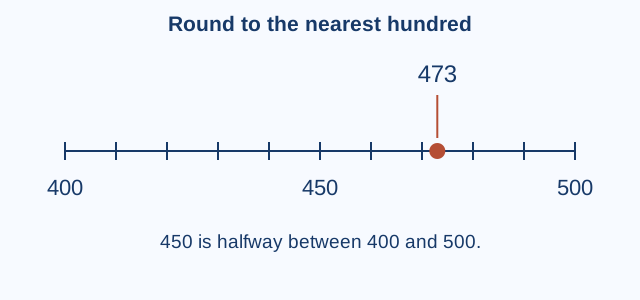
473 rounds to 500 at the nearest hundred: it is 27 away from 500 but 73 away from 400.
For the retained example 3 426, nearest-ten rounding gives 3 430; nearest-hundred rounding gives 3 400. The nearest ten is 4 away, while the nearest hundred is 26 away. The useful precision depends on the question.
Name the required place or explain the purpose.
Identify the neighbouring multiples and their halfway point.
Choose the nearest, or deliberately round upward if a protective budget is required.
A number already at the chosen multiple stays unchanged. “Nearest” and “upward” are different instructions.
Estimate a financial total and check the change
Purchase
Exact cost
Nearest-dollar estimate
1 book
$18.95
$19
1 game
$31.40
$31
2 pens at $4.80
2 × $4.80 = $9.60
2 × $5 = $10
Total
$59.95
$60
The nearest-dollar estimate is $19 + $31 + $10 = $60. Exact addition gives $18.95 + $31.40 + $9.60 = $59.95. After that exact check, a $60 payment is enough and the change is 5 cents.
Before calculating exactly, an upward budget is more protective: $19 + $32 + 2 × $5 = $61. Each price is at least its actual value. An estimate close to the budget alone cannot settle a difference of a few cents.
Use basic facts to bound the answer
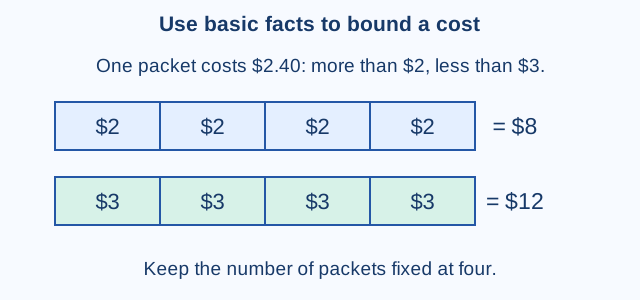
Because $2 < $2.40 < $3, four packets cost more than $8 and less than $12.
The exact cost, $9.60, is inside those bounds. Keep the number of packets fixed when multiplying the lower and upper prices.
Another operation: 318 shared into 6 groups lies between 300 ÷ 6 = 50 and 360 ÷ 6 = 60 per group. The exact quotient is 53.
Change bounds: if a cost is more than $17 and less than $18, paying $20 leaves more than $2 and less than $3. A higher cost leaves less change.
Choose an upward budget and explain the guarantee
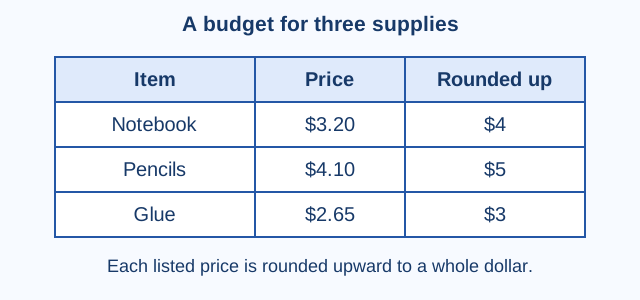
The upward budget is $4 + $5 + $3 = $12. The exact total is $9.95.
An upward total covers the listed costs because every rounded price is at least its actual price. For eight $7.35 tickets, keep all eight tickets and use $8 each: 8 × $8 = $64. Rounding the number of required tickets downward can lose this protection.
What the estimate cannot prove: prices $8.10, $10.20 and $9.30 round upward to a $30 estimate. That does not prove a $29 budget is too small: their exact total is $27.60. Use exact prices when the budget decision is close.
Compare rounding directions in addition
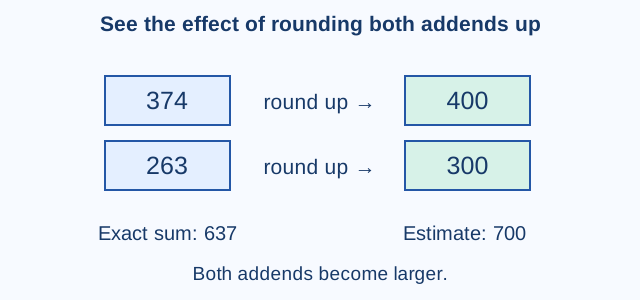
Both addends grow, so the sum grows. The estimate is 63 above the exact sum.
Rounding choice
Worked comparison
Conclusion
Both down
478 + 351 = 829; 400 + 300 = 700
Both addends decrease, giving a lower estimate.
Mixed, equal changes
244 + 356 = 600; 200 + 400 = 600
−44 and +44 cancel, so this estimate equals the exact sum.
Mixed, unequal changes
347 + 462 = 809; 300 + 500 = 800
−47 and +38 do not cancel; the estimate is 9 low.
Compare actual distances when choosing the closest estimate. For 538 + 261 = 799, estimates of 700, 800 and 900 are 99, 1 and 101 away. Here 800 is closest. Mixed rounding is not a promise of exactness.
Compare rounding directions in multiplication
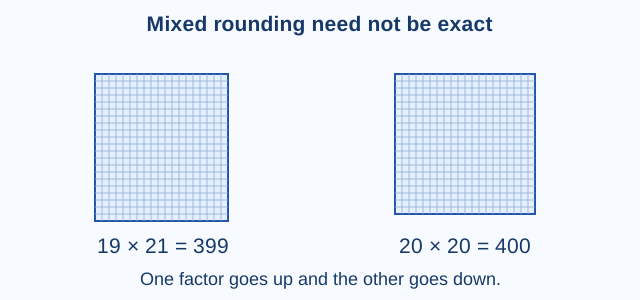
19 × 21 = 399, while 20 × 20 = 400. Changes of +1 and −1 to factors do not cancel as they would in a sum.
Rounding choice
Worked comparison
Conclusion
Both up
18 × 27 = 486; 20 × 30 = 600
Increasing both positive factors gives an upper estimate.
Both down
24 × 36 = 864; 20 × 30 = 600
Decreasing both positive factors gives a lower estimate.
Mixed
19 × 21 = 399; 20 × 20 = 400
This estimate is close, but it is not exact.
Counterexample to “mixed is always closest”: the exact product 11 × 21 is 231. Both-down 10 × 20 = 200 is 31 away; mixed 20 × 20 = 400 is 169 away; both-up 20 × 30 = 600 is 369 away. Both-down is closest here. Compare errors rather than treating a rounding direction as a universal rule.
If 6 × 48 is estimated as 6 × 50 = 300, the extra 2 occurs six times. The estimate is 12 above the exact 288.
Check all four operations and inspect suspicious bills
Calculation
Useful estimate
What it checks
386 + 217
400 + 200 = 600
The exact sum 603 has the expected size.
4 806 − 2 119
4 800 − 2 100 = 2 700
The exact difference 2 687 is close.
6 × 48
6 × 50 = 300
The exact product 288 is close.
396 ÷ 4
400 ÷ 4 = 100
99 is plausible; 990 is far too large.
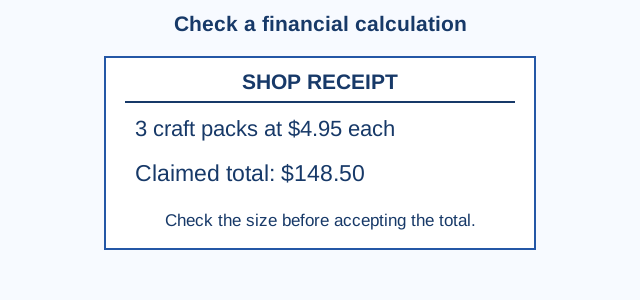
3 × about $5 is about $15, so $148.50 has the wrong size. Exact cost: $14.85.
Reasonable does not mean proven correct: 187 + 214 is about 400. Both 391 and 401 are near 400, but exact addition gives 401. An independent exact or inverse check is needed to confirm every digit.
Curriculum coverage and elaborations
Content description: choose and use estimation and rounding to check and explain the reasonableness of calculations including the results of financial transactions
E1: use basic facts to estimate a calculation and state lower and upper amounts. Model 3 bounds repeated prices, shares and change, and explains what each bound means.
E2: use rounded amounts for a shopping or excursion budget and explain why overestimating can be appropriate. Models 2 and 4 distinguish nearest estimates, upward budgets and exact payment decisions.
E3: compare both-up, both-down and one-up/one-down rounding in addition and multiplication; decide which approximation is closest and explain why. Models 5 and 6 teach each direction and explicit counterexamples to unreliable general rules.
Model 7 applies reasonableness checks across all four operations and financial calculations. A useful check includes a method, an estimate and a reasoned conclusion.
Guided learning activities
1. Match precision to purpose
Teacher asks: “How much detail is useful for a stadium crowd, a class count or a shopping budget?” Students state their chosen place and why it serves the question. Then round 3 426 to tens and hundreds and explain both results: 3 430 and 3 400.
Look for: the stated purpose and a consistent rounding method. If students always choose the same place, compare how much detail a small budget and a large crowd require.
2. Estimate, calculate and question the conclusion
Estimate 2 684 + 1 937 with 2 700 + 1 900 = 4 600, then calculate the exact 4 621. Explain why the size is sensible. Next show 3 480 + 3 398 = 6 912 as a proposed answer: a 6 900 estimate makes its size plausible, but the exact sum is 6 878.
Look for: students distinguishing a size check from exact proof. If they accept every nearby answer, ask for exact addition or an inverse check.
3. Plan and test a shopping budget
Use one item at $12.60 and two at $7.75. An upward estimate is $13 + 2 × $8 = $29. The exact total is $28.10. Students explain why $29 covers these items, and why rounding the exact $28.10 total to the nearest dollar, $28, would not provide enough.
Then compare 11 × 21 = 231 with estimates 200, 400 and 600. Ask students to show which is closest and explain why mixed rounding is not always the best choice.
Look for: every quantity retained, rounding direction checked and numerical distance used when comparing methods.
Revision Notes
Core idea: Choose an estimate for a purpose, then explain what it establishes and what still needs an exact check.
Important questions
Round 3 426 to the nearest 10 and 100. 3 430 and 3 400 respectively; state the place being used.
Estimate 2 684 + 1 937. Nearest hundreds give 2 700 + 1 900 = 4 600, close to the exact 4 621.
Is 6 912 reasonable for 3 480 + 3 398? It has a plausible size compared with 3 500 + 3 400 = 6 900, but it is not the correct exact sum. Exact addition gives 6 878.
Estimate a $59.95 purchase and find change from $60. It is about $60; the exact check gives 5 cents change. A nearest estimate alone is not enough to decide such a tight budget.
Explain when rounding up is useful. It creates an upper amount for a known list of costs. Preserve all quantities and check exact prices if an upper estimate exceeds a close budget.
How to use this unit
Use the Topic Guide and Classroom View for models and worked reasoning, then the worksheet for written estimates and explanations. Practice supplies feedback; Test checks independent choices and conclusions.
AC9M4N07 teacher slide
Teacher resource
Use this static viewer to introduce the key idea, vocabulary and teaching sequence before students begin the activities.
Always round to the same place: choose precision for the purpose, or follow the place stated in the question.
Nearest and upward mean the same: $7.35 rounds to $7 at the nearest dollar, but upward to $8.
Reasonable means exactly correct: an estimate can reject a wrong-sized answer, but a nearby answer still needs an exact check.
An estimate cannot equal an exact answer: 244 + 356 = 600 and its hundreds estimate is also 600. Equality can happen.
Mixed rounding always cancels or is closest: compare the actual changes for addition and the actual candidate errors for multiplication.
An upper estimate over budget proves the exact bill is over budget: the exact amount can be lower. Calculate it when the decision is close.
Rounding price up is enough even after reducing the quantity: keep every required item or ticket in a protective budget.
Support, Core and Extend
Support: use number lines, small whole-dollar price bounds and repeated-group models. Say “more than” and “less than” before introducing written inequality symbols.
Core: choose nearest, upward or compatible-number estimates; explain all three rounding directions for sums and products; check bills, change and budgets.
Extend: compare different candidate errors, create a counterexample to “mixed is always closest”, or explain why rounding before and after addition can differ. Stay within whole-number estimates and familiar dollar/cents amounts.
Quick check and feedback
Bound six $4.30 meals. More than 6 × $4 = $24 and less than 6 × $5 = $30. Reteach preserving the count if only one meal is bounded.
Choose an upward budget for $8.20, $6.10 and $4.65. $9 + $7 + $5 = $21; every price was rounded upward.
Can mixed rounding be exact for a sum? Yes: 246 + 354 = 200 + 400 = 600, because −46 and +46 cancel.
Is mixed rounding always closest for a product? No: for 12 × 21 = 252, 200 is closer than mixed 400 or upper 600.
Estimate 547 ÷ 9. 540 ÷ 9 = 60 gives an answer near 60, so 610 is not reasonable.
Mastery evidence: state a useful approximation, apply it correctly and explain the conclusion with its limits. If only a rounded answer is given, ask why that method fits the purpose and whether an exact check is still needed.
International curriculum mapping
This table gives closest-topic mapping for search and planning. The Australian Curriculum code is exact; overseas entries are broad equivalents because each jurisdiction structures outcomes differently.
Region
Curriculum
Closest mapping
Australia
Australian Curriculum v9.0
AC9M4N07 — choose and use estimation and rounding to check and explain the reasonableness of calculations including the results of financial transactions
Victoria
Victorian Curriculum F-10
Year 4 Maths: closest match in Number. Use this page as a VIC-aligned practice and worksheet reference.
NSW
NSW Curriculum
Stage 2 Maths: closest content focus for Choose and use estimation and rounding to check and explain the reasonableness of calculations including the results of financial transactions and related outcomes.
United States
Common Core / NGSS
Grade 4 Common Core Mathematics/ELA closest topic match for Choose and use estimation and rounding to check and explain the reasonableness of calculations including the results of financial transactions.
England / UK
National Curriculum
Key Stage 2 / Year 4: closest programme-of-study match for Choose and use estimation and rounding to check and explain the reasonableness of calculations including the results of financial transactions.
Canada
Provincial and territory curricula
Grade 4 closest topic match. Canada varies by province, so use this as a broad Ontario/BC-style learning outcome reference.
New Zealand
New Zealand Curriculum
Level 2 Maths: closest achievement-objective topic for Choose and use estimation and rounding to check and explain the reasonableness of calculations including the results of financial transactions.
India
NCERT / CBSE
Class 4 closest NCERT/CBSE topic match for Choose and use estimation and rounding to check and explain the reasonableness of calculations including the results of financial transactions.
🎥 Optional Video Lesson
The SkillrHub lesson remains the primary learning resource. This optional video reinforces the explanation; you can complete the lesson and practice without watching.
Math Antics — Use nearby round numbers to make sensible estimates.
As you watch: How do you decide which place to round to?
Load video playerLoads YouTube in this lesson. See the video notice below.
Try it: Estimate 198 + 403, calculate the exact answer, and explain whether it is reasonable.
Video unavailable, inaccurate or unsuitable for this year? Report a video problem to SkillrHub by email. You can continue with the written lesson and practice resources.
About these videos
Videos are curated from trusted independent educational creators and played through YouTube. Rights remain with their respective owners. Inclusion does not imply that a creator or YouTube endorses SkillrHub.
YouTube’s terms and privacy policy apply to its player. Advertising, recommendations and external links may appear, and videos may change or become unavailable. SkillrHub’s written lessons and practice resources remain available separately.
To report a content, suitability or rights concern, email skillrhublearning@gmail.com with the lesson code and video link. Please do not include personal student information.
Curriculum equivalents: Victoria, NSW and international
Curriculum equivalents for Choose and use estimation and rounding to check and explain...
Mapped skill: choose and use estimation and rounding to check and explain the reasonableness of calculations including the results of financial transactions
These references identify matching or closely related learning. Curriculum sequence, terminology and depth vary, so teachers should use the mapped skill and lesson difficulty to confirm suitability.
Australian Curriculum v9.0 is the canonical source for this SkillrHub lesson. Victoria and NSW entries name the closest published state codes or outcomes; international entries are planning references rather than claims of identical curricula.
Help improve SkillrHub
Questions or feedback?
Ask about this lesson, suggest an improvement or report an error. Facebook opens only when you choose an option below.
Topic reference: AC9M4N07 — AC9M4N07: Choose and use estimation and rounding to check and explain the reasonableness of calculations including the results of financial transactions