An even number can be arranged into pairs with no remainder; an odd number leaves one unpaired. Whether a whole number is odd or even is called its parity. This follows predictable patterns under addition, subtraction and multiplication.
Learning routine: Pair the quantity → Identify parity → Test an operation → Generalise → Justify
Success looks like
Classify odd/even
Use pairing explanations
Apply operation patterns
Predict parity
Justify generalisations
Key vocabulary
even number
a whole number divisible by 2
odd number
a whole number with one left after pairing
property
a rule that remains true for a number class
Concept models and worked thinking
Use pairs to explain odd and even
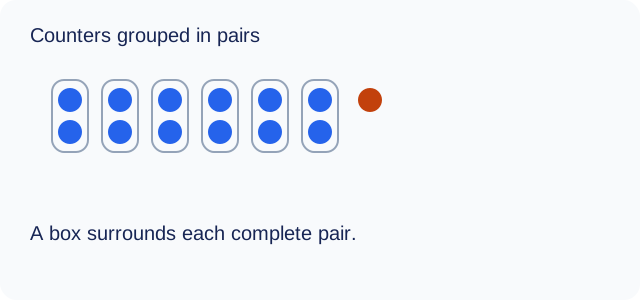
odd: one unpaired
Nine is odd because four pairs can be made and one object remains unpaired. A final digit of 0, 2, 4, 6 or 8 identifies an even whole number.
Make pairs until fewer than two objects remain.
Four pairs use eight objects; the ninth object has no partner, so nine is odd.
For larger numbers, each ten already makes five pairs. Only the ones can leave a single leftover, which explains the final-digit rule.
Explain patterns using pairs, not only examples. Two unpaired objects from odd + odd join to form another pair.
For addition, combine paired collections and inspect the leftovers. For multiplication, an even-sized group consists only of complete pairs; repeating it preserves those pairs. For odd × odd, the odd number of single leftovers has one left after pairing.
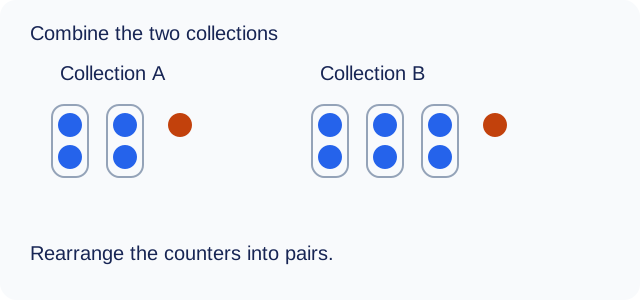
Two odd groups combine to make an even total
Each odd collection has one unpaired counter. Those two counters form a new pair, giving an even total.
This explanation works for any two odd whole numbers: their pairs stay paired and their two leftovers pair with each other.
Subtraction follows the same odd/even combinations
Starting and removed amounts
Result
Example
Even − even
Even
18 − 6 = 12
Odd − odd
Even
17 − 5 = 12
Even − odd
Odd
18 − 5 = 13
Odd − even
Odd
17 − 6 = 11
Keep the results as whole numbers here. Removing an even amount removes complete pairs; removing an odd amount also removes one unpaired item or breaks a pair.
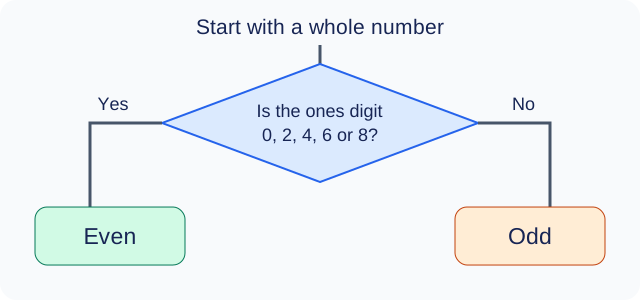
Follow an odd/even decision
Read one whole number at a time, inspect its ones digit, then follow the matching branch.
Worked trace: 354 ends in 4 → Yes → Even. 731 ends in 1 → No → Odd. Applied to 0, 18, 25 and 42, the Even branch keeps 0, 18 and 42. Zero belongs here: it makes two groups of zero with none left over.
Use odd/even reasoning to check an answer
If someone writes 62 + 28 = 89, reject it: even + even must be even, while 89 is odd. But an even proposed answer is not automatically correct: 62 + 28 = 88 also has the required parity but is wrong. Calculate the exact sum, 90, to finish the check.
Curriculum coverage and elaborations
Content description: explain and use the properties of odd and even numbers.
E1: explain why numbers ending in 0, 2, 4, 6 and 8 are even and those ending in 1, 3, 5, 7 and 9 are odd.
E2: explain why some collections can be shared evenly between 2 people and some leave a remainder.
E3: explain and use the patterns in adding, subtracting and multiplying odd and even numbers to check calculations.
E4: follow a flow-chart algorithm to decide whether numbers are even or odd and identify numbers divisible by 2.
Guided learning activities
1. Pairing proof
Use counters to model 13, 14 and 15, then record the number of pairs and whether one remains.
13 makes six pairs and one leftover. Add one counter to make 14: seven pairs. Add another to make 15: seven pairs and one leftover.
2. Operation investigation
Test several odd and even additions, then write a general rule and explain it with pairing.
odd + oddunpaired + unpaired makes a pair
odd + evenone unpaired remains
even + evenall pairs remain
3. Parity prediction
Predict whether each result is odd or even, then use a calculation to check. 4 382 + 7 915 is odd (even + odd); 326 × 47 is even (an even factor); 9 999 − 624 is odd (odd − even). Their exact values are 12 297, 15 322 and 9 375.
4 382 + 7 915326 × 479 999 − 624
Revision Notes
Core idea: An even number can be arranged into pairs with no remainder; an odd number leaves one unpaired. Whether a whole number is odd or even is called its parity. This follows predictable patterns under addition, subtraction and multiplication.
Remember
Classify odd/even
Use pairing explanations
Apply operation patterns
Predict parity
Justify generalisations
Important questions
Is 5 706 odd or even? Why? Even. The ones digit is 6; all tens and the six ones make complete pairs.
Predict the parity of odd + odd. Even. The two unpaired ones join to make one more pair.
Predict whether 37 × 25 is odd or even without calculating. Odd. Both factors are odd; an odd number of odd groups leaves one unpaired item.
Explain why even × any whole number is even. Each even-sized group can be fully paired; any whole number of those groups stays fully paired. Zero groups give zero, which is even.
Is 101 − 48 odd or even? Odd. Removing 48 objects removes 24 complete pairs, leaving the original unpaired object; 101 − 48 = 53.
How to use this unit
Teach with the Topic Guide and Classroom View, then use the worksheet, Practice and Test.
Support: physically pair counters and share whole objects between two. Core: explain all addition, subtraction and multiplication cases and follow the decision flowchart. Extend: find a counterexample to a false claim or explain a pattern with several addends. Keep the work on whole numbers; do not assume division has the same fixed rules as multiplication.
Quick check and feedback
Is 347 odd or even? Odd, because the ones digit is 7.
Will odd + odd be odd or even? Even; for example 5 + 7 = 12. Two unpaired ones combine to make a pair.
A student says 3 x 6 must be odd because it starts with 3. What is the fix? Check the product: 18 is even, and any number of equal groups of an even number is even.
Mastery evidence: Students justify parity using ones digits, pairs, arrays or a clear counterexample, not by guessing from the first digit.
AC9M4N02 Teacher Slides
Open Classroom View and expand one section at a time to project the models and worked examples.
The first digit decides odd or even — Use the ones digit: 3 482 is even despite starting with 3. Every ten, hundred and thousand can be fully paired.
Every multiplication result is even — Odd × odd is odd.
A pattern from one example is proof — Test several cases and explain using pairs or factors of 2.
Subtraction pattern ignored — Parity rules for subtraction match addition when whole-number results are allowed.
International curriculum mapping
Australia
Australian Curriculum v9.0
AC9M4N02
Victoria
Victorian Curriculum F–10
Year 4 Number: number properties.
NSW
NSW Curriculum
Stage 2 Mathematics: whole-number properties.
🎥 Optional Video Lesson
The SkillrHub lesson remains the primary learning resource. This optional video reinforces the explanation; you can complete the lesson and practice without watching.
Scratch Garden — Refresh the odd-number pattern before investigating odd and even properties.
As you watch: Which last digits repeat as the odd numbers grow?
Load video playerLoads YouTube in this lesson. See the video notice below.
Try it: Choose two odd numbers and add them. Make pairs with counters to explain why their sum is even.
Video unavailable, inaccurate or unsuitable for this year? Report a video problem to SkillrHub by email. You can continue with the written lesson and practice resources.
About these videos
Videos are curated from trusted independent educational creators and played through YouTube. Rights remain with their respective owners. Inclusion does not imply that a creator or YouTube endorses SkillrHub.
YouTube’s terms and privacy policy apply to its player. Advertising, recommendations and external links may appear, and videos may change or become unavailable. SkillrHub’s written lessons and practice resources remain available separately.
To report a content, suitability or rights concern, email skillrhublearning@gmail.com with the lesson code and video link. Please do not include personal student information.
Curriculum equivalents: Victoria, NSW and international
Curriculum equivalents for Explain and use the properties of odd and even numbers
Mapped skill: explain and use the properties of odd and even numbers
These references identify matching or closely related learning. Curriculum sequence, terminology and depth vary, so teachers should use the mapped skill and lesson difficulty to confirm suitability.
Australian Curriculum v9.0 is the canonical source for this SkillrHub lesson. Victoria and NSW entries name the closest published state codes or outcomes; international entries are planning references rather than claims of identical curricula.
Help improve SkillrHub
Questions or feedback?
Ask about this lesson, suggest an improvement or report an error. Facebook opens only when you choose an option below.
Topic reference: AC9M4N02 — AC9M4N02: Odd and even numbers