Year 4 Mathematics · AC9M4N02

Odd and even numbers

Explain with pairs, predict results, and follow an odd/even decision.

Ready to project and teach

Learning goalsSay it simply

An even number can be arranged into pairs with no remainder; an odd number leaves one unpaired. Whether a whole number is odd or even is called its parity. This follows predictable patterns under addition, subtraction and multiplication.

Learning routine: Pair the quantity → Identify parity → Test an operation → Generalise → Justify

Success looks like

  • Classify odd/even
  • Use pairing explanations
  • Apply operation patterns
  • Predict parity
  • Justify generalisations
Clean visual examples and worked thinkingExplain the relationship
AC9M4N02 — Odd and even numbers
Example 1

Use pairs to explain odd and even

odd: one unpaired

Nine is odd because four pairs can be made and one object remains unpaired. A final digit of 0, 2, 4, 6 or 8 identifies an even whole number.

  1. Make pairs until fewer than two objects remain.
  2. Four pairs use eight objects; the ninth object has no partner, so nine is odd.
  3. For larger numbers, each ten already makes five pairs. Only the ones can leave a single leftover, which explains the final-digit rule.
Example 2

Generalise operation patterns

OperationExampleResulteven + even8 + 12evenodd + odd7 + 9evenodd + even7 + 12oddeven × any whole number6 × 5evenodd × odd5 × 7odd

Explain patterns using pairs, not only examples. Two unpaired objects from odd + odd join to form another pair.

For addition, combine paired collections and inspect the leftovers. For multiplication, an even-sized group consists only of complete pairs; repeating it preserves those pairs. For odd × odd, the odd number of single leftovers has one left after pairing.

Example 3

Two odd groups combine to make an even total

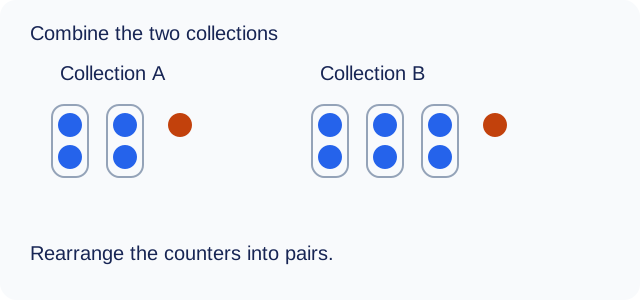
Collection A has two pairs and one unpaired counter. Collection B has three pairs and one unpaired counter.
Each odd collection has one unpaired counter. Those two counters form a new pair, giving an even total.

This explanation works for any two odd whole numbers: their pairs stay paired and their two leftovers pair with each other.

Example 4

Subtraction follows the same odd/even combinations

Starting and removed amountsResultExample
Even − evenEven18 − 6 = 12
Odd − oddEven17 − 5 = 12
Even − oddOdd18 − 5 = 13
Odd − evenOdd17 − 6 = 11

Keep the results as whole numbers here. Removing an even amount removes complete pairs; removing an odd amount also removes one unpaired item or breaks a pair.

Example 5

Follow an odd/even decision

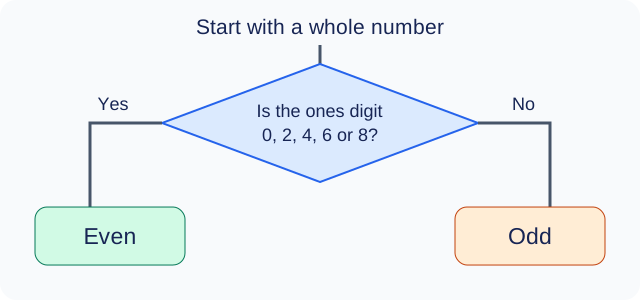
Flowchart: start with a whole number. Is the ones digit 0, 2, 4, 6 or 8? Yes leads to Even; No leads to Odd.
Read one whole number at a time, inspect its ones digit, then follow the matching branch.

Worked trace: 354 ends in 4 → Yes → Even. 731 ends in 1 → No → Odd. Applied to 0, 18, 25 and 42, the Even branch keeps 0, 18 and 42. Zero belongs here: it makes two groups of zero with none left over.

Example 6

Use odd/even reasoning to check an answer

If someone writes 62 + 28 = 89, reject it: even + even must be even, while 89 is odd. But an even proposed answer is not automatically correct: 62 + 28 = 88 also has the required parity but is wrong. Calculate the exact sum, 90, to finish the check.

Curriculum examplesAll required components

Content description: explain and use the properties of odd and even numbers.

  • E1: explain why numbers ending in 0, 2, 4, 6 and 8 are even and those ending in 1, 3, 5, 7 and 9 are odd.
  • E2: explain why some collections can be shared evenly between 2 people and some leave a remainder.
  • E3: explain and use the patterns in adding, subtracting and multiplying odd and even numbers to check calculations.
  • E4: follow a flow-chart algorithm to decide whether numbers are even or odd and identify numbers divisible by 2.
Questions and answersWith answers

Core idea: An even number can be arranged into pairs with no remainder; an odd number leaves one unpaired. Whether a whole number is odd or even is called its parity. This follows predictable patterns under addition, subtraction and multiplication.

Remember

  • Classify odd/even
  • Use pairing explanations
  • Apply operation patterns
  • Predict parity
  • Justify generalisations

Important questions

  • Is 5 706 odd or even? Why? Even. The ones digit is 6; all tens and the six ones make complete pairs.
  • Predict the parity of odd + odd. Even. The two unpaired ones join to make one more pair.
  • Predict whether 37 × 25 is odd or even without calculating. Odd. Both factors are odd; an odd number of odd groups leaves one unpaired item.
  • Explain why even × any whole number is even. Each even-sized group can be fully paired; any whole number of those groups stays fully paired. Zero groups give zero, which is even.
  • Is 101 − 48 odd or even? Odd. Removing 48 objects removes 24 complete pairs, leaving the original unpaired object; 101 − 48 = 53.
Practice and reviewTry, explain and check

1. Pairing proof

Use counters to model 13, 14 and 15, then record the number of pairs and whether one remains.

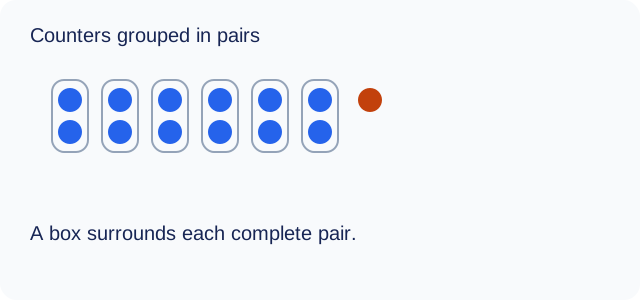
Thirteen counters: six boxed pairs and one counter outside the pairs.
13 makes six pairs and one leftover. Add one counter to make 14: seven pairs. Add another to make 15: seven pairs and one leftover.

2. Operation investigation

Test several odd and even additions, then write a general rule and explain it with pairing.

odd + oddunpaired + unpaired makes a pair
odd + evenone unpaired remains
even + evenall pairs remain

3. Parity prediction

Predict whether each result is odd or even, then use a calculation to check. 4 382 + 7 915 is odd (even + odd); 326 × 47 is even (an even factor); 9 999 − 624 is odd (odd − even). Their exact values are 12 297, 15 322 and 9 375.

4 382 + 7 915326 × 479 999 − 624
Curriculum alignmentOfficial curriculum

An even number can be arranged into pairs with no remainder; an odd number leaves one unpaired. Whether a whole number is odd or even is called its parity. This follows predictable patterns under addition, subtraction and multiplication.

Learning routine: Pair the quantity → Identify parity → Test an operation → Generalise → Justify

Success looks like

  • Classify odd/even
  • Use pairing explanations
  • Apply operation patterns
  • Predict parity
  • Justify generalisations
Teach & ExplainTeaching slides and samples

Teach this topic step by step

Explore optional teaching slide packs for classroom lessons and explanations at home.

Browse Teach & Explain · Browse Print & Go

Teachers: follow SkillrHub on TPT, then email us to request a free sample before buying. Include the year, subject and topic or curriculum code.

Request a free sample

After trying the sample, honest feedback is welcome. A TPT review is optional, where available, and does not need to be positive.