Year 4 Mathematics · AC9M4N01

Tenths, hundredths and decimal notation

Name and represent tenths and hundredths in models, measures and money.

Ready to project and teach

Learning goalsSay it simply

The decimal point separates whole-number places from fractional places. One tenth is one of 10 equal parts of a whole, one hundredth is one of 100 equal parts, and 10 hundredths equal 1 tenth.

Learning routine: Build the whole → Partition into tenths → Partition into hundredths → Write decimal → Rename → Compare

Success looks like

  • Identify tenths and hundredths
  • Read and write decimals
  • Rename tenths as hundredths
  • Compare decimals
  • Connect fractions and decimals
Clean visual examples and worked thinkingExplain the relationship
AC9M4N01 — Tenths, hundredths and decimal notation
Example 1

Represent 3.47 using a place-value chart

ones3
tenths4
hundredths7
.

3.47 = 3 ones + 4 tenths + 7 hundredths

Read 3.47 as three and forty-seven hundredths, or three ones, four tenths and seven hundredths. The 4 is worth 0.4, not 4.

  1. Put 3 in the ones column, 4 in the tenths column and 7 in the hundredths column.
  2. Read the amount as three point four seven, or three and forty-seven hundredths.
  3. Check the values: 3 + 0.4 + 0.07 = 3.47. The digit 4 is worth four tenths.
Example 2

Rename decimals without changing their value

RepresentationEquivalent value0.66 tenths0.6060 hundredths2.352 + 3/10 + 5/100

Adding a zero at the end of the decimal part does not change the value: 0.6 = 0.60. Use place value rather than digit count to compare decimals.

Six tenths can be split into sixty hundredths, so 0.6 = 0.60. A zero inside a numeral can matter: 0.06 is six hundredths, one tenth of 0.6.

Example 3

Build the whole, then split a tenth

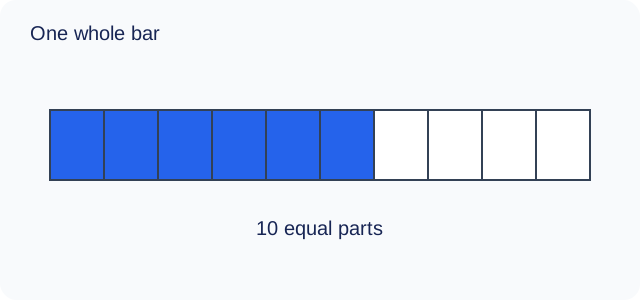
One whole bar split into ten equal parts, with six parts shaded.
Six of ten equal parts are shaded: 6 tenths = 0.6.
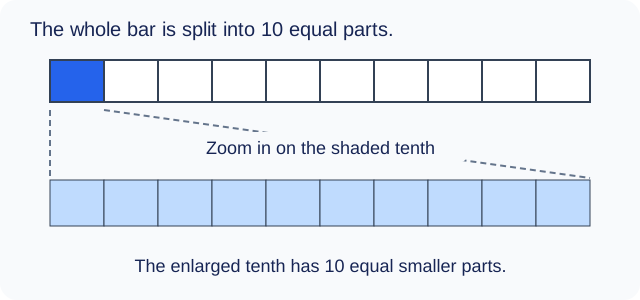
A whole bar split into ten equal parts with one part shaded. Dashed lines enlarge that tenth into a second bar split into ten equal smaller pieces.
The zoom changes the drawing size, not the value: each smaller piece is 1 hundredth of the original whole.

Exchange rule: 1 whole = 10 tenths = 100 hundredths; 1 tenth = 10 hundredths. One bundle of 10 equal straws can stand for a whole. Each straw is a tenth; splitting one straw into ten equal pieces makes hundredths.

Quick check: 14 tenths = 1.4 because ten of the tenths make one whole.

Example 4

Read decimal measures

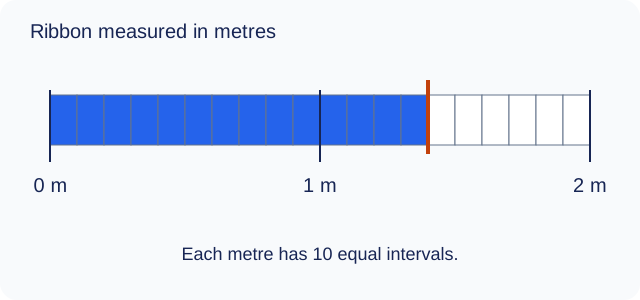
A strip from zero to two metres, with each metre split into ten equal intervals. The shaded ribbon reaches four intervals beyond one metre.
The ribbon is 1 metre and 4 tenths of the next metre: 1.4 m.

One metre is 100 centimetres, so 7 cm is 0.07 m. A length of 2 m and 35 cm is 2.35 m, read “two point three five metres”. Keep the zero when reading 2.05 m: “two point zero five metres”.

Example 5

Count money and connect the place values

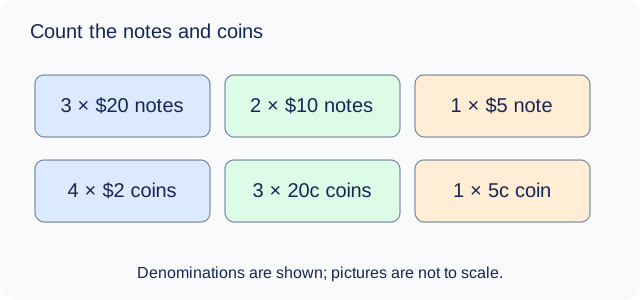
A count record: three twenty-dollar notes, two ten-dollar notes, one five-dollar note, four two-dollar coins, three twenty-cent coins and one five-cent coin.
The notes total $85; dollar coins add $8; cent coins add 65c. Total: $93.65.

Count each denomination before combining it. The three 20c coins make 60c; adding 5c makes 65 hundredths of the next dollar.

Compare the readings: $2.75 is “two dollars and seventy-five cents”; 2.75 m is “two point seven five metres”. In both, 7 means seven tenths and 5 means five hundredths of the named unit. Money uses cents; a measurement keeps its measurement unit.

Curriculum examplesAll required components

Content description: recognise and extend the application of place value to tenths and hundredths and use the conventions of decimal notation to name and represent decimals.

  • E1: divide a whole into 10 equal parts and connect tenths to decimal notation such as 0.1 and 0.2.
  • E2: use materials to show the multiplicative relationship between wholes, tenths and hundredths.
  • E3: recognise one as ten tenths and one tenth as ten hundredths and use these relationships to rename decimals.
  • E4: model decimal measures such as 1.5 m and 1.75 units.
  • E5: count mixed notes and coins and write totals using dollars and cents.
  • E6: compare how decimal money amounts and decimal measurements are read and interpreted.
Questions and answersWith answers

Core idea: The decimal point separates whole-number places from fractional places. One tenth is one of 10 equal parts of a whole, one hundredth is one of 100 equal parts, and 10 hundredths equal 1 tenth.

Remember

  • Identify tenths and hundredths
  • Read and write decimals
  • Rename tenths as hundredths
  • Compare decimals
  • Connect fractions and decimals

Important questions

  • Represent 2.34 in a place-value chart. 2 ones, 3 tenths and 4 hundredths; 2.34 = 2 + 0.3 + 0.04.
  • Rename 0.7 in hundredths. 70 hundredths, because each of the seven tenths contains ten hundredths.
  • Which is greater: 0.56 or 0.6? Explain. 0.6 is greater: it is 60 hundredths, which exceeds 56 hundredths.
  • Write 43 hundredths as a decimal. 0.43. The 4 is in the tenths place and the 3 is in the hundredths place.
  • Explain why 1.20 = 1.2. Twenty hundredths equal two tenths. Both numbers mean 1 whole and 2 tenths.
Practice and reviewTry, explain and check

1. Decimal grid build

Shade 36 hundredths on a 10 × 10 grid, then write it as a fraction, decimal and place-value statement.

36/100 = 0.36

2. Place-value rename

Use counters or cards to exchange 10 hundredths for 1 tenth and explain why 0.30 and 0.3 are equal.

30 hundredths→exchange 10 hundredths × 3→3 tenths→0.30 = 0.3

3. Decimal comparison

Use place value to compare 0.8, 0.08, 0.80 and 0.18. From least to greatest: 0.08, 0.18, then 0.8 = 0.80. Eight tenths is eighty hundredths; it is not smaller just because it has fewer decimal digits.

onestenthshundredths080008018

4. Count and say the total

Use play money: two $20 notes, one $10 note, three $2 coins, one 50c coin and one 5c coin. Count the total and write it in dollars and cents.

Expected answer: $56.55. The notes make $50, the dollar coins make $6 and the cent coins make 55c. Say “fifty-six dollars and fifty-five cents”. Then read 56.55 m as “fifty-six point five five metres”. The digit values agree but the units differ.
Curriculum alignmentOfficial curriculum

The decimal point separates whole-number places from fractional places. One tenth is one of 10 equal parts of a whole, one hundredth is one of 100 equal parts, and 10 hundredths equal 1 tenth.

Learning routine: Build the whole → Partition into tenths → Partition into hundredths → Write decimal → Rename → Compare

Success looks like

  • Identify tenths and hundredths
  • Read and write decimals
  • Rename tenths as hundredths
  • Compare decimals
  • Connect fractions and decimals
Teach & ExplainTeaching slides and samples

Teach this topic step by step

Explore optional teaching slide packs for classroom lessons and explanations at home.

Browse Teach & Explain · Browse Print & Go

Teachers: follow SkillrHub on TPT, then email us to request a free sample before buying. Include the year, subject and topic or curriculum code.

Request a free sample

After trying the sample, honest feedback is welcome. A TPT review is optional, where available, and does not need to be positive.