What students learn in AC9M4N01
This unit helps students build a clear, usable understanding of And extend the application of place value to tenths and.... The goal is not to memorise one answer pattern. Students should be able to explain the idea, recognise it in a new example and apply it in a short practice or worksheet task.
- Start with the main idea: recognise and extend the application of place value to tenths and hundredths and use the conventions of decimal notation to name and represent decimals.
- Use concrete examples, pictures, oral explanation and short written responses before moving to independent practice.
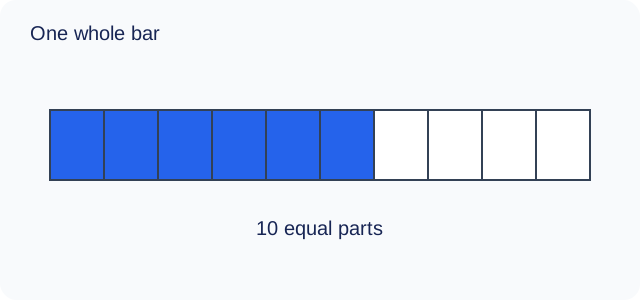
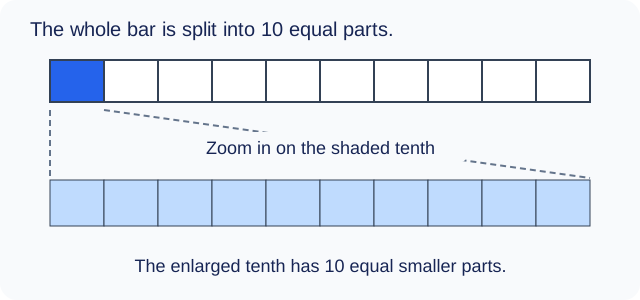
- using a bar to represent the whole, dividing it into 10 equal pieces with each piece representing 0.1 or a tenth of the whole length and understanding that 2 pieces are 0.2 or two-tenths of the whole using materials to show the multiplicative relationship between the whole, tenths and hundredths; for example, using a bundle of 10 straws to represent the whole, one straw as the tenth and cutting the tenth into 10 parts to show the hundredths; using “Decipipes” to represent tenths
- Finish with mixed questions so students must choose the correct strategy rather than copy the last example.
Curriculum coverage and elaborations
The content description and elaborations below show the curriculum ideas taught in this unit. Items marked as teaching context support lesson planning but may not appear in the initial eight-question activity.
- Content description: recognise and extend the application of place value to tenths and hundredths and use the conventions of decimal notation to name and represent decimals
- E1: using a bar to represent the whole, dividing it into 10 equal pieces with each piece representing 0.1 or a tenth of the whole length and understanding that 2 pieces are 0.2 or two-tenths of the whole
- E2: using materials to show the multiplicative relationship between the whole, tenths and hundredths; for example, using a bundle of 10 straws to represent the whole, one straw as the tenth and cutting the tenth into 10 parts to show the hundredths; using “Decipipes” to represent tenths
- E3: recognising that one is the same as ten-tenths and one-tenth is the same as 10 hundredths and using this relationship to rename decimals; for example, renaming 0.25 as two-tenths and five-hundredths or twenty-five hundredths
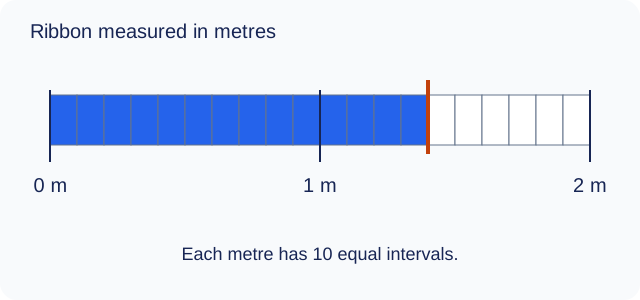
- E4: making models of measurement attributes to show the relationship between the base unit and parts of the unit; for example, 1.5 metres is one metre and five-tenths of the next metre; 1.75 units is one unit and seventy-five hundredths of the next unit
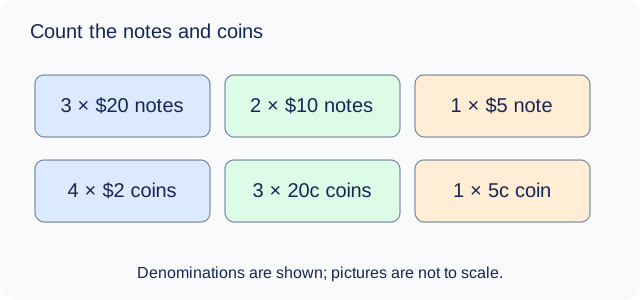
- E5: counting large quantities of mixed notes and coins, writing the total using dollars and cents, and recognising the cents as parts of the next dollar
- E6: comparing the way money and measures are read and said, and explaining how they are the same and different; for example, \$2.75 is said, “two dollars seventy-five” and 2.75 metres is said “two point seven five metres”; recognising that the 7 means seven-tenths and the 5 means five-hundredths in both
How to use this unit
Read the topic guide, use the teacher slide for instruction, then complete the Worksheet, Practice and Test. These three activities use the same eight-question unit bank.
Teacher resource
AC9M4N01 teacher slide
Use this one-page PDF to introduce the key idea, vocabulary and teaching sequence before students begin the activities.
Open teacher slide (PDF)Common mistakes to watch for
- Rushing to a rule before checking the concrete model, drawing or number sentence.
- Using the correct answer once but not being able to explain why it works.
- Mixing up similar vocabulary such as more/less, before/after, longer/shorter or equal groups/sharing.
International curriculum mapping
This table gives closest-topic mapping for search and planning. The Australian Curriculum code is exact; overseas entries are broad equivalents because each jurisdiction structures outcomes differently.
| Region | Curriculum | Closest mapping |
|---|---|---|
| Australia | Australian Curriculum v9.0 | AC9M4N01 — recognise and extend the application of place value to tenths and hundredths and use the conventions of decimal notation to name and represent decimals |
| Victoria | Victorian Curriculum F-10 | Year 4 Maths: closest match in Number. Use this page as a VIC-aligned practice and worksheet reference. |
| NSW | NSW Curriculum | Stage 2 Maths: closest content focus for And extend the application of place value to tenths and... and related outcomes. |
| United States | Common Core / NGSS | Grade 4 Common Core Mathematics/ELA closest topic match for And extend the application of place value to tenths and.... |
| England / UK | National Curriculum | Key Stage 2 / Year 4: closest programme-of-study match for And extend the application of place value to tenths and.... |
| Canada | Provincial and territory curricula | Grade 4 closest topic match. Canada varies by province, so use this as a broad Ontario/BC-style learning outcome reference. |
| New Zealand | New Zealand Curriculum | Level 2 Maths: closest achievement-objective topic for And extend the application of place value to tenths and.... |
| India | NCERT / CBSE | Class 4 closest NCERT/CBSE topic match for And extend the application of place value to tenths and.... |