Guided learning activities
1. Match precision to purpose
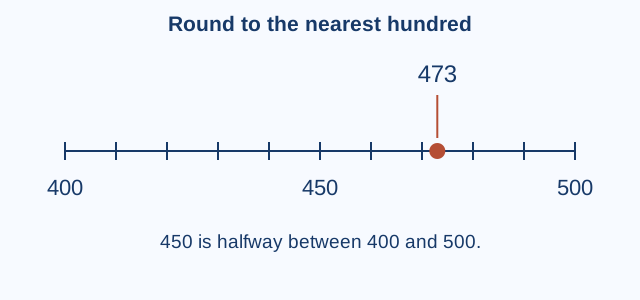
Teacher asks: “How much detail is useful for a stadium crowd, a class count or a shopping budget?” Students state their chosen place and why it serves the question. Then round 3 426 to tens and hundreds and explain both results: 3 430 and 3 400.
Look for: the stated purpose and a consistent rounding method. If students always choose the same place, compare how much detail a small budget and a large crowd require.
2. Estimate, calculate and question the conclusion
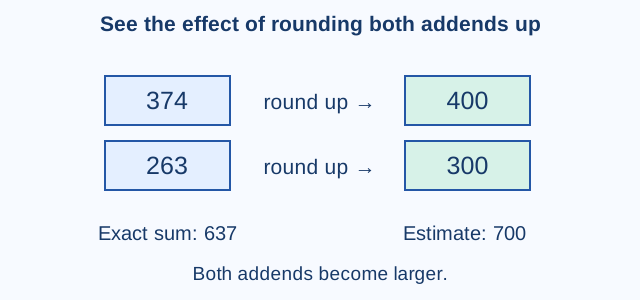
Estimate 2 684 + 1 937 with 2 700 + 1 900 = 4 600, then calculate the exact 4 621. Explain why the size is sensible. Next show 3 480 + 3 398 = 6 912 as a proposed answer: a 6 900 estimate makes its size plausible, but the exact sum is 6 878.
Look for: students distinguishing a size check from exact proof. If they accept every nearby answer, ask for exact addition or an inverse check.
3. Plan and test a shopping budget
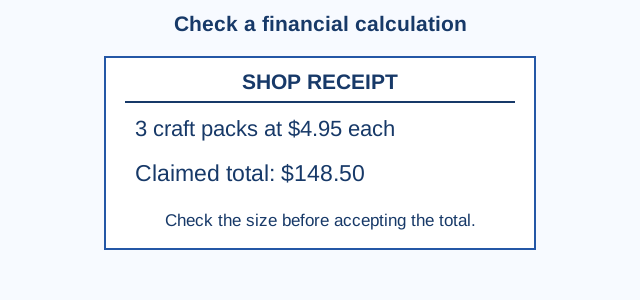
Use one item at $12.60 and two at $7.75. An upward estimate is $13 + 2 × $8 = $29. The exact total is $28.10. Students explain why $29 covers these items, and why rounding the exact $28.10 total to the nearest dollar, $28, would not provide enough.
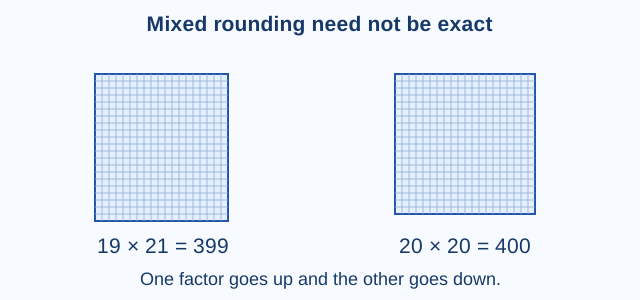
Then compare 11 × 21 = 231 with estimates 200, 400 and 600. Ask students to show which is closest and explain why mixed rounding is not always the best choice.
Look for: every quantity retained, rounding direction checked and numerical distance used when comparing methods.
Key vocabulary
- estimate
- a useful approximate value chosen for a purpose
- round to nearest
- use the nearest value at a stated place; halfway values round upward in this lesson
- round upward
- replace a value with the smallest whole dollar or stated multiple that is at least as large, leaving an exact multiple unchanged
- compatible numbers
- nearby numbers that make a calculation easy, such as 240 ÷ 6
- lower and upper bounds
- amounts known to be below and above the actual result
- reasonable
- of a sensible size for the numbers and context; this does not prove every digit is correct
Common misconceptions
- Always round to the same place: choose precision for the purpose, or follow the place stated in the question.
- Nearest and upward mean the same: $7.35 rounds to $7 at the nearest dollar, but upward to $8.
- Reasonable means exactly correct: an estimate can reject a wrong-sized answer, but a nearby answer still needs an exact check.
- An estimate cannot equal an exact answer: 244 + 356 = 600 and its hundreds estimate is also 600. Equality can happen.
- Mixed rounding always cancels or is closest: compare the actual changes for addition and the actual candidate errors for multiplication.
- An upper estimate over budget proves the exact bill is over budget: the exact amount can be lower. Calculate it when the decision is close.
- Rounding price up is enough even after reducing the quantity: keep every required item or ticket in a protective budget.
Support, Core and Extend
- Support: use number lines, small whole-dollar price bounds and repeated-group models. Say “more than” and “less than” before introducing written inequality symbols.
- Core: choose nearest, upward or compatible-number estimates; explain all three rounding directions for sums and products; check bills, change and budgets.
- Extend: compare different candidate errors, create a counterexample to “mixed is always closest”, or explain why rounding before and after addition can differ. Stay within whole-number estimates and familiar dollar/cents amounts.
Quick check and feedback
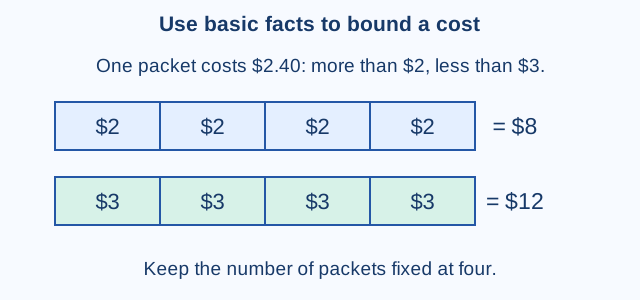
- Bound six $4.30 meals. More than 6 × $4 = $24 and less than 6 × $5 = $30. Reteach preserving the count if only one meal is bounded.
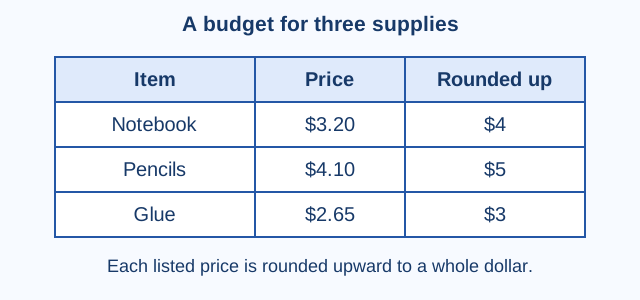
- Choose an upward budget for $8.20, $6.10 and $4.65. $9 + $7 + $5 = $21; every price was rounded upward.
- Can mixed rounding be exact for a sum? Yes: 246 + 354 = 200 + 400 = 600, because −46 and +46 cancel.
- Is mixed rounding always closest for a product? No: for 12 × 21 = 252, 200 is closer than mixed 400 or upper 600.
- Estimate 547 ÷ 9. 540 ÷ 9 = 60 gives an answer near 60, so 610 is not reasonable.
Mastery evidence: state a useful approximation, apply it correctly and explain the conclusion with its limits. If only a rounded answer is given, ask why that method fits the purpose and whether an exact check is still needed.