Year 4 Mathematics · AC9M4N06

Efficient strategies for the four operations

develop efficient strategies and use appropriate digital tools for solving problems involving addition and subtraction, and multiplication and division where there is no remainder

Ready to project and teach

Learning goalsSay it simply

Efficiency means choosing a method that is accurate, understandable and well suited to the numbers and context. Mental strategies, written methods and digital tools each have appropriate uses.

Learning routine: Estimate → Analyse numbers → Choose strategy or tool → Solve → Check → Explain.

Success looks like

  • Choose and explain a useful strategy for each of the four operations.
  • Use place value, compatible numbers, jumps, inverse facts and regrouping accurately.
  • Connect arrays and bars to the number of groups, amount in each group and total.
  • Use a calculator or spreadsheet for a suitable purpose, check the entry and interpret the result.

Materials: counters, squared paper, a number line, and access to a calculator or spreadsheet for the digital task. Work with whole numbers, nonnegative differences and division with no remainder.

Clean visual examplesModels and worked thinking
AC9M4N06 — Models and worked thinking
Example 1

Choose a friendly addition or subtraction

CalculationCompensationWhy the adjustment works
2 998 + 4673 000 + 467 − 2 = 3 465Increasing the first addend by 2 makes the sum 2 too large.
4 872 − 1 9964 872 − 2 000 + 4 = 2 876Subtracting 2 000 removes 4 too many, so return 4.
  1. Notice how close the number is to a round thousand.
  2. Record the changed calculation and the compensating adjustment.
  3. Check by another method: 2 998 + 400 + 60 + 7 = 3 465; 2 876 + 1 996 = 4 872.

Compensation is especially useful here, but another correct strategy may be clearer for a different learner. A method must preserve the original calculation.

Example 2

Partition, bridge and count the distance

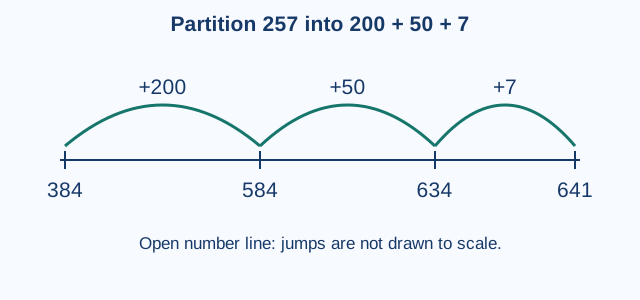
An open number line shows 384, then a jump of 200 to 584, 50 to 634 and 7 to 641. Jumps are not to scale.
384 + 257 = 641 because all three parts of 257 are added.
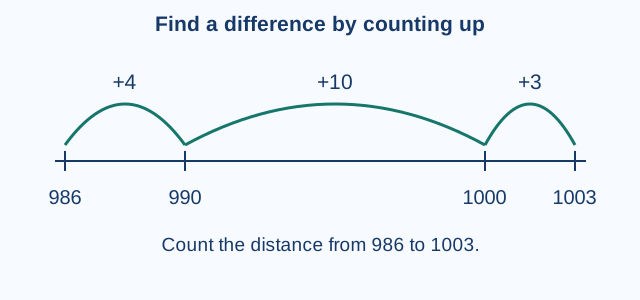
A proportional number line has forward jumps from 986 to 990 by 4, to 1000 by 10 and to 1003 by 3.
1 003 − 986 = 4 + 10 + 3 = 17. Counting up is useful when numbers are close.

Bridge a hundred: for 597 + 86, use 3 to reach 600, leaving 83 to add. The result is 683.

Compatible numbers: 1 250 + 375 + 750 = (1 250 + 750) + 375 = 2 375. Reordering the addends does not change their total.

Example 3

Explain the regrouping in a written method

PlaceThousandsHundredsTensOnes
First addend4786
Second addend2357
Work from the right4 + 2 + 1 = 7 thousands7 + 3 + 1 = 11 hundreds8 + 5 + 1 = 14 tens13 ones

Keep the place-value columns in the usual order and start working at the right, in the ones column.

In 4 786 + 2 357, 13 ones become 1 ten and 3 ones. The 14 tens become 1 hundred and 4 tens. The 11 hundreds become 1 thousand and 1 hundred. Record 7 143.

Subtract across zeros: 4 002 − 1 758 = 2 244. One place-value regrouping is 3 thousands, 9 hundreds, 9 tens and 12 ones. Remove 1 thousand, 7 hundreds, 5 tens and 8 ones, leaving 2 thousands, 2 hundreds, 4 tens and 4 ones. Check 2 244 + 1 758 = 4 002.

Example 4

Double one factor and halve the other

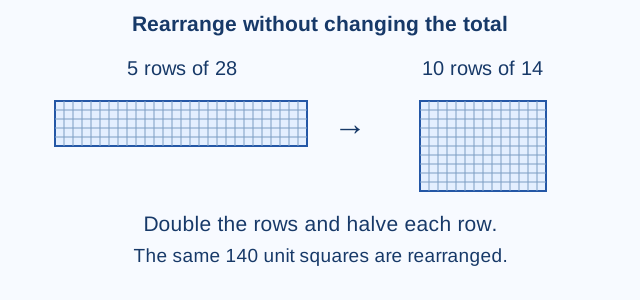
Five rows of 28 unit squares are rearranged into ten rows of 14; both arrays contain 140 squares.
5 × 28 = 10 × 14 = 140. The arrangement changes, but no square is added or lost.

Teacher asks: “What happens to the number of groups? What happens to each group?” Students explain that twice as many groups, each half the size, keep the same total.

For 25 × 16, double 25 and halve 16: 50 × 8 = 400. Another useful method is double, double: 38 × 4 gives 76, then 152. Doubling both factors would make a product four times as large; it would not preserve it.

Example 5

Connect the model to every number in a sentence

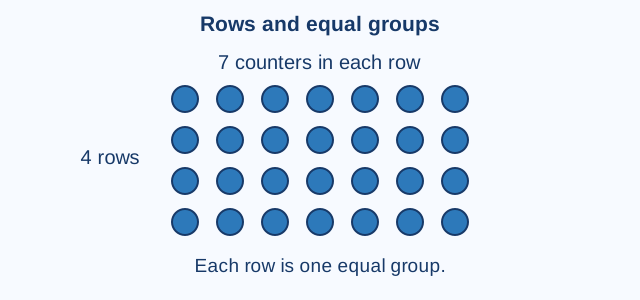
Four equal rows each contain seven counters.
4 × 7 = 28: four rows, seven counters in each row, twenty-eight counters altogether.
Missing quantitySituationSentence and meaning
Total9 trays with 8 buns on each9 × 8 = 72 buns altogether
Number of groups36 beads; 6 beads per bracelet36 ÷ 6 = 6 bracelets
Amount in each group48 cards shared equally into 4 piles48 ÷ 4 = 12 cards per pile
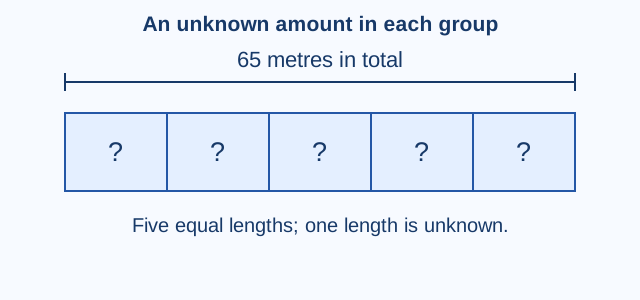
A 65-metre bar is divided into five equal parts with each part marked unknown.
65 ÷ 5 = 13 metres in each part; 5 × 13 = 65 checks the total.

Say the unit with each number. A quotient may count groups or the amount in one group, depending on what the divisor represents.

Example 6

Partition a multiplication region

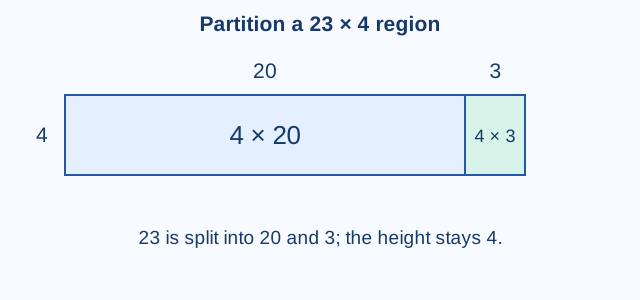
A region of height four has widths twenty and three, showing the partial products four times twenty and four times three.
23 × 4 = 20 × 4 + 3 × 4 = 80 + 12 = 92.

Every part must be multiplied by the same other factor. For the larger retained example, 36 × 24 = 36 × 20 + 36 × 4 = 720 + 144 = 864. The 24 equal groups are split into twenty groups and four groups.

Check: 32 × 3 is 90 + 6 = 96, not 90 + 2. The two ones also occur three times.

Example 7

Use equal shares and inverse facts for exact division

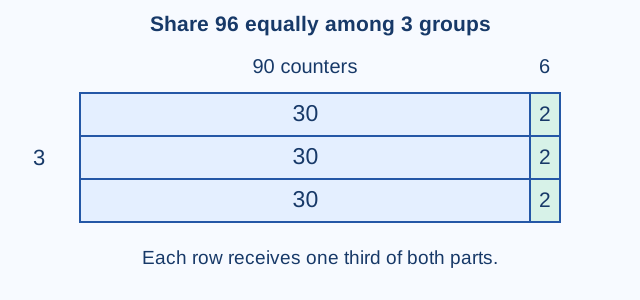
Ninety-six counters are split into ninety and six, then shared in three rows. Each row receives thirty and two.
96 ÷ 3 = 90 ÷ 3 + 6 ÷ 3 = 30 + 2 = 32 in each group.

For 936 ÷ 8, use 800 + 136: 800 ÷ 8 = 100 and 136 ÷ 8 = 17. Together, each share is 117. Check 117 × 8 = 936, so there is no remainder.

Repeated halving is useful for 96 ÷ 8: 96 → 48 → 24 → 12, because 8 = 2 × 2 × 2. In contrast, dividing by 3 and then by 2 solves division by 6. The divisor must be nonzero.

Example 8

Use a digital tool with a clear purpose

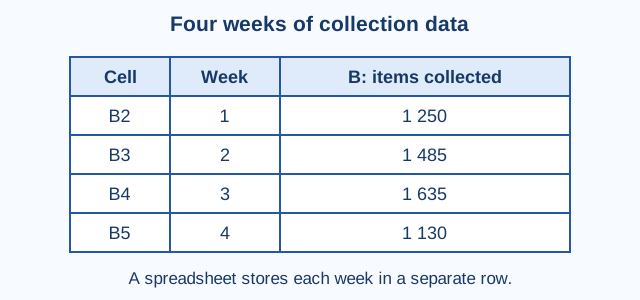
Column B has weekly collection values: B2 1250, B3 1485, B4 1635 and B5 1130.
Enter the four counts in B2:B5, then put =SUM(B2:B5) in B6, outside the data range. The total is 5 500.
  1. Identify the needed operation: combine the weekly counts by addition.
  2. Enter each amount once in B2:B5, put the sum formula in B6, and inspect the range B2:B5. Keeping the formula outside the input range avoids replacing an entry or including the total in its own sum. A spreadsheet is useful when entries will change or the list is long.
  3. Check independently: (1 250 + 1 130) + (1 485 + 1 635) = 2 380 + 3 120 = 5 500.
  4. If B5 increases by 100, the displayed total should increase to 5 600. A formula is useful only when the entries and range are correct.

A nursery shares 3 276 seedlings equally among 7 garden beds. A calculator gives 3 276 ÷ 7 = 468 seedlings per bed. Verify 468 × 7 = 3 276 and keep the unit with the answer. For 49 + 51, mental pairing gives 100 without needing a tool.

Curriculum examplesAll required components

Content description: develop efficient strategies and use appropriate digital tools for solving problems involving addition and subtraction, and multiplication and division where there is no remainder

  • E1: choose efficient larger-number addition and subtraction methods: partitioning, inverse relationships, compatible numbers, jumps, bridging, written algorithms and digital tools. Models 1–3 and 8 show and check these choices.
  • E2: demonstrate doubling/halving and regrouping factors with materials. Model 4 rearranges 5 × 28 as 10 × 14 and explains the unchanged total.
  • E3: connect array rows and columns with groups and multiplication sentences. Model 5 labels four rows, seven per row and the total.
  • E4: use a model to solve a product or exact division and explain each number. Model 5 distinguishes trays, buns, beads, bracelets, cards and piles.
  • E5: use arrays or bars when the total, number of groups or amount in each is missing. Model 5 teaches all three roles and an unknown equal length.
  • E6: use place-value partitions, basic facts and regions for products, including double-double. Models 4 and 6 connect the parts to the complete calculation.
  • E7: explain division with materials, equal thirds and inverse multiplication. Model 7 splits 96 into shareable parts and checks 936 ÷ 8.
Questions and answersWith exact answers

Core idea: A good strategy preserves the calculation, fits the numbers and can be explained and checked.

Important questions

  1. Choose a strategy for 1 999 + 586. Compensation gives 2 000 + 586 − 1 = 2 585. A checked partition or written method is also acceptable.
  2. Solve 36 × 24 by partitioning. 36 × 20 + 36 × 4 = 720 + 144 = 864.
  3. Check 936 ÷ 8 with multiplication. 117 × 8 = 936, so the quotient is 117 and no amount is left over.
  4. When is a spreadsheet appropriate? It can sum a long or changing list, provided the data and range are checked. In the weekly example, =SUM(B2:B5) gives 5 500.
  5. Compare mental and written methods. 49 + 51 is easy mentally because it makes 100; 4 786 + 2 357 may benefit from a written record of several regroupings. Either chosen method must be accurate and explainable.
Practice and reviewObserve the reasoning

Guided learning activities

1. Compare two accurate strategies

Teacher asks: “Solve 1 999 + 586 in two ways. Which method feels easier to check?” Students record compensation, 2 000 + 586 − 1 = 2 585, and a partition or written method giving the same total.

Look for: a justified choice, not a claim that one method is always fastest. If the answer is 2 587, return to the extra 1 and reverse that change.

2. Build the missing quantity

Give pairs 42 counters. First ask for 6 equal groups: each group has 7. Next ask for groups of 7: there are 6 groups. Students draw both models and label 42 ÷ 6 = 7 and 42 ÷ 7 = 6.

Look for: the quotient changing its meaning. If students swap labels, ask what the divisor counts before calculating.

3. Try and check a digital tool

Enter the four weekly values from Model 8 into cells B2:B5 and put =SUM(B2:B5) in cell B6 to calculate their sum. Change B5 from 1 130 to 1 230; the total changes from 5 500 to 5 600. If a spreadsheet is unavailable, use a calculator and keep the written list.

Look for: every entry included once, the expected 100 increase and an independent check. Recheck the cell range if changing a listed value does not change the total.

Key vocabulary

strategy
a chosen method that fits the numbers and can be explained
partition
split a number into useful parts without changing its value
compensate
make a calculation friendlier, then adjust for the change
inverse
an operation that undoes another: addition and subtraction, or multiplication and exact division
array
objects arranged in equal rows and columns
quotient
the result of division; its meaning depends on what is missing in the story
digital tool
a calculator or spreadsheet used to calculate, organise or check a suitable task

Common misconceptions

  • Use one method for every problem: inspect the numbers and the purpose before choosing.
  • Undo compensation in the wrong direction: write down the extra amount added or removed, then correct it.
  • Subtract the smaller digit from the larger digit: preserve which whole amount is being removed; regroup if needed.
  • Multiply only the tens: every partitioned part must be included.
  • Double both factors to preserve a product: this quadruples the product; double one and halve the other instead.
  • A quotient always counts groups: label the story; it can instead give the amount in each group.
  • Accept a digital display without checking: check entries, operation, scale and units.
  • Efficiency is only speed: reliability and a clear explanation matter too.

Support, Core and Extend

  • Support: use smaller numbers, counters and labelled equal-group bars. Say what each number counts before recording a sentence.
  • Core: use larger addends and differences, partitioned products and exact divisions; explain a strategy and an inverse check. Complete the spreadsheet or calculator task.
  • Extend: compare two valid methods on the same whole-number problem, predict how a data correction changes a formula total, or explain why a proposed compensation is wrong. Keep division exact and avoid negative results.

Quick check and feedback

  1. Estimate, then solve 398 + 206. About 600; exactly 604 using 400 + 206 − 2.
  2. What is 1 002 − 995? 7; count 5 to 1 000 and 2 more. If the difference is large, revisit distance on a number line.
  3. Which strategy suits 25 × 16? 25 × 4 × 4 = 100 × 4 = 400, or 50 × 8 = 400 with doubling and halving.
  4. Explain 84 ÷ 7 = 12 in a bead story. 84 beads in groups of 7 make 12 groups. Check 12 × 7 = 84.
  5. What must be checked before accepting a spreadsheet sum? The actual values, included cell range, required operation and reasonable size of the result.

Mastery evidence: select, use and justify methods across all four operations; label model quantities; complete an appropriate digital calculation and check it independently. Reteach the specific model or transformation if only an unsupported answer is given.
Curriculum alignmentOfficial references
Teach & ExplainTeaching slides and samples

Teach this topic step by step

Explore optional teaching slide packs for classroom lessons and explanations at home.

Browse Teach & Explain · Browse Print & Go

Teachers: follow SkillrHub on TPT, then email us to request a free sample before buying. Include the year, subject and topic or curriculum code.

Request a free sample

After trying the sample, honest feedback is welcome. A TPT review is optional, where available, and does not need to be positive.