The exact Australian Curriculum v9.0 content description and its four elaborations are listed below. The worked models and activities put each relationship into practice.
- Content description: find unknown values in numerical equations involving addition and subtraction, using the properties of numbers and operations
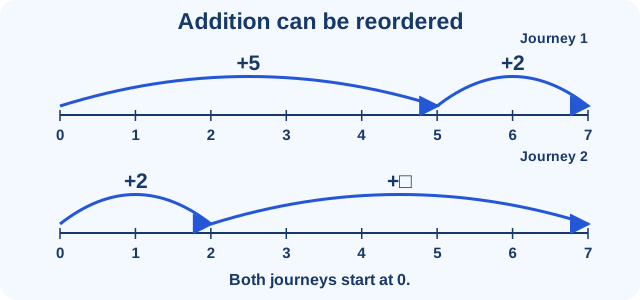
- E1: demonstrating the commutative properties of addition using materials, diagrams and number lines; for example, using number lines to demonstrate that 5 + 2 = 2 + 5, demonstrating that 2 + 2 + 3 = 7 and 2 + 3 + 2 = 7 and 3 + 2 + 2 = 7
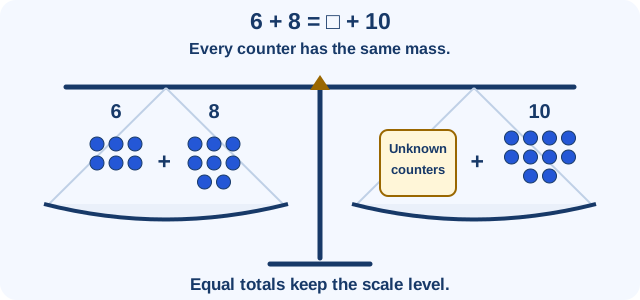
- E2: using balance scales and informal uniform units to create addition or subtraction number sentences showing equivalence, such as 7 + 8 = 6 + 9, and to find unknowns in equivalent number sentences, such as 6 + 8 = □ + 10
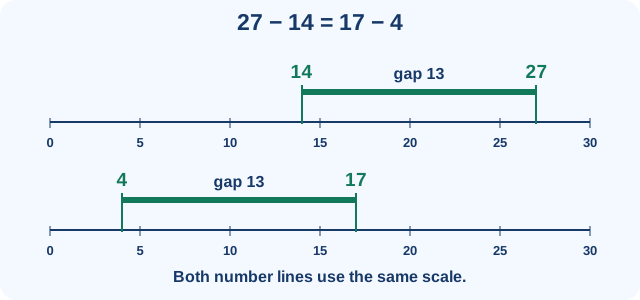
- E3: using relational thinking and knowledge of equivalent number sentences to explain whether equations involving addition or subtraction are true; for example, explaining that 27 − 14 = 17 − 4 is true and using a number line to show the common difference is 13
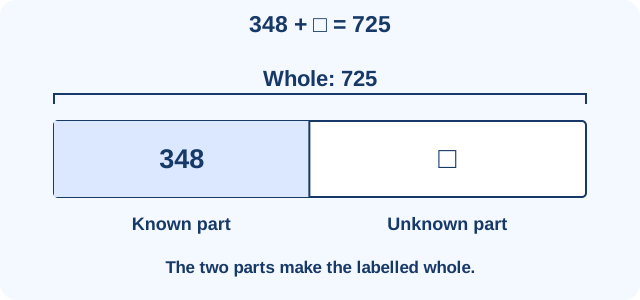
- E4: using part-part-whole diagrams or bar models to recognise and explain the inverse relationship between addition and subtraction, using this to make calculations easier; for example, solving 27 + □ = 63 using subtraction, □ = 63 − 27
1. Build and rearrange
Make groups of 2, 2 and 3 equal counters. Rearrange them into three orders and write an equation for each. Draw jumps of 5 then 2 and 2 then 5 from 0 on matching number lines.
Discuss: 2 + 2 + 3 = 7, 2 + 3 + 2 = 7 and 3 + 2 + 2 = 7. The two number-line journeys both end at 7. The groups or jumps are unchanged; only their order changes.
2. Create and preserve a balance
Use a balance scale and counters of equal mass to represent 7 + 8 = 6 + 9. Remove 3 counters from each side. Write the new equation and explain why it stays balanced. Then model 6 + 8 = □ + 10.
Discuss: The first totals are both 15. One valid choice removes 3 from the group of 8 and 3 from the group of 9, giving 7 + 5 = 6 + 6, with both totals 12. Other group choices are valid if exactly 3 counters are removed from each side. In the unknown equation, the missing group is 4 because 6 + 8 = 4 + 10.
3. Compare matching gaps
On number lines using the same scale, mark the intervals from 14 to 27 and from 4 to 17. Explain why 27 − 14 = 17 − 4 is true. Predict the difference between 24 and 37 without recounting each step.
Discuss: both original gaps are 13. Moving 14 and 27 up by 10 gives 24 and 37, so that gap is also 13.
4. Choose and check a strategy
Solve 27 + □ + 73 = 160 by grouping. Then test the proposed values 72 and 82 in 48 + □ = 120. Draw a bar to explain the successful value.
Discuss: 27 + 73 = 100, so the first box is 60. For the second equation, 48 + 72 = 120 is true but 48 + 82 = 130 is not. A whole of 120 has parts 48 and 72.