An equation states that two expressions have the same value. Solving means finding a value that preserves equality.
Learning routine: Read both sides → Identify the unknown’s role → Use a number relationship → Replace the box and check.
Success looks like
I can find an unknown addend, starting amount, removed amount or result.
I can explain why both sides of an equation have equal value, including when both sides show calculations.
I can reorder and group addition, use a common difference, or use an inverse operation to calculate efficiently.
I can show my reasoning with equal counters, a number line or a part-part-whole bar, then check the original equation.
Key vocabulary
equation
a statement that two expressions have equal value
expression
a number or calculation, such as 170 or 80 + 90
unknown
a value to find; a box marks its place in an equation
addend and sum
an addend is a part being added; the sum is the total
minuend and subtrahend
the minuend is the starting amount in a subtraction; the subtrahend is the amount removed
difference
the result of subtraction, also shown as the gap between two numbers
inverse operations
operations that undo each other; addition and subtraction connect the same whole and parts
commutative property of addition
changing the order of the addends preserves their sum
grouping addition
combining the same addends in a different grouping preserves their sum
Concept models and worked thinking
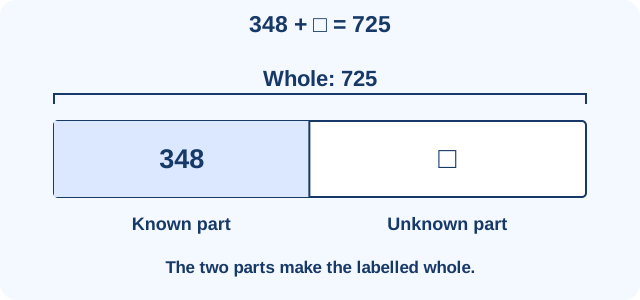
1. Solve 348 + □ = 725 using a part-part-whole bar
The box labels a part of the whole, not the whole itself.
Identify 725 as the whole and 348 as one part.
Find the other part: 725 − 348 = 377. One way is 725 − 300 − 48 = 425 − 48 = 377.
Replace the box and check: 348 + 377 = 725.
Addition combines the parts; subtraction finds a part from the whole. These are inverse operations.
2. Decide which role the unknown has
Equation
Meaning and calculation
Check
□ + 46 = 100
Missing addend: 100 − 46 = 54.
54 + 46 = 100.
□ − 286 = 439
Missing starting amount: put the parts together, 286 + 439 = 725.
725 − 286 = 439.
900 − □ = 347
Missing removed amount: 900 − 347 = 553.
900 − 553 = 347.
□ = 70 − 26
Missing result: 70 − 26 = 44.
44 = 70 − 26.
The equals sign does not mean “the answer comes next”. A result may appear on either side. Decide whether the box is a whole, a part or a result before choosing a calculation.
Zero also has a role: 83 − □ = 83 needs 0 because nothing is removed; □ − 18 = 0 needs 18 because the whole starting amount is removed.
3. Reorder and group addition to make useful pairs
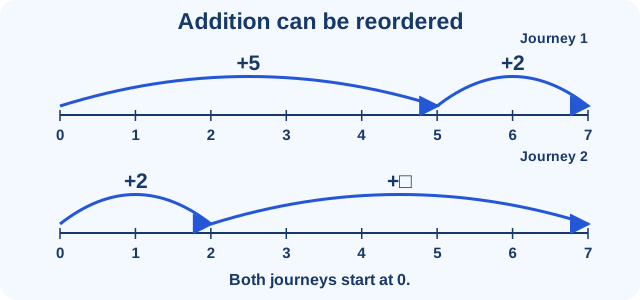
The missing jump is 5: 5 + 2 = 2 + 5. The order changes; the total does not.
With three groups of counters, 2 + 2 + 3, 2 + 3 + 2 and 3 + 2 + 2 all total 7. Rearranging the groups does not add or remove counters.
For 38 + □ + 62 = 145, group the known addends first: 38 + 62 = 100. Then 100 + □ = 145, so □ = 45. Check: 38 + 45 + 62 = 145.
Subtraction is different: the starting amount and the amount removed have different roles. Reordering addition does not give permission to swap the numbers in a subtraction.
4. Keep both sides balanced
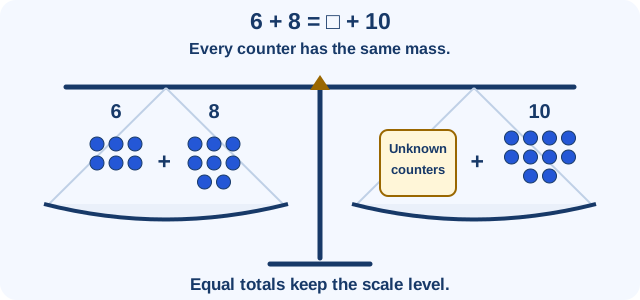
Each counter is the same informal unit of mass. Equal masses correspond to equal total numbers of these counters.
The left pan has 6 + 8 = 14 counters. The right pan needs 4 more alongside its 10: □ = 14 − 10 = 4. Check: 6 + 8 = 4 + 10.
For 125 + □ = 80 + 90, first find the known side: 80 + 90 = 170. The missing addend is 170 − 125 = 45. Check: 125 + 45 and 80 + 90 both equal 170.
Equal changes to both sides preserve equality. Starting with 7 + 8 = 6 + 9, remove 3 equal counters from each pan. If they come from the group of 8 and the group of 9, one valid result is 7 + 5 = 6 + 6, with both sides equal to 12. Other group choices can also preserve equality.
5. Compare differences without starting again
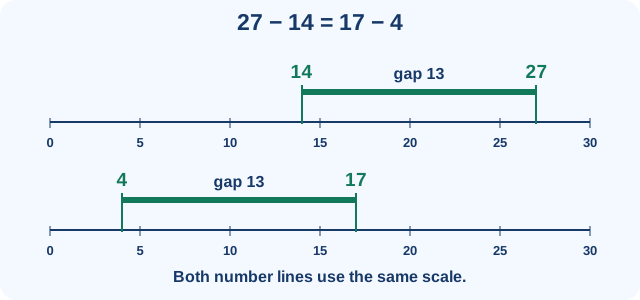
The second interval is the first shifted 10 places left. Its length is unchanged.
27 − 14 = 17 − 4 is true. Subtracting 10 from both numbers shifts both endpoints equally, so the common difference stays 13.
This can make calculations easier: 74 − 38 = 76 − 40 = 36. Adding 2 to both numbers preserves their difference. Changing just one number does not generally preserve it: 27 − 14 = 13, but 27 − 4 = 23.
For sums, a different balancing change is useful: 31 + 19 = 30 + 20 because one addend decreases by 1 while the other increases by 1. Both sums equal 50.
6. Use counting on as an inverse strategy
For 27 + □ = 63, find the distance from 27 to 63.
27 → 30: +3→30 → 60: +30→60 → 63: +3
The total increase is 3 + 30 + 3 = 36. This is the same missing part found by 63 − 27 = 36. Check: 27 + 36 = 63.
Explain the connection: adding the missing part reaches the whole; subtracting the known part from the whole leaves the missing part.
Curriculum coverage and elaborations
The exact Australian Curriculum v9.0 content description and its four elaborations are listed below. The worked models and activities put each relationship into practice.
Content description: find unknown values in numerical equations involving addition and subtraction, using the properties of numbers and operations
E1: demonstrating the commutative properties of addition using materials, diagrams and number lines; for example, using number lines to demonstrate that 5 + 2 = 2 + 5, demonstrating that 2 + 2 + 3 = 7 and 2 + 3 + 2 = 7 and 3 + 2 + 2 = 7
E2: using balance scales and informal uniform units to create addition or subtraction number sentences showing equivalence, such as 7 + 8 = 6 + 9, and to find unknowns in equivalent number sentences, such as 6 + 8 = □ + 10
E3: using relational thinking and knowledge of equivalent number sentences to explain whether equations involving addition or subtraction are true; for example, explaining that 27 − 14 = 17 − 4 is true and using a number line to show the common difference is 13
E4: using part-part-whole diagrams or bar models to recognise and explain the inverse relationship between addition and subtraction, using this to make calculations easier; for example, solving 27 + □ = 63 using subtraction, □ = 63 − 27
Guided learning activities
1. Build and rearrange
Make groups of 2, 2 and 3 equal counters. Rearrange them into three orders and write an equation for each. Draw jumps of 5 then 2 and 2 then 5 from 0 on matching number lines.
Discuss: 2 + 2 + 3 = 7, 2 + 3 + 2 = 7 and 3 + 2 + 2 = 7. The two number-line journeys both end at 7. The groups or jumps are unchanged; only their order changes.
2. Create and preserve a balance
Use a balance scale and counters of equal mass to represent 7 + 8 = 6 + 9. Remove 3 counters from each side. Write the new equation and explain why it stays balanced. Then model 6 + 8 = □ + 10.
Discuss: The first totals are both 15. One valid choice removes 3 from the group of 8 and 3 from the group of 9, giving 7 + 5 = 6 + 6, with both totals 12. Other group choices are valid if exactly 3 counters are removed from each side. In the unknown equation, the missing group is 4 because 6 + 8 = 4 + 10.
3. Compare matching gaps
On number lines using the same scale, mark the intervals from 14 to 27 and from 4 to 17. Explain why 27 − 14 = 17 − 4 is true. Predict the difference between 24 and 37 without recounting each step.
Discuss: both original gaps are 13. Moving 14 and 27 up by 10 gives 24 and 37, so that gap is also 13.
4. Choose and check a strategy
Solve 27 + □ + 73 = 160 by grouping. Then test the proposed values 72 and 82 in 48 + □ = 120. Draw a bar to explain the successful value.
Discuss: 27 + 73 = 100, so the first box is 60. For the second equation, 48 + 72 = 120 is true but 48 + 82 = 130 is not. A whole of 120 has parts 48 and 72.
Revision Notes
Core idea: both sides of an equation must have the same value. Find the role of the unknown, choose a useful number relationship, then replace the box and check.
Important questions
What does the equals sign mean? The expressions on its two sides have equal value. In 25 = 18 + 7, both sides are 25.
Solve 348 + □ = 725. The missing part is 725 − 348 = 377. Check: 348 + 377 = 725.
Solve 900 − □ = 347. The removed part is 900 − 347 = 553. Check: 900 − 553 = 347.
Use grouping in 38 + □ + 62 = 145. 38 + 62 = 100, leaving 45 for the missing addend.
Solve 125 + □ = 80 + 90. The known total is 170, so the missing addend is 45.
Why is 27 − 14 = 17 − 4 true? Both endpoints decrease by 10, preserving the difference of 13.
Why is 83 − □ = 83 solved by 0? The amount has not changed, so nothing was removed.
Assessment, support and extension
Quick exit check
Find the box in □ − 24 = 58. Explain its role.
Complete 47 + 26 = 50 + □ without first finding the entire sum.
Explain why 43 − 18 = 48 − 23 is true.
Expected responses: 82 is the starting whole because 24 + 58 = 82; the missing addend is 23 because increasing 47 by 3 requires decreasing 26 by 3; the last equation is true because both subtraction numbers increase by 5, preserving the difference of 25.
Support and extension
Support: start with whole numbers below 20 and real equal counters. Label whole and parts before recording an equation. Move the result to the other side and ask whether its meaning changes.
Extension within this code: give two different whole-number values that make □ + 18 = 18 + □ true when the same value fills both boxes. For example, 5 and 42 both work. Explain why any shared whole-number value works using the commutative property of addition.
How to use this unit
Teach with the Topic Guide and Classroom View, then use Homework, Practice and Test. The worksheet asks for written working and models; Practice gives feedback, and Test checks independent application.
AC9M4A01 Classroom View
Teacher resource
Project the Classroom View and expand each section as you teach.
“The equals sign tells me an answer comes next.” It states equal value. Read and compare the complete expressions on both sides.
“Always subtract to find the box.” In □ − 35 = 62, the unknown is the starting whole, so add 35 + 62 = 97. In 97 − □ = 62, the unknown is the removed part, so calculate 97 − 62 = 35.
“Subtraction can be reordered like addition.” The starting amount and removed amount have different roles. The commutative property of addition does not apply to subtraction.
“Any change preserves an equation.” Check the relationship. For a constant difference, change both subtraction numbers by the same amount; for an unchanged sum, an increase in one addend must be balanced by an equal decrease in the other.
“Finding a number finishes the work.” Put it into the original box and evaluate both sides. A check must keep the original operations and order.
International curriculum mapping
This table gives closest-topic mapping for search and planning. The Australian Curriculum code is exact; overseas entries are broad equivalents because each jurisdiction structures outcomes differently.
Region
Curriculum
Closest mapping
Australia
Australian Curriculum v9.0
AC9M4A01 — find unknown values in numerical equations involving addition and subtraction, using the properties of numbers and operations
Victoria
Victorian Curriculum F-10
Year 4 Maths: closest match in Algebra. Use this page as a VIC-aligned practice and worksheet reference.
NSW
NSW Curriculum
Stage 2 Maths: closest content focus for Find unknown values in numerical equations involving addition and subtraction, using the properties of numbers and operations and related outcomes.
United States
Common Core Mathematics
Grade 4 Common Core Mathematics closest topic match for Find unknown values in numerical equations involving addition and subtraction, using the properties of numbers and operations.
England / UK
National Curriculum
Key Stage 2 / Year 4: closest programme-of-study match for Find unknown values in numerical equations involving addition and subtraction, using the properties of numbers and operations.
Canada
Provincial and territory curricula
Grade 4 closest topic match. Canada varies by province, so use this as a broad Ontario/BC-style learning outcome reference.
New Zealand
New Zealand Curriculum
Level 2 Maths: closest achievement-objective topic for Find unknown values in numerical equations involving addition and subtraction, using the properties of numbers and operations.
India
NCERT / CBSE
Class 4 closest NCERT/CBSE topic match for Find unknown values in numerical equations involving addition and subtraction, using the properties of numbers and operations.
🎥 Optional Video Lesson
The SkillrHub lesson remains the primary learning resource. This optional video reinforces the explanation; you can complete the lesson and practice without watching.
Recommended: Missing number for addition and subtraction within 1000 | 3rd grade | Khan Academy
Khan Academy — Use the relationship between addition and subtraction to find a missing value.
As you watch: Which inverse operation helps you find the unknown?
Load video playerLoads YouTube in this lesson. See the video notice below.
Try it: Solve 620 − □ = 285, then substitute your answer to check the equation.
Video unavailable, inaccurate or unsuitable for this year? Report a video problem to SkillrHub by email. You can continue with the written lesson and practice resources.
About these videos
Videos are curated from trusted independent educational creators and played through YouTube. Rights remain with their respective owners. Inclusion does not imply that a creator or YouTube endorses SkillrHub.
YouTube’s terms and privacy policy apply to its player. Advertising, recommendations and external links may appear, and videos may change or become unavailable. SkillrHub’s written lessons and practice resources remain available separately.
To report a content, suitability or rights concern, email skillrhublearning@gmail.com with the lesson code and video link. Please do not include personal student information.
Curriculum equivalents: Victoria, NSW and international
Curriculum equivalents for Find unknown values in numerical equations involving addition and subtraction...
Mapped skill: find unknown values in numerical equations involving addition and subtraction, using the properties of numbers and operations
These references identify matching or closely related learning. Curriculum sequence, terminology and depth vary, so teachers should use the mapped skill and lesson difficulty to confirm suitability.
Australian Curriculum v9.0 is the canonical source for this SkillrHub lesson. Victoria and NSW entries name the closest published state codes or outcomes; international entries are planning references rather than claims of identical curricula.
Help improve SkillrHub
Questions or feedback?
Ask about this lesson, suggest an improvement or report an error. Facebook opens only when you choose an option below.
Topic reference: AC9M4A01 — AC9M4A01: Find unknown values in numerical equations involving addition and subtraction, using the properties of numbers and operations