AC9M4SP03: Recognise line and rotational symmetry of shapes and create symmetrical patterns and pictures, using dynamic geometric software where appropriate
recognise line and rotational symmetry of shapes and create symmetrical patterns and pictures, using dynamic geometric software where appropriate
Line symmetry occurs when reflection across an axis maps a figure onto itself. Rotational symmetry occurs when a turn less than 360° maps the figure onto itself; rotational order counts matching positions in one full turn.
Learning routine: Identify possible transformation → Test reflection/rotation → Check exact match → Count axes/order → Create and verify
Success looks like
Test line symmetry
Count axes
Test rotational symmetry
Determine order
Create and verify patterns
Key vocabulary
line symmetry
matching halves across a reflection line
rotational symmetry
matching after a turn less than one full turn
order
the number of matching positions in one full turn
Concept models and worked thinking
Test line and rotational symmetry
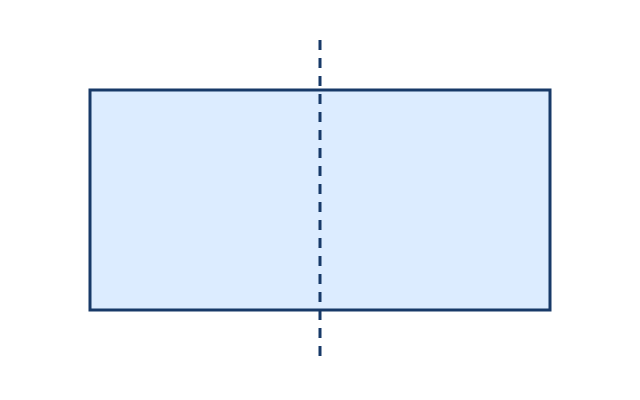
This plain rectangle has two reflection lines and a half-turn match.
A visual guess is not enough. Fold, trace, reflect or rotate to test whether every point maps to a matching point.
Identify the labels, quantities or evidence shown.
Explain the relationship represented by the model.
Check that the conclusion answers the original question.
Compare symmetry properties of familiar shapes
ShapeLines of symmetryRotational ordersquare44rectangle (not square)22equilateral triangle33kite that is not a rhombus11parallelogram (neither rectangle nor rhombus)02
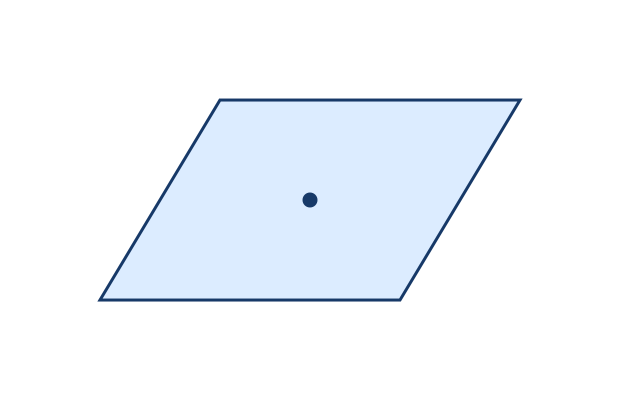
Line symmetry and rotational symmetry are different properties. A parallelogram may have rotational symmetry without any line symmetry.
Transfer the relationship to the new situation and justify the result using precise vocabulary and evidence.
Curriculum coverage and elaborations
The content description and elaborations below show the curriculum ideas taught in this unit. Items marked as teaching context support lesson planning.
Content description: recognise line and rotational symmetry of shapes and create symmetrical patterns and pictures, using dynamic geometric software where appropriate
E1: identifying rotational symmetry of shapes by tracing around various shapes and objects to create an image, and using the image to test and record which different rotations result in the same image
E2: using dynamic geometric software or generative artificial intelligence tool to manipulate shapes and create symmetrical patterns; for example, creating tessellation patterns that are symmetrical and discussing any line or rotational symmetries
E3: using stimulus materials such as the motifs in Central Asian textiles, Tibetan artefacts, Indian lotus designs and Islamic artwork to investigate and discuss line and rotational symmetry
E4: exploring the natural environment on Country/Place to investigate and discuss patterns and symmetry of shapes and objects such as in flowers, plants and landscapes
Guided learning activities
1. Mirror and tracing test
Use mirrors or tracing paper to test proposed lines of symmetry and record counterexamples.
This plain rectangle has two reflection lines and a half-turn match.
2. Rotational order wheel
Rotate shapes through equal fractions of a full turn and count matching positions.
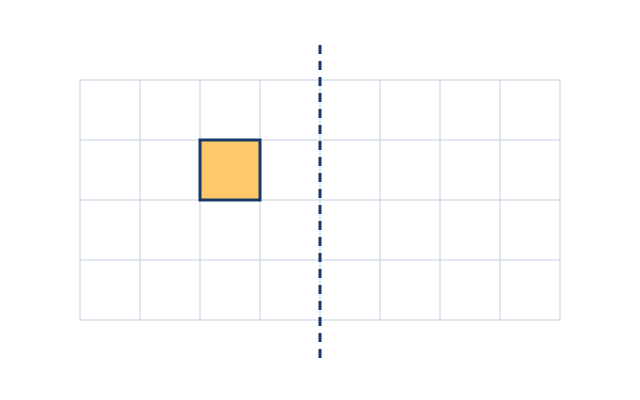
Create a repeated motif using reflection or rotation, then state the transformation and verify invariance.
motifreflectrotate 90°repeatverify overlap
Revision Notes
Core idea: Line symmetry occurs when reflection across an axis maps a figure onto itself. Rotational symmetry occurs when a turn less than 360° maps the figure onto itself; rotational order counts matching positions in one full turn.
Remember
Test line symmetry
Count axes
Test rotational symmetry
Determine order
Create and verify patterns
Important questions
State symmetry of a square. Explain using the model or evidence above.
Does a parallelogram have line symmetry? Explain using the model or evidence above.
Find rotational order of an equilateral triangle. Explain using the model or evidence above.
Explain exact overlap. Explain using the model or evidence above.
Create a reflected motif. Explain using the model or evidence above.
How to use this unit
Read the topic guide and use the teacher slide for instruction. Students can then use the worksheet for written work, open Practice for supported feedback, or take the Test when they are ready.
AC9M4SP03 teacher slide
Teacher resource
Open this fixed classroom slide deck to introduce the key idea, vocabulary and teaching sequence before students begin the activities.
Near match accepted — Symmetry requires exact correspondence.
Every diagonal is an axis — Only lines that map the entire shape onto itself count.
360° counted as the only rotational match — Count matching positions reached after starting through one full turn, including the final full-turn position once; do not count the starting orientation again.
Line and rotational symmetry assumed together — A shape can have one without the other.
International curriculum mapping
This table gives closest-topic mapping for search and planning. The Australian Curriculum code is exact; overseas entries are broad equivalents because each jurisdiction structures outcomes differently.
Region
Curriculum
Closest mapping
Australia
Australian Curriculum v9.0
AC9M4SP03 — recognise line and rotational symmetry of shapes and create symmetrical patterns and pictures, using dynamic geometric software where appropriate
Victoria
Victorian Curriculum F-10
Year 4 Maths: closest match in Space. Use this page as a VIC-aligned practice and worksheet reference.
NSW
NSW Curriculum
Stage 2 Maths: closest content focus for Recognise line and rotational symmetry of shapes and create symmetrical patterns and pictures, using dynamic geometric software where appropriate and related outcomes.
United States
Common Core / NGSS
Grade 4 Common Core Mathematics/ELA closest topic match for Recognise line and rotational symmetry of shapes and create symmetrical patterns and pictures, using dynamic geometric software where appropriate.
England / UK
National Curriculum
Key Stage 2 / Year 4: closest programme-of-study match for Recognise line and rotational symmetry of shapes and create symmetrical patterns and pictures, using dynamic geometric software where appropriate.
Canada
Provincial and territory curricula
Grade 4 closest topic match. Canada varies by province, so use this as a broad Ontario/BC-style learning outcome reference.
New Zealand
New Zealand Curriculum
Level 2 Maths: closest achievement-objective topic for Recognise line and rotational symmetry of shapes and create symmetrical patterns and pictures, using dynamic geometric software where appropriate.
India
NCERT / CBSE
Class 4 closest NCERT/CBSE topic match for Recognise line and rotational symmetry of shapes and create symmetrical patterns and pictures, using dynamic geometric software where appropriate.
Complete learning sequence and evidence
E1: Trace and test actual turns
Trace a plain non-square rectangle, mark its centre and keep the tracing still. Turn the card about the marked centre: quarter-turn fails, half-turn matches, three-quarter-turn fails and full-turn matches. Count the two matches reached after starting; do not count the original position again. A square instead matches at all four quarter-turn steps. Rotational order is optional descriptive language; observing and explaining actual matches is the core evidence.
E2: Create and verify a digital pattern
Use dynamic geometry or drawing software to reflect an original half-picture across a line or rotate identical motifs around a centre. Save the actual design and test its complete coloured arrangement. A tessellation fills the plane without gaps or overlaps, but repetition alone does not prove mirror symmetry. If an adult-supported generative AI tool is used, test its output: misplaced tiles or colours may invalidate its symmetry claim. A paper construction provides access to the concept; the digital task should be completed when an appropriate tool is available.
E3: Investigate a specific attributed motif
With an adult, choose a permitted image from a Central Asian textile, Tibetan artefact, Indian lotus design or Islamic artwork. Record the image source and identify one particular motif. Trace it and test a proposed mirror line and a non-full turn. Describe observed matches and mismatches; a border can differ from a central motif. Do not claim that every design from a tradition has the same symmetry or substitute an invented cultural design for inspecting the real stimulus.
E4: Observe symmetry on Country/Place
Observe or photograph a permitted leaf, flower, plant or landscape without damaging it and follow local guidance. Sketch the actual example, propose a line or centre and compare at least three corresponding features. A leaf may be approximately mirror-symmetric even if one edge is damaged; real petals may differ. Distinguish approximate natural resemblance from exact geometric coincidence. Then create an original idealised picture inspired by the observed shapes and demonstrate its exact reflection or turn match.
Use this model to identify components, positions or matching parts and explain your check.Use this model to identify components, positions or matching parts and explain your check.Use this model to identify components, positions or matching parts and explain your check.Use this model to identify components, positions or matching parts and explain your check.
Year-level boundary
Must teach actual reflection and rotation tests and creation of symmetrical pictures/patterns. Prerequisites are familiar shapes and simple turns. Use tracing, folding and informal fractions of a turn. Formal rotational-order vocabulary may support observation but is not a substitute for it. Do not overteach transformation matrices or proof formalism.
Support / Core / Extend
Support: fold a plain rectangle on its centre lines. Core: trace and test turns, then create a reflected picture. Extend: change one coloured feature and explain exactly which symmetry is lost.
Exit ticket and adult checks
Trace and test a non-square rectangle, then create a picture with a demonstrated mirror line or non-full-turn match.
Expected evidence and reteaching: Expect two reflection lines and a half-turn match for the plain rectangle; accept other created shapes with a complete verified symmetry. Reteach coincidence rather than equal area if a diagonal is claimed.
Important questions, answers and assessment review
Does a parallelogram have line symmetry?
Some special parallelograms do: rectangles and rhombi. A parallelogram that is neither a rectangle nor a rhombus has no mirror line, but does match after a half-turn.
Does equal area on each side prove line symmetry?
No. All corresponding parts must coincide under reflection or folding.
How do we avoid counting the starting position twice?
Count matches reached after starting through one complete turn, including the full-turn position once.
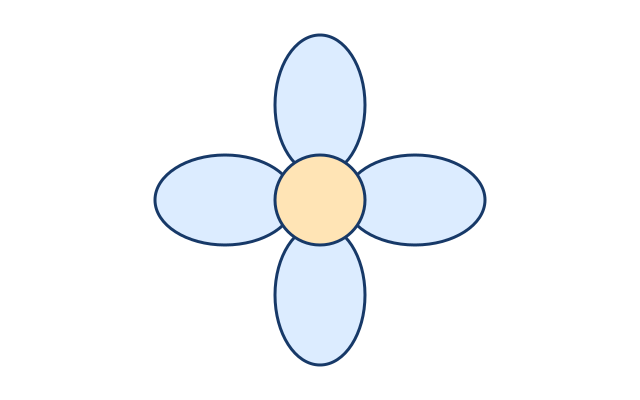
Assessment: a digital pattern claims a quarter-turn match but one coloured petal differs. What do you check?
Turn the whole design about its centre and compare every coloured feature. A mismatched petal can break the claimed symmetry; repair it and test again.
🎥 Optional Video Lesson
The SkillrHub lesson remains the primary learning resource. This optional video reinforces the explanation; you can complete the lesson and practice without watching.
Math Antics — Look for matching parts when a shape is reflected or turned.
As you watch: What must match for a fold or a turn to show symmetry?
Load video playerLoads YouTube in this lesson. See the video notice below.
Try it: Draw a pattern with one line of symmetry, then test whether it also matches after a half-turn.
Video unavailable, inaccurate or unsuitable for this year? Report a video problem to SkillrHub by email. You can continue with the written lesson and practice resources.
About these videos
Videos are curated from trusted independent educational creators and played through YouTube. Rights remain with their respective owners. Inclusion does not imply that a creator or YouTube endorses SkillrHub.
YouTube’s terms and privacy policy apply to its player. Advertising, recommendations and external links may appear, and videos may change or become unavailable. SkillrHub’s written lessons and practice resources remain available separately.
To report a content, suitability or rights concern, email skillrhublearning@gmail.com with the lesson code and video link. Please do not include personal student information.
Curriculum equivalents: Victoria, NSW and international
Curriculum equivalents for Line and rotational symmetry of shapes and create symmetrical patterns...
Mapped skill: recognise line and rotational symmetry of shapes and create symmetrical patterns and pictures, using dynamic geometric software where appropriate
These references identify matching or closely related learning. Curriculum sequence, terminology and depth vary, so teachers should use the mapped skill and lesson difficulty to confirm suitability.
Australian Curriculum v9.0 is the canonical source for this SkillrHub lesson. Victoria and NSW entries name the closest published state codes or outcomes; international entries are planning references rather than claims of identical curricula.
Help improve SkillrHub
Questions or feedback?
Ask about this lesson, suggest an improvement or report an error. Facebook opens only when you choose an option below.
Topic reference: AC9M4SP03 — AC9M4SP03: Recognise line and rotational symmetry of shapes and create symmetrical patterns and pictures, using dynamic geometric software where appropriate