Learning goals
Character, setting and the question “What happens next?”
Learning intention: Explain how an author’s words and an illustrator’s choices develop characters, establish a setting and make us care about a choice or outcome.
- Character: a person, animal or other figure in a story. Speech, actions and selected appearance details help us understand them.
- Setting: where and when the story happens. Weather, time and physical obstacles can affect what a character can do.
- Plot tension: uncertainty about a problem, choice or consequence that can make us want to keep reading. A story can have quiet tension as well as danger.
- Illustration: an image that can show, add to or complicate the words. Look at size, position, expression, movement, light and what is left unseen.
Success: I name an exact word or visible detail, explain what it suggests here, and connect it to character, setting or an unresolved event. A feeling in one moment is not proof of a permanent personality.
E1 · Appearance, behaviour and speech
Worked example: Leo takes a step
Original story: Leo’s silver cape shook as he gripped the curtain. “Could you stand where I can see you?” he whispered to his sister. When his name was called, he stepped into the light.
Teacher model: The cape tells us about his costume. Its shaking, his grip and his quiet request suggest nervousness in this scene. We should not decide that silver clothes prove courage. Stepping into the light despite the earlier signs shows an effort that may make us care about his performance.
Ask: Which clue is stronger evidence of nerves: the silver colour or his request? Expected response: The request, especially with his grip and whisper, because he seeks reassurance. If a learner chooses colour, reread the actions and words together.
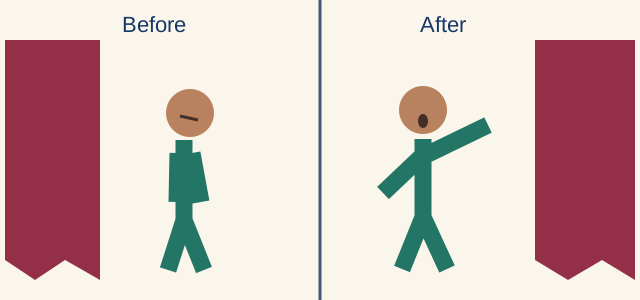
Original paired scene: Before, Robin asks, “Could I practise behind the curtain?” After, Robin calls, “Welcome to our show!” The earlier inward pose and later extended arm reinforce the change from private practice to public performance. A pose alone can have more than one meaning; the dialogue supplies context.
E2 · Dialogue reveals reasons and preferences
Worked example: Two ways to solve a problem
Original dialogue: “I want the wings to move,” said Zara. “Let’s try another hinge.” “We have tried four,” said Eli. “Can we draw the problem first, so we don’t waste the last piece?”
Zara’s request suggests she is keen to keep experimenting. Eli wants to plan because materials are running out. Neither line proves that Eli dislikes making things or that Zara never plans. We learn their current motives by linking the words to the shared model problem.
Try it: Write one new line that fits Eli’s approach. Example: “Let’s mark where the hinge catches before we cut.” Explain how it continues his careful planning. An unrelated line about colour does not yet show this motive.
E3 · Setting, choices and consequences
Worked example: The wallet
Original story: Mina counted her coins. Still not enough for the fair. She found a wallet containing banknotes and Mr Ali’s name. She closed it and took it to the help desk.
The missing fair money gives the choice a cost. Returning the wallet suggests honesty through action. The reader may care because keeping money could benefit Mina, yet she chooses to return it. Naming a quality is only the start; explain the detail that supports it.
Worked example: Fog at the jetty
Original story: A horn sounded beyond the fog. A loose plank rocked under Noor’s shoe. Her brother waited behind the safety gate. Noor stopped and called a ferry worker.
Fog limits sight and the plank makes the route uncertain. Those setting details help explain her choice to seek help. We may wonder whether the worker hears. Changing to a secure walkway in clear daylight would remove those particular obstacles; changing Noor’s name would not.
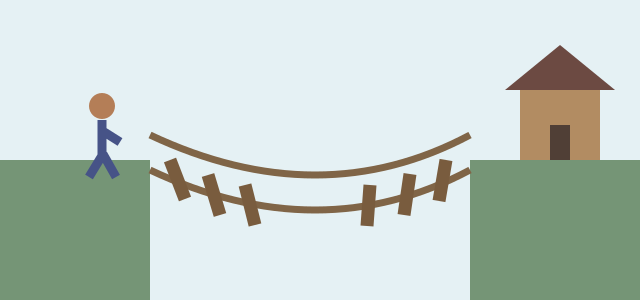
Original pictured scene: “The hut is close,” said Niko, “but these boards do not look safe.” The hut shows a goal; the missing boards above the gap show an obstacle. Together they give a reason to pause and seek a safer way.
E4 · First Nations story illustration
Read and view: Little Bird’s Day
Sally Morgan, a Palyku author, wrote Little Bird’s Day. Johnny Warrkatja Malibirr, a Yolŋu/Ganalbingu illustrator, created its illustrations. Read and view this particular work; it does not stand for all First Nations Peoples or Countries/Places.
With an adult, open the publisher’s book page and official story illustration preview. The full book can be used where available; this task uses the supplied preview and does not require a purchase.

Look first without guessing: a yellow sun rises behind a dark hill; a coiled snake has its eye closed; a frog and lizard appear below. The sun’s position suggests the day beginning, while the eye can suggest rest. The rusty red ground and arrangement of animals establish a visible place. Describe what the picture supports; do not invent sacred meanings for its patterns.
Discuss: What does the sun add to the story’s setting? What does the snake’s eye suggest? Model response: The sun suggests morning. The closed eye suggests resting, so the picture helps us imagine animals at the beginning of the day. Your response can differ if you point to visible evidence. If the preview is unavailable, return to this source task later; original practice pictures alone do not complete this First Nations text activity.
How words and pictures work together

Original scene: “I will wait here for the guide,” Amira said. The illustrator makes her small beside a tall cliff and shows the path curving toward the cliff. The scale makes the place feel vast. The words add her plan to wait: the drawing alone does not reveal that intention.

Original scene: Kai heard three taps. “Is that you?” No answer came. The light beneath the closed door adds a clue, but neither words nor picture shows the visitor. This withheld information can make the reader curious. A picture showing the visitor would answer that question.
Try it: Separate an observation from an inference. Observation: there is light beneath the door. Inference: someone may be beyond it. The picture does not prove who is there or what Kai always feels about visitors.
Common misconceptions and quick fixes
- “Clothing colour proves someone is kind or brave.” Appearance can establish a scene, but use behaviour and speech for a supported interpretation of qualities.
- “A worried pose always means the same thing.” Use words and surrounding events; body cues do not diagnose real people’s feelings.
- “Setting is just decoration.” Ask how fog, time, a path or an obstacle changes the character’s options.
- “Tension must be frightening.” A hidden visitor, waiting friend or difficult honest choice can create quiet uncertainty.
- “All illustrations only repeat the words.” Identify what each mode actually adds. Do not attach unsupported cultural meanings to an image.
Four-step lesson and adaptations
- 1. Model: read Leo’s scene and connect a quoted request to a cautious inference. Name costume, action and speech separately.
- 2. Guided analysis: compare Zara and Eli’s reasons. Then view the Ridge illustration and separate visible details from guesses.
- 3. Shared and independent response: with an adult, view the named Little Bird’s Day preview; explain the sun and one animal detail. Independently explain the jetty choice using setting evidence.
- 4. Check: use the exit scene below. Look for specific words, an unresolved consequence and a reason a reader might care. Reteach the evidence-to-effect link if the learner only retells.
Support: read aloud, offer “I notice … so I think …”, or let the learner point and explain orally. Core: explain a word and picture choice with evidence. Extend: compare two plausible interpretations and say which detail strengthens one; stay with concrete Year 4 reasoning. Materials: lesson images and access to the publisher preview. No personal or family stories are required.
Important questions and answers
Does a character’s choice tell us everything about them?
No. It gives evidence in this situation. Mina’s wallet action supports honesty here; it does not prove she has never made a mistake.
How do we explain tension instead of retelling?
Name the uncertain outcome and why it matters. Noor needs help on the unstable jetty; we do not yet know whether her call is heard.
What can an illustration add?
Scale, light, position, action or a detail not named in the words. The Ridge picture shows the cliff’s size; Amira’s dialogue supplies her plan.
Assessment-style questions and review hints
Original scene: The librarian trusted Arun with the key. A clink came from the drain. Arun found a hole in his pocket. The reading group would arrive in five minutes.
Question 1: What probably happened? Answer: The key may have fallen into the drain, supported by clink, drain and pocket hole. Question 2: Why add five minutes? Answer: The time limit adds urgency because the group needs the display. Review hint: connect clues without inventing a certain outcome.
Assessment includes selected answers and actual explanations. An adult reviews open responses; a completion click alone is not evidence of understanding. The named First Nations source activity requires actual viewing.
Exit ticket and mastery evidence
Original scene: Bea reached for the final biscuit, then saw her brother’s empty plate. “Would you like to share?” she asked.
Explain one character clue and why her choice could engage a reader. Expected evidence: noticing the empty plate and offering to share suggest consideration; the last biscuit gives the choice a small cost. Accept other supported responses. If the response only says “Bea is nice”, ask which action or words show that and why the last biscuit matters.
Also explain one visible choice in the Little Bird’s Day preview and how it contributes to setting or activity. Record this source viewing separately from original-picture practice.
Curriculum Coverage & Elaborations
Curriculum Coverage & Elaborations
The content description is the required target. The elaborations below are taught as examples and contexts, not as disconnected checklist wording.
- E1: examining an author’s choice of language to describe a character’s appearance, behaviour and speech
- E2: discussing what is learnt about a character through dialogue such as their likes, dislikes or personal qualities
- E3: identifying moments in the plot where characters are faced with choices, and commenting on how the author makes the reader care about their decisions and the consequences
- E4: identifying how illustrations contribute to the meaning of stories by First Nations Australian authors
🎥 Optional Video Lesson
The SkillrHub lesson remains the primary learning resource. This optional video reinforces the explanation; you can complete the lesson and practice without watching.
Before you watch:
- Pause after each worked example.
- Try the examples yourself.
- Return to the SkillrHub lesson before continuing.
Recommended: Plot Mountain! | The Plot Diagram Song | Scratch Garden
Scratch Garden — See how a character’s problem builds tension in a story.
As you watch: How do the character and setting make the problem more interesting?
Load video player Loads YouTube in this lesson. See the video notice below.
Try it: Describe a character, a setting and a problem. Explain one way to make the reader want to know what happens next.
Video unavailable, inaccurate or unsuitable for this year? Report a video problem to SkillrHub by email. You can continue with the written lesson and practice resources.
About these videos
Videos are curated from trusted independent educational creators and played through YouTube. Rights remain with their respective owners. Inclusion does not imply that a creator or YouTube endorses SkillrHub.
YouTube’s terms and privacy policy apply to its player. Advertising, recommendations and external links may appear, and videos may change or become unavailable. SkillrHub’s written lessons and practice resources remain available separately.
To report a content, suitability or rights concern, email skillrhublearning@gmail.com with the lesson code and video link. Please do not include personal student information.
Curriculum equivalents: Victoria, NSW and international
Curriculum equivalents for How authors and illustrators make stories engaging by the way...
Mapped skill: discuss how authors and illustrators make stories engaging by the way they develop character, setting and plot tensions
These references identify matching or closely related learning. Curriculum sequence, terminology and depth vary, so teachers should use the mapped skill and lesson difficulty to confirm suitability.
| Region | Curriculum framework | Closest level or code |
|---|---|---|
| Australia | Australian Curriculum v9.0 | AC9E4LE03 · Year 4 |
| Victoria | Victorian Curriculum F–10 Version 2.0 — English | VC2E4LE03 · Level 4 |
| New South Wales | NSW English K–10 Syllabus (2022) | EN2-UARL-01 · Stage 2 |
| United States (USA) | Common Core State Standards for English Language Arts | Grade 4 |
| Canada (Ontario) | Ontario Curriculum — English | Grade 4 |
| United Kingdom (England) | National Curriculum in England — English | Year 5, Key Stage 2 |
| India | NCERT / CBSE — English | Class 4 |
Australian Curriculum v9.0 is the canonical source for this SkillrHub lesson. Victoria and NSW entries name the closest published state codes or outcomes; international entries are planning references rather than claims of identical curricula.
Help improve SkillrHub
Questions or feedback?
Ask about this lesson, suggest an improvement or report an error. Facebook opens only when you choose an option below.
Topic reference: AC9E4LE03 — AC9E4LE03: Discuss how authors and illustrators make stories engaging by the way they develop character, setting and plot tensions
Privacy: Please don’t share personal student or school information. Younger students should ask a parent, guardian or teacher to post on their behalf.