Reading for the homework
Read and view: Little Bird’s Day
Sally Morgan, a Palyku author, wrote Little Bird’s Day. Johnny Warrkatja Malibirr, a Yolŋu/Ganalbingu illustrator, created its illustrations. Read and view this particular work; it does not stand for all First Nations Peoples or Countries/Places.
With an adult, open the publisher’s book page and official story illustration preview. The full book can be used where available; this task uses the supplied preview and does not require a purchase.
Look first without guessing: a yellow sun rises behind a dark hill; a coiled snake has its eye closed; a frog and lizard appear below. The sun’s position suggests the day beginning, while the eye can suggest rest. The rusty red ground and arrangement of animals establish a visible place. Describe what the picture supports; do not invent sacred meanings for its patterns.
Discuss: What does the sun add to the story’s setting? What does the snake’s eye suggest? Model response: The sun suggests morning. The closed eye suggests resting, so the picture helps us imagine animals at the beginning of the day. Your response can differ if you point to visible evidence. If the preview is unavailable, return to this source task later; original practice pictures alone do not complete this First Nations text activity.
Eight separately written homework tasks include reading, explanation and original work. Use the response spaces; an adult checks the evidence. If the external source cannot load, complete the other tasks and return to the source task later.
Eight homework tasks
Task 1
Original story: Rani pressed her drawing flat and tucked it under a book when visitors arrived. Later she slid it onto the table: “Would you like to see?” Explain a change using a detail from each moment.
Adult check and possible response
Rani first hides the picture, then offers to share it. The change suggests growing willingness to show her work.
Require both actions and a supported comparison; do not claim she will never feel shy again.
Task 2
Original dialogue: “Let’s race to finish,” said Cole. “I want to check the joins first,” said An. “The tower has to stand.” Explain how the speakers’ priorities differ. Write one new line that fits An.
Adult check and possible response
Cole prioritises speed; An prioritises checking stability. A fitting line is “Can you hold the base while I check this corner?”
Require evidence for both priorities and purposeful new dialogue consistent with An’s concern.
Task 3
Original scene: The playground lights went out. Nessa stopped beside the unfamiliar path and called her coach. Explain how the changed setting affects the choice. Change one setting detail to remove that obstacle.
Adult check and possible response
Darkness makes the unfamiliar route hard to see. Working lights or daylight would remove that visibility obstacle.
Require causal setting-to-choice link and a relevant change; do not assume the call has already been answered.
Task 4
Original scene: Jay promised to return the class kite before lunch. A gust pulled it into a tree just as the lunch bell rang. Identify the choice or problem the reader cares about, and explain two details that make it matter.
Adult check and possible response
Jay needs to respond to the kite being stuck. The promise gives responsibility and the lunch bell adds urgency.
Require unresolved problem and both promise/time evidence. Accept safe next choices such as informing the teacher, not unsafe climbing advice.
Task 5
View the Ridge illustration. Label or describe two visible choices involving size, position or visibility. Explain how one contributes to the setting. Say one fact the picture does not establish.
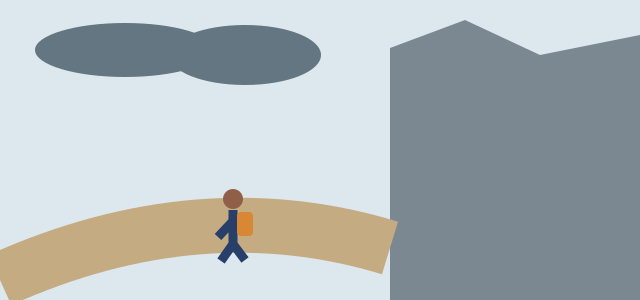
Adult check and possible response
The figure is small beside the cliff; the path curves toward the cliff. The size contrast makes the setting seem vast. We do not know the guide’s name.
Require two actual observations, one effect and one genuinely unavailable fact. Learner may annotate a printout or describe in words.
Task 6
View the Door illustration. Write two or three original sentences that fit it, including dialogue. Then explain which part of your story is shown by the picture and which part you added.
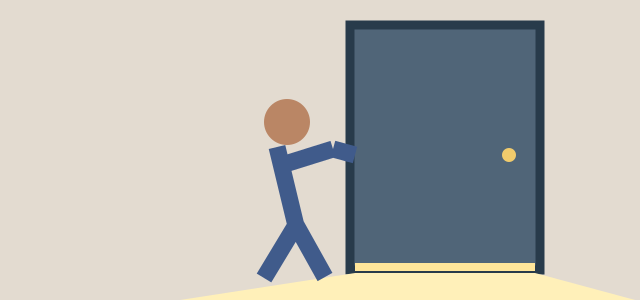
Adult check and possible response
“Are you home?” Remy asked. Light shone under the door. The pictured light is evidence; Remy’s name and exact question are invented additions.
Require fitting original micro-scene, dialogue, and an explicit distinction between visible evidence and invention.
Task 7
With an adult, open the official Little Bird’s Day preview (link on the worksheet page). Name its author and illustrator. Explain how the sun and one animal detail add to the story’s meaning.
Adult check and possible response
Sally Morgan is the author and Johnny Warrkatja Malibirr is the illustrator. The sun behind the hill suggests dawn; the snake’s closed eye suggests resting.
Require actual image viewing and two details with interpretations. Accept other supported visible details; no invented cultural symbolism. Leave pending if source unavailable.
Task 8
Original scene: “I can pretend I never saw it,” said Peta, holding the damaged team banner. Then she found the teacher and explained what had happened. Give a 30-second spoken or short written explanation of how the dialogue and action develop Peta. Ask an adult which clue made your explanation clear, then improve one sentence.
Adult check and possible response
The first line shows a temptation to avoid the problem, but telling the teacher shows a responsible choice. The change makes us interested in how she handles the consequence.
Require actual explanation, exact speech/action evidence, adult comment and a revised explanatory sentence. Accept supported alternatives. Do not record peer collaboration if only an adult participated.
