Eclipse alignment
Eclipses, tides and seasons are explained by models of relative position, motion and alignment. The key is to connect the geometry of the model to the observed phenomenon rather than memorising isolated facts.
AC9S7U03 • Year 7 Science • Earth and space sciences
Use models of changing Earth–Sun–Moon positions to explain seasons, tides, lunar phases and eclipses, and evaluate what those models can and cannot show.
Many predictable phenomena on Earth come from repeating changes in the relative positions of Earth, the Sun and the Moon. Models help us connect geometry, illumination and gravity to observations such as seasons, tides, Moon phases and eclipses.
By the end of this topic, you should be able to:
Eclipses, tides and seasons are explained by models of relative position, motion and alignment. The key is to connect the geometry of the model to the observed phenomenon rather than memorising isolated facts.
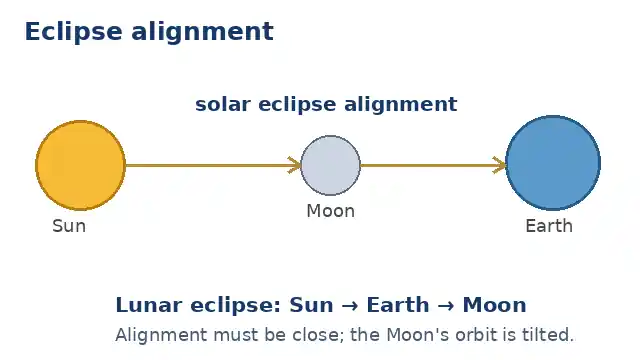
The diagram shows why eclipses require near alignment. They do not happen every month because the Moon’s orbit is tilted relative to Earth’s orbital plane, so the shadows usually pass above or below the other body.
If the Moon is between Earth and the Sun but not close to an orbital node, a new moon occurs without a solar eclipse because the three bodies are not aligned closely enough for the Moon’s shadow to cross Earth.
Seasons are not caused by Earth being much closer to the Sun in summer. They are mainly caused by Earth’s axial tilt changing Sun angle and day length through the year.
Use position words precisely: between, aligned, tilted, rotates, revolves. A labelled sketch can earn clarity when your written explanation is brief.
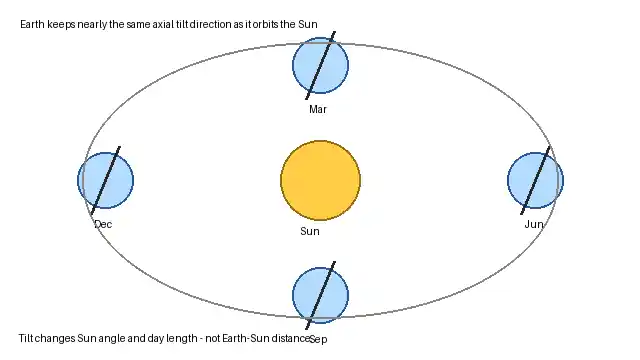
Earth's rotational axis is tilted about 23.5°. As Earth orbits the Sun, the axis keeps nearly the same orientation in space. This means each hemisphere alternately tilts toward and away from the Sun.
| Hemisphere tilted toward Sun | Hemisphere tilted away |
|---|---|
| higher Sun angle | lower Sun angle |
| more direct sunlight | sunlight spread over larger area |
| longer daylight | shorter daylight |
| generally warmer season | generally cooler season |
Why angle matters: when the same incoming solar energy is concentrated over a smaller surface area, intensity per unit area is greater.
In January, the Southern Hemisphere has summer while the Northern Hemisphere has winter. Both hemispheres are essentially the same distance from the Sun. Therefore opposite seasons cannot be explained by Earth–Sun distance; axial tilt and illumination geometry explain the pattern.
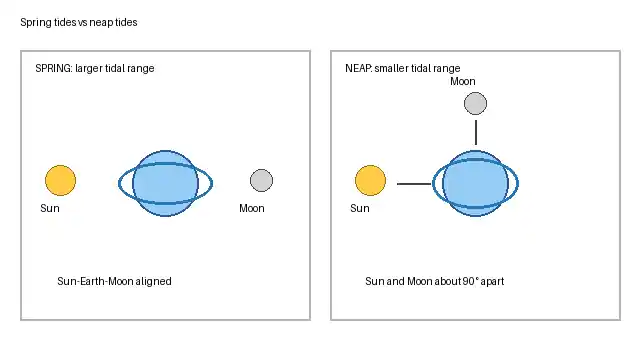
Ocean tides are caused mainly by the Moon's differential gravitational effect across Earth, with the Sun also contributing. The Moon has the stronger tidal effect because it is much closer.
There are tidal bulges on both the near and far sides of Earth. Earth's rotation carries coastlines through this changing pattern, although real local tide heights and times are also affected by coastline shape, ocean depth, weather and basin geometry.
“Spring” here means a stronger tidal range; it is not the season spring.
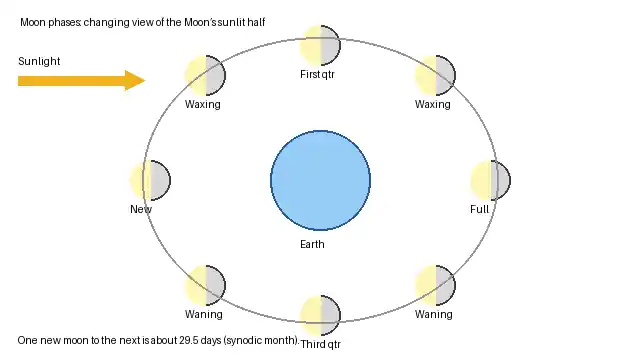
The Moon does not make its own visible light; it reflects sunlight. About half of the Moon is illuminated by the Sun at almost all times. As the Moon orbits Earth, we see different fractions of that illuminated half.
Broad sequence: new → waxing crescent → first quarter → waxing gibbous → full → waning gibbous → third quarter → waning crescent → new.
The phase cycle from one new moon to the next is about 29.5 days. This is the synodic month. The Moon's orbit relative to distant stars is shorter, about 27.3 days; these are not the same period because Earth is also moving around the Sun.
Common misconception: normal lunar phases are not caused by Earth's shadow. Earth's shadow is involved in a lunar eclipse.
| Phenomenon | Relative position | What happens |
|---|---|---|
| Solar eclipse | Sun — Moon — Earth | Moon's shadow falls on part of Earth |
| Lunar eclipse | Sun — Earth — Moon | Moon passes through Earth's shadow |
Why not every month? The Moon's orbital plane is tilted by about 5° relative to Earth's orbital plane around the Sun. Most new and full moons therefore pass above or below exact shadow alignment. Eclipses occur when the phase and orbital-node alignment coincide.
In a solar eclipse, the darkest central shadow is the umbra; the surrounding partial-shadow region is the penumbra.
axial tilt, orbit, revolution, sunlight intensity, hemisphere, tide, tidal range, spring tide, neap tide, lunar phase, waxing, waning, solar eclipse, lunar eclipse, umbra, penumbra, orbital plane, node, synodic month, model limitation
Aboriginal and Torres Strait Islander astronomical knowledge is diverse and connected to particular Peoples, Countries/Places, languages and cultural authority. Some coastal knowledge traditions include careful observations connecting lunar cycles with tidal or marine conditions.
When studying a specific example, identify the People and place, use reliable community-approved or authoritative sources, and avoid turning one community's knowledge into a claim about all First Nations Australians.
First Nations Australian seasonal calendars can use recurring combinations of plant flowering, animal behaviour, rainfall, winds, water conditions, temperature and sky observations. These indicators are place-specific and need not fit a fixed four-season calendar or fixed dates.
The scientific skill is to recognise how repeated environmental relationships can support prediction. The cultural responsibility is to preserve attribution and respect community authority over knowledge.
First Nations Australian oral traditions and cultural records can contain observations of solar or lunar eclipses, changes in light and community responses. In a classroom comparison, distinguish:
Do not rank knowledge systems casually or invent cultural details. Use specific, properly attributed sources.
A globe, lamp and small Moon model can represent tilt, illumination, alignment and shadows. A virtual simulation can let students change viewpoints and trace cycles quickly.
But models simplify reality. Common limitations include:
A strong scientific response states what relationship the model preserves and what it simplifies.
Content description — AC9S7U03: model cyclic changes in the relative positions of Earth, Sun and Moon and explain how these cycles cause eclipses and influence predictable phenomena on Earth, including seasons and tides.
Elaborations are teaching examples and breadth checks; the content description is the required learning target.
Comparable middle-years Earth and space science internationally includes seasons from axial tilt, lunar phases, eclipse geometry, gravity and tides, and evaluating physical or digital astronomical models. Exact sequencing varies by jurisdiction; AC9S7U03 remains the authoritative Australian alignment here.
Seasons: axial tilt + orbit; direct light is concentrated over less area; opposite hemisphere tilt gives opposite seasons; distance cannot explain simultaneous opposite seasons; tides: differential gravity of Moon plus Sun; Moon is closer; spring tides near new/full alignment; neap tides near quarter right-angle geometry; phases: changing view of sunlit half; phase cycle about 29.5 days; solar eclipse: Moon between Sun/Earth; lunar: Earth between Sun/Moon; Moon's orbital plane is tilted so most alignments miss; classroom models distort scale; First Nations knowledge is diverse, place-based and governed by cultural authority.
The SkillrHub lesson remains the primary learning resource. This optional video reinforces the explanation; you can complete the lesson and practice without watching.
Before you watch:
NASA Space Place — Model how the relative positions of the Sun, Moon and Earth produce a solar eclipse.
As you watch: Why does the Moon sometimes block only part of the Sun from an observer’s view?
Load video player Loads YouTube in this lesson. See the video notice below.
Try it: Use a lamp and two balls to model the alignment, then draw the positions. Never use this activity to look directly at the Sun.
Video unavailable, inaccurate or unsuitable for this year? Report a video problem to SkillrHub by email. You can continue with the written lesson and practice resources.
Videos are curated from trusted independent educational creators and played through YouTube. Rights remain with their respective owners. Inclusion does not imply that a creator or YouTube endorses SkillrHub.
YouTube’s terms and privacy policy apply to its player. Advertising, recommendations and external links may appear, and videos may change or become unavailable. SkillrHub’s written lessons and practice resources remain available separately.
To report a content, suitability or rights concern, email skillrhublearning@gmail.com with the lesson code and video link. Please do not include personal student information.
Mapped skill: model cyclic changes in the relative positions of the Earth, sun and moon and explain how these cycles cause eclipses and influence predictable phenomena on Earth, including seasons and tides
These references identify matching or closely related learning. Curriculum sequence, terminology and depth vary, so teachers should use the mapped skill and lesson difficulty to confirm suitability.
| Region | Curriculum framework | Closest level or code |
|---|---|---|
| Australia | Australian Curriculum v9.0 | AC9S7U03 · Year 7 |
| Victoria | Victorian Curriculum F–10 Version 2.0 — Science | VC2S8U12 · Levels 7–8 |
| New South Wales | NSW Science 7–10 Syllabus (2023) | SC4-OTU-01 · Stage 4 |
| United States (USA) | Next Generation Science Standards (NGSS) | Middle School (Grades 6–8) |
| Canada (Ontario) | Ontario Curriculum — Science | Grade 7 |
| United Kingdom (England) | National Curriculum in England — Science | Year 8, Key Stage 3 |
| India | NCERT / CBSE — Science | Class 7 |
Australian Curriculum v9.0 is the canonical source for this SkillrHub lesson. Victoria and NSW entries name the closest published state codes or outcomes; international entries are planning references rather than claims of identical curricula.
Help improve SkillrHub
Ask about this lesson, suggest an improvement or report an error. Facebook opens only when you choose an option below.
Topic reference: AC9S7U03 — Earth, Sun & Moon Cycles
Privacy: Please don’t share personal student or school information. Younger students should ask a parent, guardian or teacher to post on their behalf.