Food-web energy pathways
A food web is a model of connected feeding pathways. Arrows point from the food source to the consumer receiving matter and chemical energy, while decomposers connect to dead material and waste from many trophic levels.
AC9S7U02 • Year 7 Science • Biological sciences
Use food-web models to trace matter and energy, then predict how changes to organisms and environmental conditions can affect populations across an ecosystem.
An ecosystem includes living organisms and the non-living environment interacting. A food web is a scientific model that connects feeding relationships so we can trace the transfer of matter and energy and make reasoned predictions about population change.
By the end of this topic, you should be able to:
A food web is a model of connected feeding pathways. Arrows point from the food source to the consumer receiving matter and chemical energy, while decomposers connect to dead material and waste from many trophic levels.
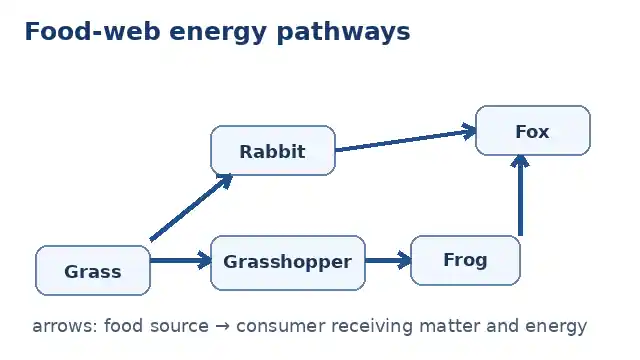
If grass decreases, organisms that depend directly on grass may decline first. Predators can then be affected indirectly because less prey is available. The web helps predict pathways, but population data are needed to test the prediction.
Suppose rabbit numbers fall after disease. Foxes may have less rabbit prey and switch to frogs, increasing pressure on frogs. A strong prediction states both the direct effect and a plausible indirect pathway.
Energy is not recycled through ecosystems. Matter can cycle; usable energy flows through food pathways and is progressively dissipated as heat.
For population-change questions, write: change → direct interaction → indirect interaction → conditional prediction.
A food chain shows one feeding pathway. A food web links several pathways because most organisms eat, or are eaten by, more than one species.
| Role | What it does | Examples |
|---|---|---|
| Producer | Makes organic matter using an energy source, usually sunlight | plants, algae |
| Primary consumer | Feeds directly on producers | grasshopper, rabbit |
| Higher-level consumer | Feeds on other consumers | frog, snake, fox |
| Decomposer | Breaks down dead organic matter and waste | many fungi and bacteria |
In grass → rabbit, the arrow points from the organism eaten to the consumer. It shows matter and chemical energy moving from grass to rabbit. It does not simply show which organism chases another.
Sun → grass → grasshopper → frog → snake
grass → rabbit → fox
grasshopper → bird → fox
dead matter and wastes from all organisms → bacteria and fungi → mineral nutrients → grass
The model contains several energy pathways. Decomposers connect to material from every trophic level rather than sitting only at the end of one chain.
Producers capture incoming energy and store some of it as chemical energy in organic matter. Consumers receive matter and energy by feeding. Decomposers break down dead material and release nutrients that can be taken up again by producers.
| Matter | Energy |
|---|---|
| Atoms move through organisms, air, water and soil and can be reused. | Energy enters, moves through feeding pathways and is dissipated as heat. |
| Decomposition is essential to nutrient cycling. | A continuing energy input is needed; energy is not recycled back to the Sun or producers. |
Organisms use energy for respiration, movement, growth, repair and maintaining life. Much of this energy is dissipated as heat, and not all biomass is eaten or digested. Therefore less usable energy is available to the next trophic level.
A simplified model sometimes uses an approximate 10% transfer between trophic levels. This is useful for estimating why top-predator populations are relatively small, but it is not an exact rule: transfer efficiency varies among organisms and ecosystems.
Start with the changed organism, identify its direct interactions, then trace indirect effects through the web.
predator decline → herbivore increase → greater grazing → producer decline → possible later food shortage for herbivores and other consumers.
fewer pollinators → lower reproduction in pollinator-dependent plants → less plant food for some herbivores → less prey or energy available to higher consumers.
fewer decomposers → slower breakdown of dead matter → slower nutrient release → possible reduction in producer growth → later effects on consumers.
A chain of effects across several trophic levels is called a trophic cascade. Strong answers use words such as “may”, “likely” and “depending on” because alternative foods, migration, disease, feedback and time delays can change the outcome.
Abiotic factors are non-living conditions: rainfall, temperature, water availability, light, fire, soil nutrients and habitat structure. Biotic factors involve living organisms and interactions: predators, competitors, disease, pollinators and introduced species.
| Change | Direct effect | Possible indirect pathway |
|---|---|---|
| Drought | reduced producer growth | fewer herbivores, then fewer predators |
| Habitat clearing | loss of shelter, food or breeding sites | population decline and altered predation/competition |
| Introduced herbivore | greater consumption of native plants | vegetation loss, reduced shelter and altered consumer populations |
| Introduced predator | new predation pressure | native prey decline and cascading food-web changes |
| Seasonal change | changes in water, food or breeding conditions | migration, delayed reproduction or altered population size |
ecosystem, population, producer, consumer, decomposer, microorganism, trophic level, food chain, food web, matter cycle, energy flow, abiotic factor, biotic factor, competition, invasive species, trophic cascade, resilience, model limitation
Aboriginal and Torres Strait Islander ecological knowledge is diverse and connected to particular Peoples, Countries/Places, languages and cultural authority. Community-led management can combine long-term observation of Country, seasonal knowledge, local species relationships and contemporary monitoring to understand invasive-species effects on food webs and resources.
Specific examples must be accurately sourced. Do not invent a “traditional” response or write as though every community uses the same practice. A responsible case study identifies the place, species, source and community authority where that information is publicly available.
First Nations Australian fire management includes diverse, place-specific practices developed over long relationships with Country. Fire timing, frequency, intensity, season, weather, fuel, purpose and landscape position can influence vegetation structure, shelter, food availability and the distribution of fauna.
Patchy or mosaic fire histories can create varied habitat conditions, but ecological outcomes are not identical everywhere. Avoid the claim that one type of fire always increases biodiversity or prevents intense fire. Use community-approved, place-aware evidence for specific claims.
If a monitored low-intensity burn is followed by increased flowering in one local plant species, the evidence supports a local association for that species and context. It does not prove that all burns benefit all species across Australia.
Food webs are useful because they make interconnected pathways visible and help identify direct and indirect effects. However, a basic food web usually does not show:
A model-based prediction should therefore be treated as a reasoned, testable expectation rather than a guaranteed forecast. Field observations and population data can test and improve the model.
Content description — AC9S7U02: use models, including food webs, to represent matter and energy flow in ecosystems and predict the impact of changing abiotic and biotic factors on populations.
Elaboration breadth reviewed:
Elaborations are teaching examples and breadth checks; the content description is the required learning target.
Comparable middle-years science internationally includes food chains and food webs, transfer of energy and matter, decomposers, ecological interactions, population responses to environmental change and evaluating ecosystem models. Exact terminology and year placement vary; AC9S7U02 is the authoritative alignment for this resource.
A food web shows interconnected feeding and transfer pathways; arrows point from food to consumer; producers capture incoming energy, consumers feed and decomposers break down dead matter; microorganisms release nutrients; matter can be reused while energy is dissipated; less energy reaches higher levels; a trophic cascade spreads effects across levels; predator removal can increase herbivores and reduce plants; pollinator loss can reduce plant reproduction and food; abiotic means non-living and biotic means living/interacting; drought often reduces producers first; introduced species can add competition, grazing or predation; food webs make pathways visible but omit strength, timing and many conditions; First Nations knowledge is diverse, governed and place-specific; alternatives and model limitations make predictions conditional.
The SkillrHub lesson remains the primary learning resource. This optional video reinforces the explanation; you can complete the lesson and practice without watching.
Before you watch:
FuseSchool — Connect feeding relationships and trace energy through an ecosystem.
As you watch: What does each arrow in a food web represent?
Load video player Loads YouTube in this lesson. See the video notice below.
Try it: Draw a local food web with at least five organisms and predict two effects of a decline in one population.
Video unavailable, inaccurate or unsuitable for this year? Report a video problem to SkillrHub by email. You can continue with the written lesson and practice resources.
Videos are curated from trusted independent educational creators and played through YouTube. Rights remain with their respective owners. Inclusion does not imply that a creator or YouTube endorses SkillrHub.
YouTube’s terms and privacy policy apply to its player. Advertising, recommendations and external links may appear, and videos may change or become unavailable. SkillrHub’s written lessons and practice resources remain available separately.
To report a content, suitability or rights concern, email skillrhublearning@gmail.com with the lesson code and video link. Please do not include personal student information.
Mapped skill: use models, including food webs, to represent matter and energy flow in ecosystems and predict the impact of changing abiotic and biotic factors on populations
These references identify matching or closely related learning. Curriculum sequence, terminology and depth vary, so teachers should use the mapped skill and lesson difficulty to confirm suitability.
| Region | Curriculum framework | Closest level or code |
|---|---|---|
| Australia | Australian Curriculum v9.0 | AC9S7U02 · Year 7 |
| Victoria | Victorian Curriculum F–10 Version 2.0 — Science | VC2S8U04 · Levels 7–8 |
| New South Wales | NSW Science 7–10 Syllabus (2023) | SC4-LIV-01 · Stage 4 |
| United States (USA) | Next Generation Science Standards (NGSS) | Middle School (Grades 6–8) |
| Canada (Ontario) | Ontario Curriculum — Science | Grade 7 |
| United Kingdom (England) | National Curriculum in England — Science | Year 8, Key Stage 3 |
| India | NCERT / CBSE — Science | Class 7 |
Australian Curriculum v9.0 is the canonical source for this SkillrHub lesson. Victoria and NSW entries name the closest published state codes or outcomes; international entries are planning references rather than claims of identical curricula.
Help improve SkillrHub
Ask about this lesson, suggest an improvement or report an error. Facebook opens only when you choose an option below.
Topic reference: AC9S7U02 — Food Webs, Energy Flow and Ecosystem Change
Privacy: Please don’t share personal student or school information. Younger students should ask a parent, guardian or teacher to post on their behalf.