Learn how scientists organise biodiversity, identify organisms with dichotomous keys, use scientific names and revise classifications when new evidence becomes available.
Classification groups organisms using shared characteristics so scientists can identify, compare and communicate about biodiversity. A dichotomous key works by making one evidence-based choice at a time until only one identification remains.
A useful key uses observable, mutually exclusive choices and follows one branch at each step.
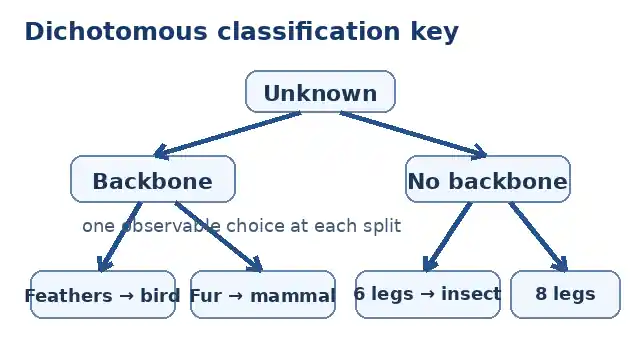
Read the diagram
Read from the top. Each split asks a yes-or-no style question about an observable feature. The final label is reached by evidence, not by guessing which organism looks most similar overall.
Worked example
An unknown animal has a backbone, feathers and a beak. Follow the vertebrate branch, then the feathered branch: the key identifies it as a bird. Record the features used so another person can reproduce the identification.
Common misconception
Classification is not a ranking from ‘simple’ to ‘advanced’. Groups represent shared features and relationships, not worth or progress.
Exam tip
When asked to evaluate a key, check that every choice is observable, mutually exclusive and leads to exactly one next step.
Retrieval question: Why is ‘lives near water’ usually a weaker first key choice than ‘has six legs’?
What you need to know
Learning intention: Explain how classification organises biodiversity and use dichotomous keys to identify organisms.
Classification organises the diversity of life into groups using shared characteristics. It helps scientists identify organisms, compare them, communicate consistently and organise biological knowledge.
compare similarities and differences within and between organism groups
use and create dichotomous keys
order the Linnaean ranks from kingdom to species
recognise binomial scientific names
explain why classification is useful
explain how improved microscopy changed classification
use a key during fieldwork
compare contemporary scientific classification with diverse, place-based First Nations Australian classification knowledge respectfully
Why classify living things? — E1 & E4
Earth contains enormous biological diversity. Classification gives scientists a shared way to organise this diversity and reduce confusion caused by different common names.
Useful features are observable, consistently defined and able to separate groups. Examples include body covering, number and type of limbs, presence of a backbone, symmetry, leaf shape and reproductive structures.
Worked reasoning: four animals have feathers, fur, smooth moist skin or dry scales. “Has feathers / does not have feathers” is a strong first split because it is objective and mutually exclusive. “Looks large / looks small” is weak unless a measurement boundary is defined.
Important: habitat alone does not prove close biological relationship. Unrelated organisms can live in similar environments.
Linnaean hierarchical classification — E3
The commonly taught hierarchy from broadest to most specific is:
Rank
Purpose
Kingdom
very broad group
Phylum
major shared body-plan features
Class
narrows the group
Order
more specific grouping
Family
closely related genera
Genus
very closely related species
Species
most specific rank in this sequence
Kingdom → Phylum → Class → Order → Family → Genus → Species. Moving down the hierarchy produces smaller, more specific groups.
Binomial nomenclature
Scientific names use two parts: Genus + species epithet. The genus begins with a capital letter, the species epithet begins with lowercase, and both are italicised when typed: Homo sapiens.
This standardised naming system helps scientists in different countries refer to the same organism precisely.
Species note: “can interbreed and produce fertile offspring” is a useful school-level definition for many sexually reproducing organisms, but it is not universal for asexual organisms, fossils and some other biological cases.
Dichotomous keys — E2 & E6
A dichotomous key identifies organisms through a sequence of two-choice decisions. Each pair should use contrasting, observable statements.
Step
Choice A
Choice B
1
Has feathers → bird
No feathers → go to 2
2
Has fur → mammal
No fur → go to 3
3
6 jointed legs + exoskeleton → arthropod
4 legs + dry scales → reptile example
How to use a key
Start at step 1.
Observe the organism carefully.
Choose the statement that matches.
Follow the direction to the next step.
Continue until an identification is reached.
Check the final identification against the observed features.
How to build or modify a good key
List observable features.
Choose a feature that splits the organisms into two clear groups.
Write mutually exclusive paired statements.
Repeat within each group.
Make sure every organism has exactly one valid path.
Test every route and revise vague or overlapping choices.
Common key problems: “large/small” without a threshold, overlapping choices, skipping an organism, or using a feature that cannot be observed reliably.
Fieldwork identification — E6
During fieldwork, a key turns observations into a traceable identification process. Record features such as body covering, limb number, leaf margin or reproductive structures, follow the key from the beginning, and keep a record of the path taken.
If the final identification conflicts with the specimen's features, re-check both the observations and the choices made. A key is a tool, not proof that cannot be questioned.
Why classification changes — E5
Scientific classifications can change when new evidence becomes available. Earlier systems relied heavily on visible features. Improvements in microscopy revealed microorganisms, cells and internal cell structures that could not previously be observed.
Cause-and-effect example: improved microscopes reveal a major cell-structure difference → scientists gain new evidence → organisms previously grouped together may need to be separated → classification is revised.
Extension: modern molecular evidence such as DNA comparisons can also inform relationships. DNA is useful context here, but the curriculum elaboration specifically foregrounds changes made possible by microscopy.
First Nations Australian classification knowledge — E7
Aboriginal and Torres Strait Islander Peoples hold diverse knowledge systems connected to particular Peoples, Countries/Places and languages. There is no single national First Nations classification system.
Depending on local knowledge and purpose, living things may be understood through relationships involving Country/Place, habitat, season, behaviour, ecological interactions, food or other culturally significant roles. These systems may organise knowledge differently from the fixed nested ranks used in contemporary Western taxonomy.
When a specific local example is used, rely on appropriate community-approved or authoritative sources and respect cultural authority, permissions and restrictions around knowledge sharing. Do not invent generic cultural examples or rank one knowledge system as inherently superior to another.
Common misconceptions
“Classification is permanent.” It can be revised when new evidence changes understanding.
“A dichotomous key is the Linnaean hierarchy.” A key identifies through paired choices; the hierarchy organises nested taxonomic ranks.
“Habitat proves close relationship.” Similar habitats can contain unrelated organisms.
“Every species can be defined perfectly by fertile offspring.” That definition has useful but real limitations.
“All First Nations Australians classify organisms in the same way.” Knowledge systems are diverse and place-based.
“If a key gives an answer, it must be correct.” Observation errors or a poorly designed key can produce a wrong identification.
Worked scientific reasoning
Example 1 — Diagnose a bad key
A key gives “large leaf” and “medium leaf”. A 7 cm leaf could fit either description because neither category has a defined boundary. Improve the key by defining measurable alternatives such as “leaf length ≥ 8 cm / leaf length < 8 cm”.
Example 2 — New evidence
Two microorganisms look similar under a basic microscope. A better microscope reveals different internal structures. The scientifically appropriate response is to re-evaluate their classification using the new evidence rather than assuming the original grouping must remain permanent.
Example 3 — Scientific name
In Canis lupus, Canis is the genus and lupus is the species epithet. Together they form the binomial scientific name.
Apply and transfer
Create the first two paired statements for four leaves that differ in margin shape and vein pattern.
A field key produces an identification that conflicts with the specimen's body covering. Describe how you would check the result.
Explain why improved microscopy could justify changing an existing classification.
Compare the purpose of a dichotomous key with the purpose of the Linnaean hierarchy.
Explain why a place-based First Nations classification example should be sourced to a particular People or Country/Place rather than invented generically.
Australian Curriculum v9.0 coverage
AC9S7U01: investigate the role of classification in ordering and organising the diversity of life on Earth and use and develop classification tools including dichotomous keys.
E1 breadth: similarities and differences of features within and between groups.
E2: creating and modifying dichotomous keys.
E3: Linnaean hierarchy and scientific naming conventions.
E4: reasons for classification including identification and communication.
E5: changes to classification through improvements in microscopy.
E6: using provided keys during fieldwork.
E7: investigating First Nations Australian systems of classifying living things and comparing them with contemporary science.
The elaborations are used here as teaching breadth examples; the content descriptor remains the required learning target.
🎥 Optional Video Lesson
The SkillrHub lesson remains the primary learning resource. This optional video reinforces the explanation; you can complete the lesson and practice without watching.
Amoeba Sisters — Follow paired choices to identify organisms and organise observable features.
As you watch: Why must the two choices at each step be clearly distinguishable?
Load video playerLoads YouTube in this lesson. See the video notice below.
Try it: Construct a short dichotomous key for four leaves using observable features, then have someone test it.
Video unavailable, inaccurate or unsuitable for this year? Report a video problem to SkillrHub by email. You can continue with the written lesson and practice resources.
About these videos
Videos are curated from trusted independent educational creators and played through YouTube. Rights remain with their respective owners. Inclusion does not imply that a creator or YouTube endorses SkillrHub.
YouTube’s terms and privacy policy apply to its player. Advertising, recommendations and external links may appear, and videos may change or become unavailable. SkillrHub’s written lessons and practice resources remain available separately.
To report a content, suitability or rights concern, email skillrhublearning@gmail.com with the lesson code and video link. Please do not include personal student information.
Curriculum equivalents: Victoria, NSW and international
Curriculum equivalents for Investigate the role of classification in ordering and organising the...
Mapped skill: investigate the role of classification in ordering and organising the diversity of life on Earth and use and develop classification tools including dichotomous keys
These references identify matching or closely related learning. Curriculum sequence, terminology and depth vary, so teachers should use the mapped skill and lesson difficulty to confirm suitability.
Australian Curriculum v9.0 is the canonical source for this SkillrHub lesson. Victoria and NSW entries name the closest published state codes or outcomes; international entries are planning references rather than claims of identical curricula.
Help improve SkillrHub
Questions or feedback?
Ask about this lesson, suggest an improvement or report an error. Facebook opens only when you choose an option below.
Topic reference: AC9S7U01 — Biological Classification and Dichotomous Keys