Learning goals and visual vocabulary
Explore how an image guides attention
An image maker chooses what to show, where to place things and what to emphasise. These choices help a viewer make meaning. We can notice a choice, point to evidence and explain its possible effect. We can also make our own choices for a purpose.
- Frame and framing
- The frame is the picture’s boundary. Framing chooses what is included, what is outside and how closely we view the subject.
- Composition
- The arrangement of parts within an image, including their size, position, spacing and relationships.
- Placement
- Where an element sits: near an edge, beside another object, in the foreground or farther away.
- Salience
- How much an element stands out. Size, contrast, space, detail and placement can contribute. The largest or most central object is not automatically the only salient feature.
- Still and moving images
- A still picture holds one view. Moving images can change the view over time, revealing or withholding information. A storyboard is a plan made of still frames; viewing a storyboard is not the same as watching the finished movement.
- Multimodal text
- A text that combines modes, such as an illustration with a written caption. Explain what each contributes and how they work together.
Success check: I can name a visual choice, locate its evidence, explain a possible viewer response and make a labelled choice for my own purpose.
Worked model: framing and missing context
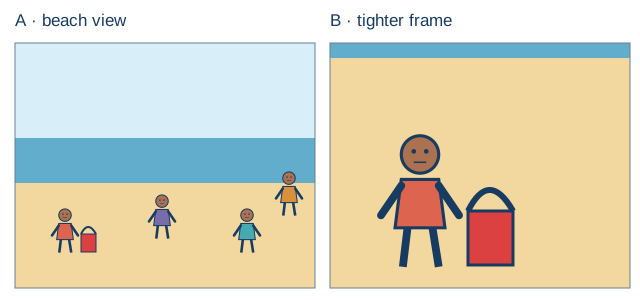
A crop changes the information available
Read the image: A shows four people, sea and sand. B enlarges the red-shirted child and bucket; the other three people are outside its frame. The bucket handle is easier to inspect, but less surrounding information is available.
Think aloud: “I name the tighter frame, point to the enlarged bucket and missing people, then connect the choice to a purpose. B would help me inspect the bucket. A better supports a caption about several people at this part of the beach.”
Careful interpretation: the crop may make the child seem alone. It does not prove the child feels lonely or that everyone else left. “A child stands beside a bucket” fits B’s visible evidence; “The whole beach is empty” goes beyond it.
Your turn: point to one object that stays in both frames and one piece of context B excludes. Suggest a useful purpose for each frame. Accept a different purpose when the visible evidence supports it.
Worked model: size, space and salience
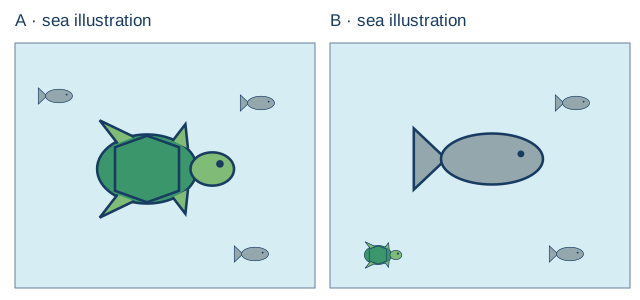
Explain what makes an element stand out
In A, the large turtle is near the middle and the fish are much smaller. The shell lines are easy to inspect. In B, the turtle is small near the bottom left and a large fish occupies the middle. These relative sizes and placements can shift attention.
Model explanation: “For a message about turtle shells, I choose A because it gives the shell more visible space. I can point to its outline and internal lines. I am explaining a design choice, not claiming these drawings measure real animal sizes.”
Guided creation: sketch a turtle message that keeps one other sea animal visible. Give the turtle emphasis using two choices, such as size and clear space. Label the choices and explain how they serve the message. An adult checks the composition and explanation; artistic polish is not the learning target.
Worked model: contrast, symbols and words
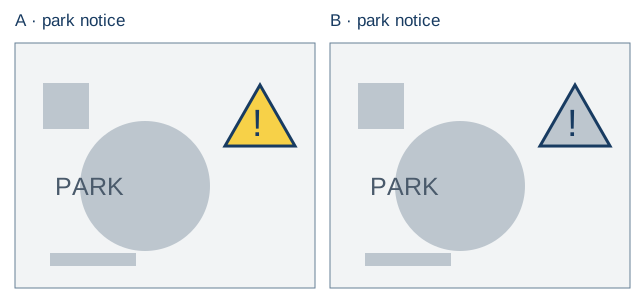
A small feature can attract attention
The triangle is smaller than the circle and sits away from the centre. In A, its yellow fill contrasts with the mostly grey shapes; in B, its fill matches them more closely. The shapes keep their size and position, so we can explore a change in contrast.
The exclamation mark can support an attention or warning message. It does not name a particular hazard. Clear words, such as “Keep the path clear”, would supply an action that this symbol alone cannot explain. Image and words make different contributions.
Compare responses: one viewer might first notice the triangle’s contrast; another might notice the large circle and word PARK. Each should point to a visible reason. Do not turn a possible effect into a rule about every viewer.
Accessibility: compare the fills and outlines as well as naming colours. A useful safety notice should communicate through clear words and symbols, without relying on colour alone.
Watch: framing changes over time
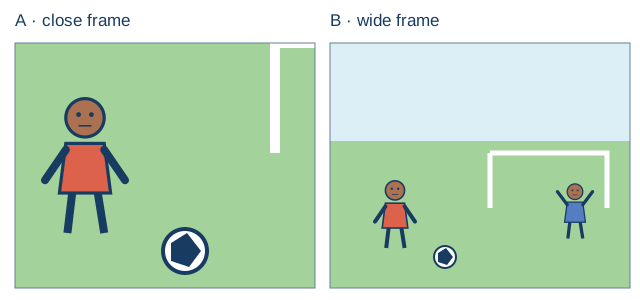
Watch, pause, compare and explain
A close frame can enlarge a subject; a wider frame can show its surroundings. Explain the particular visible choice and a possible effect on attention, rather than assuming one feeling for every viewer.
Text description of the Practice clip
The opening enlarges the red-shirted player and ball. The frame gradually widens to include a second player on the right and more of the goal. It holds the wide view at the end. The drawn people and ball do not move, and there is no sound.
Moving-image tasks require the actual clip. If it cannot play here, try the download; if playback remains unavailable, leave viewing tasks pending with an adult.
First viewing: play the whole clip. What becomes visible later? Second viewing: pause near the opening and the ending. Point to the red-shirted player, the second player and the goal.
Model explanation: “The clip starts close to one player, gradually widens, and ends with a shared field context. The second player is revealed later. The changing frame guides my attention from one player towards their surroundings.”
The drawn players do not run, and the clip does not show a pass or a goal. Its visible movement is a change of framing, created from original vector artwork. This is still a real moving clip to view; the side-by-side illustrations above are still comparisons.
Change the plan: start wide and end close. This would provide context first and then concentrate on one player. Draw three ordered planning frames and explain the intended attention shift. Call the drawing a storyboard plan unless an actual new moving clip is made.
Four teaching steps and learner support
Notice, connect, create and check
- Explicit Teaching & Modelling: use the beach pair. Model choice → visible evidence → possible effect: tighter frame → other people excluded → a more isolated impression. Ask learners to distinguish the impression from a proven fact.
- Guided Analysis: compare the park notices. Learners identify the changed fill and retained layout, then explain how contrast might affect attention. If they only name yellow, ask, “Compared with what?”
- Collaborative / Independent Practice: view the football clip twice. Partners describe the opening, change and ending, then independently draw a revised sequence with labelled framing choices.
- Formative Assessment: use the exit task below. Check an actual design and its explanation, not just recognition of vocabulary. Revisit the relevant model if the learner gives a feeling without evidence.
Materials and pace: these original images, the local six-second clip, paper and a pencil or usual communication tools. Use two or three short sessions; no paid resource or outside login is required.
Support: enlarge one pair, point together to included elements, read the factual image descriptions, or let a learner explain through speech, signs or supported drawing. Record when a description is used as an access support. Moving-image evidence still needs actual playable viewing where the task requires it.
Core: connect one or two visible choices to a supported response. Extend within this code: redesign for a different audience or reveal information in another order, explaining the trade-off in context and attention. Formal camera theory, rule-of-thirds calculations and professional editing are not required.
Misconceptions and evidence checks
Avoid shortcuts
- “The biggest object must be the most important.” Size can draw attention, but contrast, spacing, detail and purpose also matter. Compare the smaller yellow triangle with the larger grey circle.
- “A crop shows everything that happened.” It shows a selected view. Ask what might be outside it; do not invent a definite missing event.
- “A close view always makes everyone sad.” A close view can reveal detail; its effect depends on the subject and context. Explain a possible response using evidence.
- “Naming a colour is an explanation.” Connect the colour to its surroundings and a purpose, such as making a warning symbol easier to notice.
- “The player shrank during the clip.” The view pulled back, so the player occupies less screen space. No change to the person is shown.
- “A storyboard proves I watched the movement.” A storyboard supplies still planning frames. Watch the actual clip to describe its gradual change or timing.
Responsible captions: distinguish a visible observation, a possible interpretation and a fact that needs another source. Placement alone cannot prove friendship, anger, loneliness or a match result.
Questions, creation and exit ticket
Important questions and answers
- Why might I choose a wide frame?
- To supply relationships and surroundings, such as both football players and the goal. It can make small facial details harder to inspect.
- Can a still image and a caption give different information?
- Yes. A symbol can attract attention while a caption names the action. Check that the caption is supported rather than assuming the image proves every claim.
- What changes when a clip delays a wide view?
- The viewer gets surrounding information later. Describe the particular revealed detail and avoid inventing action that is not shown.
Assessment-style question
Compare the beach pair. Which view would you choose for “Look closely at the bucket handle”, and why?
Answer: B enlarges the bucket and handle. A gives more surrounding people, but that is not this caption’s main purpose. Review hint: match the selected visual detail to the stated purpose.
Independent exit task
Create a new picture for “Two people build a model together”. Include both people and the model. Label one framing choice and one placement or salience choice, then explain how they help a viewer understand shared work. Add a three-frame plan showing how a moving version could reveal the model.
Adult evidence: inspect the actual new picture and ordered plan. Require both people and model, two meaningful labels and a supported explanation; accept varied effective designs. The moving plan is creation evidence, not a substitute for the earlier actual viewing task. If the learner names features without effects, ask what information each choice helps the viewer notice.
Test reminder
Inspect the supplied still images and play the Test clip when a question asks you to watch it. Use visible details to support your response. Complete drawing, planning and explanation tasks so an adult can check your actual work.
Curriculum Coverage & Elaborations
Curriculum Coverage & Elaborations
The content description is the required target. The elaborations below are taught as examples and contexts, not as disconnected checklist wording.
- E1: examining visual and multimodal texts, building a vocabulary to describe visual elements and techniques such as framing, composition and salience, and beginning to understand how these choices influence viewer response
Exact content description — AC9E4LA10: explore the effect of choices when framing an image, placement of elements in the image and salience on composition of still and moving images in texts
Coverage in this lesson: E1 is developed through the original beach, sea and park-notice still comparisons, the actual football clip, the vocabulary and evidence routine, and labelled original designs. The Practice and Test combine image inspection with adult-reviewed viewing, explanation and creation.
Source scope: Australian Curriculum v9 provides the target. IXL supplied a partial benchmark for comparing visible illustration details and supported responses; the original lesson extends to framing and moving images. ACMI’s written cinematography guidance informed teacher planning and is intended for older learners; no outside film is assigned here.
Teacher background: ACMI: Film It — Cinematography; NESA English glossary. These support planning, not a claim of exact state outcome equivalence.
Curriculum equivalents: Victoria, NSW and international
Curriculum equivalents for The effect of choices when framing an image, placement of...
Mapped skill: explore the effect of choices when framing an image, placement of elements in the image and salience on composition of still and moving images in texts
These are broad planning references outside Australian Curriculum v9. Exact state outcome equivalence has not been verified for this lesson. Check local wording, sequence and depth before using it as a mapped outcome.
| Region | Curriculum framework | Closest level or code |
|---|---|---|
| Australia | Australian Curriculum v9.0 | AC9E4LA10 · Year 4 |
| Victoria | Victorian Curriculum F–10 Version 2.0 — English | Level 4 — broad planning alignment |
| New South Wales | NSW English K–10 Syllabus (2022) | Stage 2 — broad planning alignment |
| United States (USA) | Common Core State Standards for English Language Arts | Grade 4 |
| Canada (Ontario) | Ontario Curriculum — English | Grade 4 |
| United Kingdom (England) | National Curriculum in England — English | Year 5, Key Stage 2 |
| New Zealand | New Zealand English curriculum | Broad primary English planning alignment; check the current local sequence. |
| India | NCERT / CBSE — English | Class 4 |
Australian Curriculum v9.0 is the canonical source for this SkillrHub lesson. State and international entries are broad planning references rather than verified exact outcome equivalences or claims of identical curricula.
Help improve SkillrHub
Questions or feedback?
Ask about this lesson, suggest an improvement or report an error. Facebook opens only when you choose an option below.
Topic reference: AC9E4LA10 — AC9E4LA10: Explore the effect of choices when framing an image, placement of elements in the image and salience on composition of still and moving images in texts
Privacy: Please don’t share personal student or school information. Younger students should ask a parent, guardian or teacher to post on their behalf.