Use particle models to distinguish pure substances from mixtures, identify solutes and solvents, and choose separation techniques by the physical-property differences between components.
A pure substance contains one chemical substance with a fixed composition. In a simplified particle model, the same particle type is repeated throughout. A mixture contains two or more substances physically together, so different particle types are present.
The central reasoning pattern is: identify a physical-property difference → choose a method that exploits that difference → explain what each stage separates.
interpret particle diagrams for pure substances and mixtures
identify solute and solvent in common solutions
explain filtration, decantation, evaporation, crystallisation, chromatography and distillation
select methods using particle size, density, solubility, volatility or another useful physical property
design multi-step separation sequences for complex mixtures
compare home, recycling and water-treatment applications
investigate First Nations Australian separation methods using reliable source-specific information
Key concept
Choosing a separation method
Pure substances contain one substance with characteristic properties; mixtures contain two or more substances physically combined. Separation methods work because components differ in physical properties such as particle size, solubility, boiling point or magnetic behaviour.
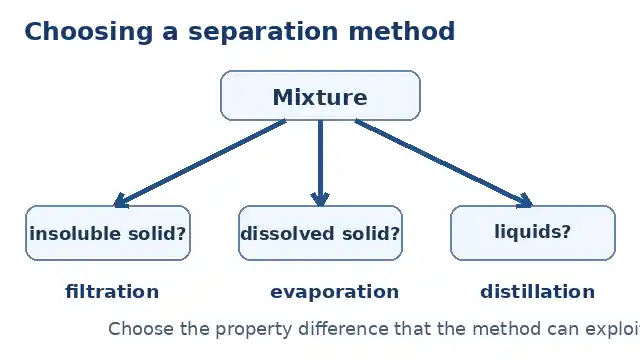
Choose a separation method by identifying the property difference you can exploit.
Read the diagram
Filtration separates an insoluble solid from a liquid using particle size. Evaporation can recover a dissolved solid, while distillation can recover a solvent or separate liquids using boiling-point differences.
Worked example
For sand and salt water: filter first to remove insoluble sand, then evaporate or distil the filtrate. One method is not enough because the mixture contains components with different relevant properties.
Common misconception
Dissolved salt has not disappeared. Its particles are dispersed through the solution and can be recovered by a physical separation process.
Exam tip
Name the method and the property difference: ‘Use filtration because sand is insoluble and its particles are retained by the filter.’
Retrieval question: Why would filtration fail to separate dissolved salt from water?
Pure substances and mixtures — E1
Pure substance
● ● ● ● ● ●
One repeated particle type. A pure substance may be an element or a compound.
Mixture
● ▲ ● ■ ▲ ●
Two or more particle types/substances are present together.
Important: a pure compound can contain more than one element. It is pure if every particle represents the same compound with the same composition.
Mixtures can be homogeneous, such as saltwater, or heterogeneous, such as muddy water. A clear appearance does not prove purity.
Model limitation: particle diagrams are not to scale and do not show every detail of real particles, spacing or motion.
Solutions, solutes and solvents — E2
A solution is a homogeneous mixture in which one or more solutes are dispersed through a solvent.
Solute
The substance being dissolved. Example: salt in saltwater.
Solvent
The medium that dissolves the solute. In many Year 7 examples, water is the solvent.
Solution
The resulting homogeneous mixture. The solute remains present even when it cannot be seen.
Worked example — sugar water
Sugar particles leave the visible crystal structure and become dispersed among water particles. The sugar has not been destroyed and the solution is still a mixture.
Physical separation techniques — E3
Method
What it separates
Property/process used
Example
Filtration
insoluble suspended solid from fluid
particle size relative to filter pores
sand from water
Decantation
upper liquid from sediment or a separated liquid layer
settling/phase separation, often related to density
pouring clearer water from sediment
Evaporation
volatile solvent from nonvolatile solute
volatility
recovering salt when water need not be collected
Crystallisation
dissolved solid as crystals
changing solubility conditions
forming salt or sugar crystals
Chromatography
dissolved components
different affinity for mobile and stationary phases
separating ink dyes
Distillation
volatile component(s)
boiling point/volatility plus condensation
collecting water from saltwater
Other useful physical techniques include sieving, magnetic separation, float-sink separation and hand-picking.
Choose the method from the property — E5
Particle size
Filtration or sieving works when components differ enough in size.
Density / phase separation
Settling, decantation or float-sink methods work when components form different layers or respond differently to a liquid.
Solubility
Selective dissolving can separate one solid that dissolves from another that does not.
Volatility / boiling point
Evaporation and distillation use differences in ease of vaporisation.
Magnetism
Useful when one solid, such as iron, is attracted to a magnet and another is not.
Do not choose a method from the mixture name alone. State the property difference the method uses.
Worked multi-step separations
Sand + saltwater
Filter: sand is trapped as residue because it is insoluble and larger than filter pores.
The filtrate is saltwater.
If only salt is needed, use evaporation/crystallisation.
If water must also be recovered, use distillation; water is collected as distillate and salt remains.
Iron + sand + salt
Use a magnet to remove iron.
Add water so salt dissolves while sand remains insoluble.
Filter to collect sand as residue.
Recover salt from the filtrate by crystallisation/evaporation.
Black ink
Use paper chromatography. Several bands indicate multiple components that travel differently because their relative attraction to solvent and paper differs.
Real-world applications — E4
Home: straining pasta, filtering tea and separating visible solids.
Recycling: magnets, screens, air classification and float-sink density separation.
Water treatment: settling and filtration remove suspended material, but do not automatically remove all dissolved substances.
Desalination: distillation is one physical method that can separate water from dissolved salt.
First Nations Australian separation techniques — E6
The curriculum asks students to investigate examples such as hand-picking, sieving, winnowing, yandying, filtering, cold-pressing and steam distilling. Study a specific practice using reliable community, curriculum or other authoritative sources for the relevant Country and context.
Winnowing
Moving air separates materials with different aerodynamic responses related to mass, density, size and shape.
Yandying
Controlled rocking can sort particles that move and settle differently because of properties such as density, size and shape.
Sieving / filtering
Openings or filter media separate according to particle size.
Cold-pressing
Mechanical pressure physically expresses liquid oils from plant material.
Steam distillation
Where documented for a particular context, volatile components can be carried with vapour and condensed for collection.
Respectful science practice: do not describe these as one uniform national system or assume every community uses every technique. Keep attribution and local context when known.
Designing a separation investigation
A strong plan identifies the components present, the property difference, the technique, what is collected at each stage, safety controls and evidence that separation worked.
Investigation — recover sand, salt and water
Filter first to recover sand. Then distil the saltwater filtrate so water is condensed and collected while salt remains in the flask. Allow the remaining salt to dry/crystallise. Wear eye protection, use stable heat-resistant glassware and safe heating, and never taste laboratory samples.
International curriculum connections
Comparable middle-years chemical science internationally includes particle representations of substances and mixtures, solutions, physical properties and physical separation techniques. Exact sequencing varies by jurisdiction; AC9S7U06 is the authoritative Australian alignment for this page.
Australian Curriculum coverage
AC9S7U06: use a particle model to describe differences between pure substances and mixtures and apply understanding of properties of substances to separate mixtures.
E1: particle representations of pure substances and mixtures.
E2: solutions, solutes and solvents.
E3: filtration, decantation, evaporation, crystallisation, chromatography and distillation.
E4: separation in home, recycling and water-purification contexts.
E5: select methods using physical properties such as particle size, density and volatility.
E6: investigate documented First Nations Australian separation techniques such as hand-picking, sieving, winnowing, yandying, filtering, cold-pressing and steam distilling.
15 important questions
How does a particle model distinguish a pure substance from a mixture?
Why can a pure compound contain two element types and still be pure?
What is a solution?
Identify solute and solvent in saltwater.
Why can filtration separate sand from water but not dissolved salt?
What property does decantation often exploit?
When would you choose evaporation rather than distillation?
How does crystallisation recover a dissolved solid?
Why do dyes move different distances in chromatography?
What happens in the condenser during distillation?
How does density help recycling separation?
Design a sequence for sand + saltwater.
Design a sequence for iron + sand + salt.
Why should First Nations Australian separation practices be taught with source-specific context?
What six features should appear in a strong separation investigation plan?
Answer guide
1 Same particle type versus two or more substance/particle types. 2 Every particle can be the same compound with fixed composition. 3 Homogeneous mixture of solute(s) in solvent. 4 Salt=solute, water=solvent. 5 Sand particles are suspended and large; dissolved salt passes filter pores. 6 Settling/phase separation, often related to density. 7 Evaporation when only nonvolatile solute is needed; distillation when volatile component must be collected. 8 Change solubility conditions so solute forms crystals. 9 Different affinity for mobile solvent and stationary paper. 10 Vapour cools and condenses to liquid. 11 Materials float/sink according to density relative to a liquid. 12 Filter, then evaporate/crystallise or distil depending on products required. 13 Magnet, selective dissolving, filtration, salt recovery. 14 Practices vary by community/Country and need accurate attribution. 15 Components, property, method, outputs, safety, evidence.
Common misconceptions
“Clear means pure.” False: dissolved substances can be invisible.
“Filter paper removes salt from saltwater.” False: ordinary filtration removes suspended particles, not dissolved salt.
“A pure substance must contain one element.” False: a pure compound can contain multiple elements in identical compound particles.
“Evaporation and distillation are the same.” Distillation condenses and collects the vaporised component.
“Chromatography is only about solubility.” Separation depends on relative attraction to mobile and stationary phases.
“One method can separate every complex mixture.” Many mixtures require a sequence of techniques.
🎥 Optional Video Lesson
The SkillrHub lesson remains the primary learning resource. This optional video reinforces the explanation; you can complete the lesson and practice without watching.
Recommended: How to Separate Solutions, Mixtures and Emulsions
FuseSchool — Choose separation methods using differences in material properties.
As you watch: Why will filtering not remove dissolved salt from water?
Load video playerLoads YouTube in this lesson. See the video notice below.
Try it: Plan how to recover sand and salt from a sand–salt–water mixture; explain the property used at each step.
Video unavailable, inaccurate or unsuitable for this year? Report a video problem to SkillrHub by email. You can continue with the written lesson and practice resources.
About these videos
Videos are curated from trusted independent educational creators and played through YouTube. Rights remain with their respective owners. Inclusion does not imply that a creator or YouTube endorses SkillrHub.
YouTube’s terms and privacy policy apply to its player. Advertising, recommendations and external links may appear, and videos may change or become unavailable. SkillrHub’s written lessons and practice resources remain available separately.
To report a content, suitability or rights concern, email skillrhublearning@gmail.com with the lesson code and video link. Please do not include personal student information.
Curriculum equivalents: Victoria, NSW and international
Curriculum equivalents for A particle model to describe differences between pure substances and...
Mapped skill: use a particle model to describe differences between pure substances and mixtures and apply understanding of properties of substances to separate mixtures
These references identify matching or closely related learning. Curriculum sequence, terminology and depth vary, so teachers should use the mapped skill and lesson difficulty to confirm suitability.
Australian Curriculum v9.0 is the canonical source for this SkillrHub lesson. Victoria and NSW entries name the closest published state codes or outcomes; international entries are planning references rather than claims of identical curricula.
Help improve SkillrHub
Questions or feedback?
Ask about this lesson, suggest an improvement or report an error. Facebook opens only when you choose an option below.
Topic reference: AC9S7U06 — Pure Substances, Mixtures & Separation Techniques