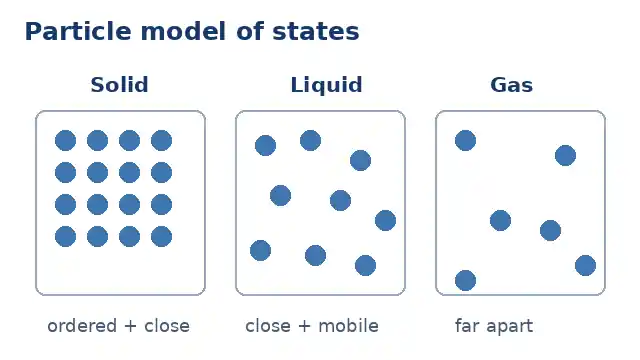
What students learn in AC9S7U05
This unit helps students build a clear, usable understanding of Particle theory to describe the arrangement of particles in a.... The goal is not to memorise one answer pattern. Students should be able to explain the idea, recognise it in a new example and apply it in a short practice or worksheet task.
- Start with the main idea: use particle theory to describe the arrangement of particles in a substance, including the motion of and attraction between particles, and relate this to the properties of the substance.
- Use concrete examples, pictures, oral explanation and short written responses before moving to independent practice.
- using and constructing models, diagrams or virtual simulations to represent changes in particle arrangement as substances change state relating motion and energy of particles to distances between particles of the same substance in different states
- Finish with mixed questions so students must choose the correct strategy rather than copy the last example.
Curriculum coverage and elaborations
The content description and elaborations below show the curriculum ideas taught in this unit. Items marked as teaching context support lesson planning but may not appear in the initial eight-question activity.
- Content description: use particle theory to describe the arrangement of particles in a substance, including the motion of and attraction between particles, and relate this to the properties of the substance
- E1: using and constructing models, diagrams or virtual simulations to represent changes in particle arrangement as substances change state
- E2: relating motion and energy of particles to distances between particles of the same substance in different states
- E3: comparing attractive forces in the solid, liquid and gaseous states of the same substance and relating this to relative position and movement of particles
- E4: examining how the changing motion and energy of particles is affected by the amount of heat energy absorbed or released
- E5: comparing the properties of different states of matter and explaining differences using particle theory
- E6: investigating properties of materials such as density, melting point and compressibility and explaining these in terms of particle arrangement
- E7: explaining the process of diffusion in a liquid and a gas in terms of particles
How to use this unit
Read the topic guide, use the teacher slide for instruction, then complete the Worksheet, Practice and Test. These three activities use the same eight-question unit bank.
Teacher resource
AC9S7U05 teacher slide
Use this one-page PDF to introduce the key idea, vocabulary and teaching sequence before students begin the activities.
Open teacher slide (PDF)Common mistakes to watch for
- Describing what is seen without connecting it to a question, pattern or prediction.
- Using everyday words only and missing simple scientific vocabulary.
- Changing more than one thing in an investigation, which makes the comparison unfair.
International curriculum mapping
This table gives closest-topic mapping for search and planning. The Australian Curriculum code is exact; overseas entries are broad equivalents because each jurisdiction structures outcomes differently.
| Region | Curriculum | Closest mapping |
|---|---|---|
| Australia | Australian Curriculum v9.0 | AC9S7U05 — use particle theory to describe the arrangement of particles in a substance, including the motion of and attraction between particles, and relate this to the properties of the substance |
| Victoria | Victorian Curriculum F-10 | Year 7 Science: closest match in Chemical sciences. Use this page as a VIC-aligned practice and worksheet reference. |
| NSW | NSW Curriculum | Stage 4 Science: closest content focus for Particle theory to describe the arrangement of particles in a... and related outcomes. |
| United States | Common Core / NGSS | Grade 7 NGSS science closest topic match for Particle theory to describe the arrangement of particles in a.... |
| England / UK | National Curriculum | Key Stage 3 / Year 7: closest programme-of-study match for Particle theory to describe the arrangement of particles in a.... |
| Canada | Provincial and territory curricula | Grade 7 closest topic match. Canada varies by province, so use this as a broad Ontario/BC-style learning outcome reference. |
| New Zealand | New Zealand Curriculum | Level 4 Science: closest achievement-objective topic for Particle theory to describe the arrangement of particles in a.... |
| India | NCERT / CBSE | Class 7 closest NCERT/CBSE topic match for Particle theory to describe the arrangement of particles in a.... |