1. Read signs
Negative x is left of the origin and negative y is below it.
Try it · Which quadrant contains (−3, −2)?
Quadrant III.
YEAR 6 MATHS · AC9M6SP02
Locate points using signed coordinates and describe how movement changes them.
WORKED EXAMPLE
Read coordinates across first, then up or down.
Negative x is left of the origin and negative y is below it.
Quadrant III.
A horizontal move changes x while y stays the same.
(2, 3).
Moving down decreases y.
(2, −2).
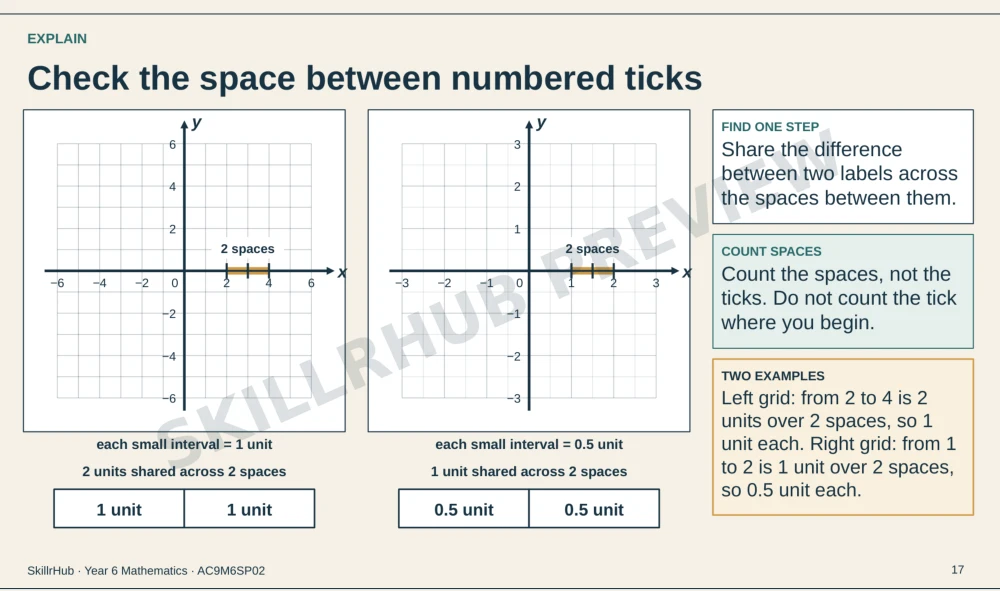
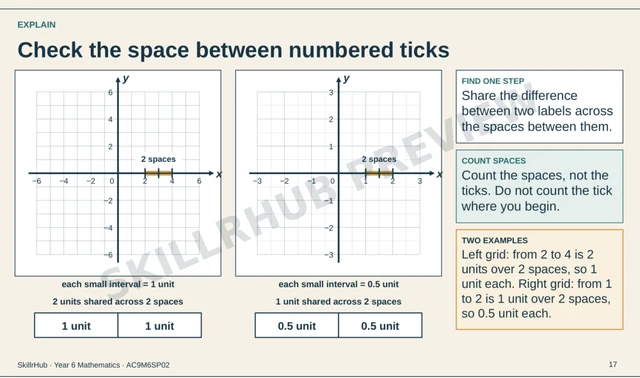
Count the spaces, not the tick marks. On the left grid, 2 to 4 spans two small spaces, so each is 1 unit. On the right grid, 1 to 2 spans two small spaces, so each is 0.5 unit. The same number of spaces can represent different distances.
On a coordinate grid, 0 to 2 on the x-axis spans four equal spaces. Start at the origin and move two spaces left without moving up or down. What point do you reach?
Each space is 2 ÷ 4 = 0.5 unit. Two spaces left is −1 on the x-axis, and y stays 0. The point is (−1, 0).
At (2, −2).
Students plot ordered pairs with positive and negative coordinates, identify quadrants and explain coordinate changes under horizontal, vertical and symmetric movement.
Use the visual model first. Ask students to identify the quantities, structure or conditions before calculating or explaining.
x first, then y
Quadrants are numbered anticlockwise from the upper right. The signs follow (+,+), (−,+), (−,−), (+,−).
Connect the central relationship to a new context, then verify the conclusion with a second representation, estimate, inverse operation or reasonableness check.
State the transformation or displacement, then verify distance and orientation on the grid.
AC9M6SP02: locate points in the 4 quadrants of a Cartesian plane; describe changes to the coordinates when a point is moved to a different position in the plane
Use the central and application models above to connect each elaboration to the same underlying concept.
Represent coordinates in four quadrants and label the important parts, quantities or choices.
Use the application model to compare two cases, explain the relationship and identify a likely error.
Apply the idea in an unfamiliar context and use a second method, evidence source or text feature to check it.
Decision: continue when students can explain the model, apply it to a new example and justify their check. Otherwise return to the central model and reduce the numerical or representational load.
AC9M6SP02: locate points in the 4 quadrants of a Cartesian plane; describe changes to the coordinates when a point is moved to a different position
The Australian Curriculum code and wording are exact. International teachers can use the underlying mathematical concept while matching the lesson to their local grade or year outcomes.
Project the fixed, branded four-page teaching sequence.
Open Classroom ViewUse the printable activity for written practice.
Browse paid worksheetsUse supported Practice first, then the separate Test when ready.
Mapped skill: locate points in the 4 quadrants of a Cartesian plane; describe changes to the coordinates when a point is moved to a different position in the plane
These references identify matching or closely related learning. Curriculum sequence, terminology and depth vary, so teachers should use the mapped skill and lesson difficulty to confirm suitability.
| Region | Curriculum framework | Closest level or code |
|---|---|---|
| Australia | Australian Curriculum v9.0 | AC9M6SP02 · Year 6 |
| Victoria | Victorian Curriculum F–10 Version 2.0 — Mathematics | VC2M6SP02 · Level 6 |
| New South Wales | NSW Mathematics K–10 Syllabus (2022) | MA3-GM-01 · Stage 3 |
| United States (USA) | Common Core State Standards for Mathematics | Grade 6 |
| Canada (Ontario) | Ontario Curriculum — Mathematics | Grade 6 |
| United Kingdom (England) | National Curriculum in England — Mathematics | Year 7, Key Stage 3 |
| India | NCERT / CBSE — Mathematics | Class 6 |
Australian Curriculum v9.0 is the canonical source for this SkillrHub lesson. Victoria and NSW entries name the closest published state codes or outcomes; international entries are planning references rather than claims of identical curricula.
Related topics
Published and maintained by SkillrHub. Australian Curriculum v9 code: AC9M6SP02.
Free learning resources and examples for this Australian Curriculum topic. Try free practice questions in published banks and save progress with a free account, confirmed email and selected learner profile. Optional paid worksheet packs are separate.
Supported guests: 20 free questions daily. Registered accounts: 500 free questions in total across subjects, including guest questions already used. Some banks require an account. Read the access details.
Matching Practice and Test question-bank review recorded on by the SkillrHub content team. This record applies to the question banks.
Read our editorial standards · Report a correction for AC9M6SP02