Year 3 Maths • Time • Australian Curriculum
Year 3 Time Worksheets & Activities Australia: Analogue Clocks, Digital Time, Minutes, Hours and Duration
Year 3 time becomes much easier when children connect clocks, time units and duration instead of treating them as separate tricks. This guide brings those ideas together and links directly to SkillrHub's Year 3 topic guides, printable worksheets, practice and tests.
Published 22 August 2026 • Updated 7 September 2026 • SkillrHub
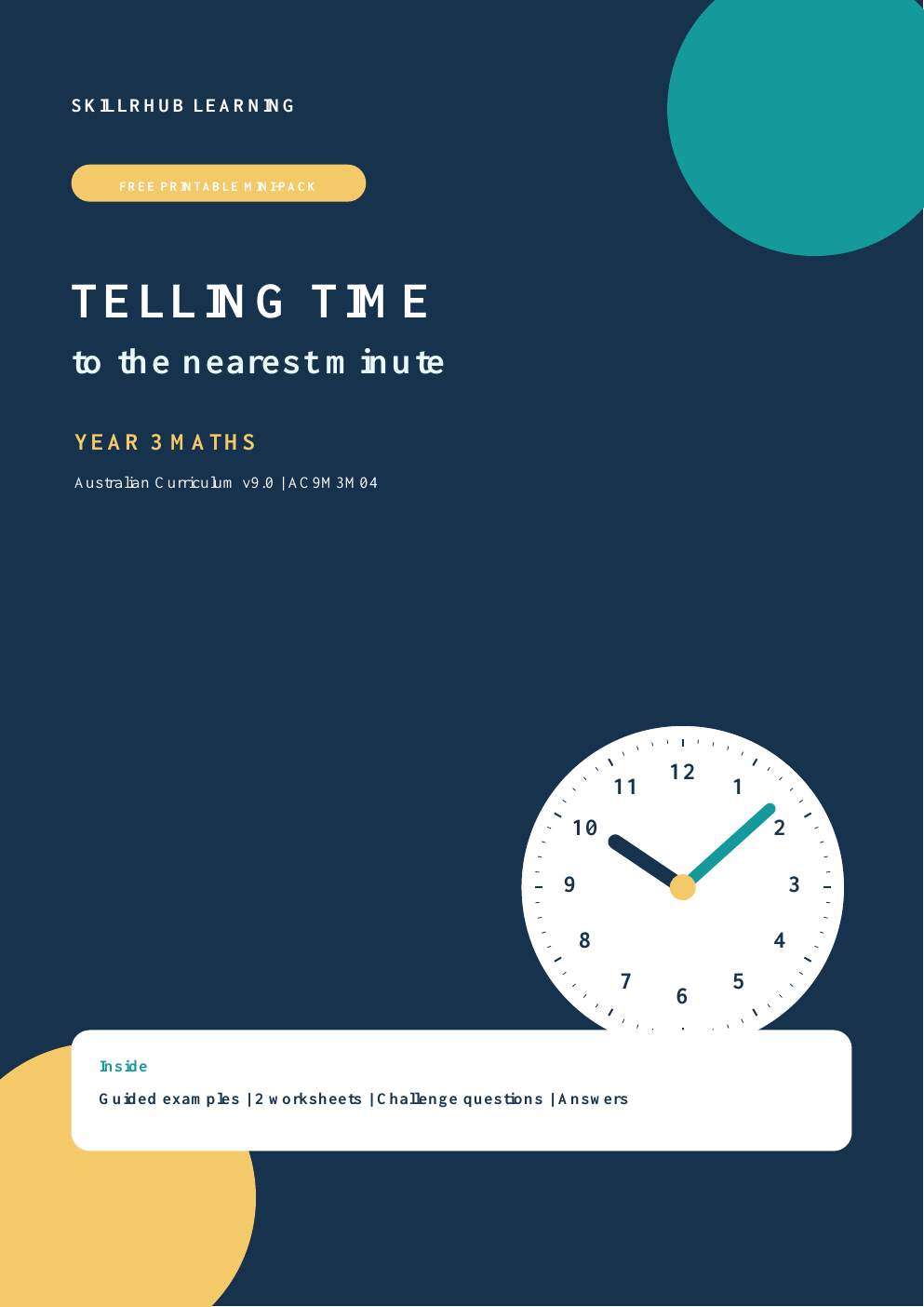
Free printable PDF • 7 pages
Download the Year 3 Telling Time Mini Pack
Use this low-preparation pack to teach and practise reading analogue and digital clocks to the nearest minute. It is aligned to AC9M3M04 and includes a QR route back to SkillrHub practice.
What's inside
- Teacher guide and quick teaching script
- Guided clock-reading examples
- Worksheet A and Worksheet B
- Challenge questions and complete answer key
A4 printable • Free for personal and classroom use
Continue the learning pathway
Optional print-and-go convenience
Want the complete Year 3 Time pack?
The free mini pack and all online learning remain available. For teachers and families who want a prepared set, SkillrHub also offers a US$2.99 printable practice pack, 60 teaching slides for US$6.99, and the combined US$7.98 bundle.
Full product previews and purchase details are available on TPT.
What should a Year 3 student know about time?
By Year 3, students are moving beyond reading simple hour and half-hour times. They need to understand how formal units of time relate to one another and how the hour and minute relationships shown on an analogue clock connect with digital displays. In practical terms, this means that a child should be able to reason about hours, minutes and seconds, read and compare times, use clock structure to explain where the hands should be, and solve everyday questions involving how long something takes.
The two ideas support each other. A student who memorises that one hour equals 60 minutes but does not understand the movement of the minute hand may struggle with a clock face. A student who can read a clock picture but has weak knowledge of 60-minute cycles may struggle with duration. Good Year 3 time worksheets therefore need a progression: first understand the units, then read and represent time, then apply the ideas to elapsed time and real situations.
SkillrHub separates these related ideas into the curriculum-aligned AC9M3M03 time-units topic and AC9M3M04 analogue-and-digital-time topic. Use both if a learner needs a complete time revision pathway.
Analogue clocks: teach the relationships, not just the hand positions
Analogue clocks are challenging because two scales operate on the same face. The short hour hand shows progress through a 12-hour cycle, while the longer minute hand shows progress through a 60-minute cycle. The numbers 1 to 12 therefore do two jobs: they identify hours and also mark groups of 5 minutes for the minute hand.
Instead of asking children only to name a displayed time, ask them to explain the clock. For example, at 4:35, the minute hand is on the 7 because seven groups of five minutes make 35 minutes. The hour hand is no longer exactly on 4 because more than half of the hour has passed. This explanation builds a mental model that transfers to unfamiliar times.
A useful analogue-clock sequence
Begin with full hours, then half hours, quarter hours and five-minute intervals. After that, work toward individual minutes. Mix recognition questions with construction questions: sometimes show a clock and ask for the time; sometimes give a time and ask the learner to draw or describe where each hand belongs. The second direction is important because it reveals whether the student actually understands the relationship.
Digital time: connect the display to the same 60-minute system
A digital display can look simpler, but students still need to interpret it. In a time such as 7:42, the first part represents the hour and the second part represents minutes after that hour. The number 42 is not a decimal fraction of an hour; it belongs to a base-60 time system. That distinction becomes important when children later calculate duration.
Use paired representations whenever possible. Show 2:15 beside an analogue clock displaying quarter past two. Show 8:45 beside a clock displaying quarter to nine. Ask students to move between words, digital notation and analogue displays. When a child can express the same time in three forms, their understanding is much more robust than if they can only copy one format.
Hours, minutes and seconds: the relationships students need
| Relationship | Meaning | Useful example |
|---|---|---|
| 60 seconds = 1 minute | Seconds combine to make minutes | 120 seconds = 2 minutes |
| 60 minutes = 1 hour | Minutes combine to make hours | 180 minutes = 3 hours |
| 24 hours = 1 day | Hours combine to make a full day | 48 hours = 2 days |
Year 3 students benefit from estimating which unit makes sense before calculating. Brushing teeth is better measured in minutes than hours. A short sprint is better measured in seconds than days. A school day is naturally discussed in hours. Choosing the appropriate unit prevents the relationships from becoming empty facts.
A good worksheet can mix conversion with reasonableness. Instead of only asking “How many minutes are in 3 hours?”, include questions such as “Would a lunch break be closer to 30 seconds, 30 minutes or 30 hours?” This makes the unit relationships meaningful.
How to teach duration and elapsed time
Duration is the amount of time between a start and an end. For many Year 3 learners, counting forward is clearer than trying to perform a written subtraction with clock times. Suppose a lesson starts at 9:35 and ends at 10:20. A student can count from 9:35 to 10:00 as 25 minutes, then from 10:00 to 10:20 as another 20 minutes, giving a total duration of 45 minutes.
This “bridge through the hour” strategy is especially useful because time is not a base-10 system. A child who tries to subtract 9:35 from 10:20 as though the numbers were ordinary decimals can easily make an error. Number-line or timeline drawings make the jumps visible and help students explain their reasoning.
Three duration strategies worth practising
Count on in friendly jumps: move to the next hour, then continue to the finish. Use a timeline: draw the start and end and label each jump. Convert when appropriate: for simple whole-hour relationships, express the times in minutes and compare. Students should understand more than one method, but they do not need to use the most complicated method for every question.
10 practical Year 3 time activities
- Clock match: match analogue clock cards to digital times and word descriptions.
- Build the time: give a digital time and ask the learner to position movable hour and minute hands.
- Five-minute hunt: point to each clock number and count 5, 10, 15 … 60 to reinforce minute structure.
- Daily routine timeline: place breakfast, school, sport and bedtime on a timeline and compare durations.
- Estimate then measure: predict how many seconds a small activity takes, then use a timer.
- What unit fits? sort activities into seconds, minutes, hours or days and justify each choice.
- Missing time: give a start time and duration and ask for the finish time.
- How long? give start and finish times and ask students to show jumps on a timeline.
- Fix the clock: deliberately draw an incorrect hour-hand position and ask the learner to explain the error.
- Timetable challenge: use a simple school or transport timetable to answer before/after and duration questions.
These activities work well before or alongside a worksheet. The goal is to make the relationships visible so the worksheet becomes practice rather than guesswork.
Common Year 3 time mistakes and what they reveal
1. Confusing the hour and minute hands
If a learner repeatedly swaps the hands, return to hand length and purpose rather than simply marking answers wrong. Ask what each hand measures and how far it moves in an hour.
2. Treating the clock numbers as single minutes
A student may say the minute hand on 8 means 8 minutes. Rebuild the five-minute counting sequence around the clock face: 5, 10, 15, 20 and so on.
3. Keeping the hour hand fixed on the hour number
At 6:50, the hour hand should be close to 7, not exactly on 6. This error shows that the learner sees the hands as separate labels rather than two continuous measures of the same passing time.
4. Using base-10 subtraction for time
Clock minutes reset after 59, not 99. Timeline strategies help students respect the 60-minute structure.
5. Choosing unreasonable units
If a child says a movie lasts 90 seconds or a hand clap lasts 2 hours, the issue is not calculation. It is unit sense. Include estimation and comparison regularly.
A Year 3 time worksheet progression from easy to challenging
Stage 1 — Unit relationships: identify seconds, minutes and hours; match everyday events to sensible units; complete simple conversions such as 2 hours = 120 minutes.
Stage 2 — Read clocks: identify full hours, half hours, quarter hours and five-minute intervals, then progress to individual minutes.
Stage 3 — Represent time: convert between analogue displays, digital notation and words such as “quarter past” or “twenty minutes to”.
Stage 4 — Compare and order: decide which events occur earlier or later and order several times.
Stage 5 — Duration: find elapsed time using timelines, bridge-through-the-hour strategies and simple timetable contexts.
Stage 6 — Multi-step application: solve realistic questions involving a start time, several activities and a final time, then explain whether the answer is reasonable.
Open the relevant Year 3 topic guide first, then use the printable worksheet for written practice, online Practice for immediate feedback and the Test for an independent check. If the student struggles, return to the specific misconception rather than simply giving more of the same questions.
Australian Curriculum connections: AC9M3M03 and AC9M3M04
SkillrHub organises these Year 3 time resources around Australian Curriculum Version 9.0 content descriptions. AC9M3M03 focuses on the relationships between formal units of time, including days, hours, minutes and seconds. AC9M3M04 focuses on the relationship between hours and minutes on analogue and digital clocks and representing time. For official curriculum wording and requirements, the Australian Curriculum published by ACARA remains the source of truth.
For learning support, start with AC9M3M03 if the learner needs stronger time-unit relationships, and AC9M3M04 if the main challenge is reading or representing analogue and digital time.
How parents can use Year 3 time worksheets at home
Keep sessions short and connected to real routines. Ask the child to read the kitchen clock, estimate how long dinner preparation will take, calculate the time until a television program starts or compare the duration of two activities. Then use a focused worksheet to consolidate the same skill. Real clocks and real schedules give the symbols meaning.
When checking answers, ask “How did you know?” before supplying the correction. A correct answer obtained by guessing gives less information than a wrong answer explained clearly. The explanation tells you which part of the time model the child understands and where the next teaching step should be.
How teachers can use the resources
A simple classroom sequence is: brief explicit teaching, model one or two examples, use a clock or timeline representation, give focused independent questions, then finish with a short check for understanding. Students who are secure can move into multi-step timetable and duration questions. Students who are not secure can return to the visual representation without being pushed prematurely into harder arithmetic.
The Year 3 Maths curriculum hub makes it possible to move from the time units into other Measurement topics without losing the curriculum context.
Start the Year 3 time pathway
If the learner needs help with time units, begin with hours, minutes and seconds — AC9M3M03. If the learner needs help reading and representing clocks, continue with analogue and digital time — AC9M3M04. For broader revision, open all Year 3 Maths curriculum resources or browse the printable worksheet library.