Year 4 Maths • Fractions • Free printable
Free Year 4 Fractions Worksheets: Equivalent Fractions, Fraction Families and Number Lines
Fractions make more sense when students see one value represented in several ways. This practical guide explains how to teach equivalent fractions and fraction number lines, how to respond to common misconceptions, and how to use the free SkillrHub mini pack with AC9M4N03 and AC9M4N04.
Published 30 August 2026 • SkillrHub
Free printable PDF • 6 pages
Download the Year 4 Fractions Mini Pack
The pack gives students a compact practice sequence for equivalent fractions and number-line representations. It supports selected learning in AC9M4N03 and AC9M4N04.
What's inside
- Teacher and parent quick-start guide
- Fraction families using visual models
- Equivalent-fraction questions
- Fractions and mixed numerals on number lines
- Challenge questions, exit ticket and answer key
A4 printable • Free for personal and classroom use
Prefer TPT? The same free sample is listed in the SkillrHub Learning store.
What Year 4 students need to understand about fractions
Many children first meet fractions as shaded pieces of a shape. That is a useful beginning, but Year 4 learning needs to move beyond “colour three pieces” questions. Students should recognise that a fraction is a number, that different-looking fractions can have the same value, and that fractions can be located and counted on a number line. These ideas connect visual models, symbols and numerical reasoning.
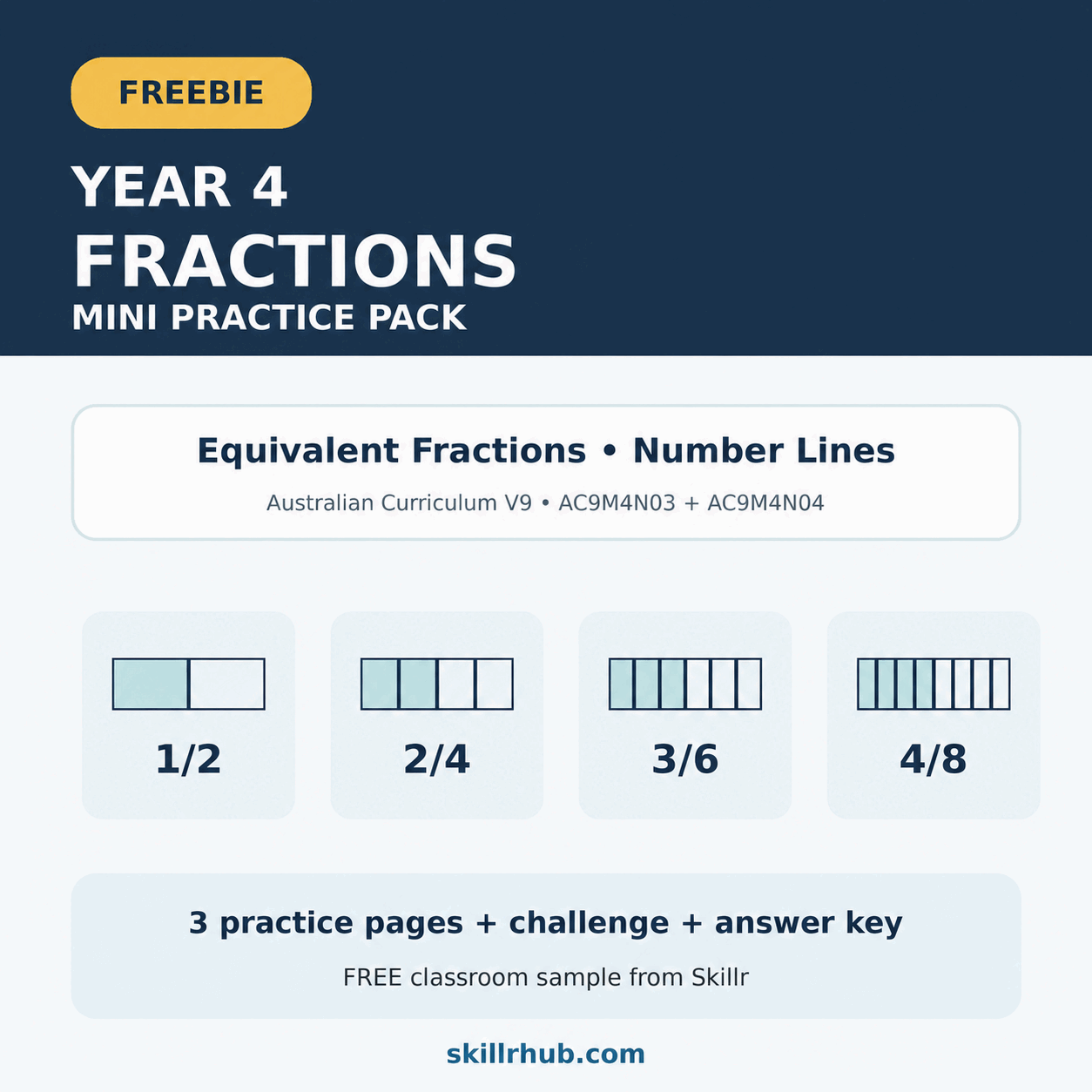
For example, one half, two quarters and four eighths name the same quantity. The diagrams look different because each whole has been partitioned into a different number of equal parts, yet the amount selected has not changed. On a number line, all three fractions occupy the same point. When students can explain both representations, equivalent fractions stop being a rule about multiplying numbers and become a relationship they understand.
SkillrHub separates this learning across two connected Australian Curriculum topics. AC9M4N03 develops equivalent fraction representations using related denominators and connects fractions with decimal notation. AC9M4N04 develops counting by fractions, including mixed numerals, and locating those numbers on number lines. The free pack concentrates on the overlap that builds a strong bridge between them: equivalent families, equal partitions and number-line placement.
Start with fraction families, not isolated tricks
A fraction family is a group of fractions with the same value. A useful first family is 1/2, 2/4, 3/6 and 4/8. Place the representations side by side and ask what changes and what stays the same. The number of pieces changes. The names change. The size of each individual piece changes. The total shaded amount stays the same.
This discussion matters because the phrase “whatever you do to the top, do to the bottom” can produce correct answers without understanding. A student might generate 3/6 from 1/2 by multiplying both numbers by 3, but the visual explanation gives the operation meaning: every half has been split into three smaller equal pieces, so one selected part becomes three selected parts and two total parts become six total parts. The amount is preserved.
Questions that reveal genuine understanding
- How could you prove that 2/3 and 4/6 represent the same amount?
- If every fourth is split in half, what denominator will the new fraction use?
- Can two fractions be equivalent if their numerators and denominators are different?
- Which model would convince someone who disagrees with your answer?
- What must be true about the whole before two diagrams can be compared?
The final question is especially important. Fraction comparisons assume equal-sized wholes. One half of a large pizza may be more food than three quarters of a small pizza. Students need to know whether they are comparing proportions of the same whole or actual quantities from different wholes.
Use multiple representations in a deliberate order
Students learn more reliably when they move from concrete or visual representations to symbols, then back again. The goal is not to abandon diagrams as soon as possible. The goal is to use each representation to explain the others.
| Representation | What it makes visible | Useful teacher prompt |
|---|---|---|
| Fraction strips or folded paper | Equal parts and the physical size of each part | “Which pieces cover exactly the same length?” |
| Area models | Equivalent shaded proportions | “What changed when each piece was subdivided?” |
| Number lines | Fractions as numbers with magnitude and order | “Why do both names point to the same location?” |
| Fraction notation | The numerator-denominator relationship | “What does each number tell us about the model?” |
A simple lesson might begin with two equal strips. Fold one into halves and the other into quarters. Align them and compare 1/2 with 2/4. Draw the same relationship, mark both fractions at the same number-line point, and only then record the symbolic multiplication. Later, reverse the direction: present 3/4 = ?/8 and ask students to build or sketch a proof.
Teaching fractions on number lines
Number lines can initially be harder than shaded shapes because students must focus on intervals rather than marks. To place quarters between 0 and 1, divide the distance into four equal intervals. This creates five marks: 0, 1/4, 2/4, 3/4 and 4/4. A common error is to draw four marks and accidentally create thirds. Ask students to count spaces, not just vertical lines.
Once the interval size is clear, extend the line beyond one whole. If the step is one quarter, the count continues 4/4, 5/4, 6/4 and so on. The denominator remains 4 because the size of the step has not changed. Mixed numerals can be added alongside improper fractions: 5/4 occupies the same point as 1 1/4, and 6/4 occupies the same point as 1 2/4 or 1 1/2.
A reliable number-line routine
- Read the endpoints. Check whether the line runs from 0 to 1, 0 to 2 or between two other numbers.
- Count equal intervals. Use the spaces between marks to identify the denominator or step size.
- Label known whole numbers. These anchors help students check whether a proposed fraction is reasonable.
- Count using the same-sized fraction step. Continue beyond one without changing the denominator.
- Rename when useful. Connect improper fractions and mixed numerals at the same point.
- Check position and spacing. A value between 1 and 2 cannot appear to the left of 1, and equal steps require equal distances.
Common Year 4 fraction misconceptions
- “A larger denominator means a larger fraction.” When the whole is fixed, more equal parts make each part smaller. Compare unit fractions with fraction strips: 1/8 is smaller than 1/4.
- “Equivalent fractions only look similar.” Ask the student to place both fractions on the same number line or cover one fraction strip with another. Equivalent fractions have the same value, not merely a similar diagram.
- “Multiply the denominator but leave the numerator.” Subdividing every part changes both how many parts exist and how many selected parts name the same amount. Rebuild the model before returning to the rule.
- “The denominator changes after one whole.” Counting 3/4, 4/4, 5/4 does not create fifths. The denominator names the size of each step, so it stays 4.
- “A mixed numeral means multiplication.” In 1 3/4, the symbols mean one whole and three quarters. Read it aloud and decompose it as 4/4 + 3/4 = 7/4.
- “Marks are the same as intervals.” Four equal intervals from 0 to 1 require five boundary marks. Have the student shade or point to each space while counting.
Misconceptions are diagnostic information. Instead of assigning a longer sheet immediately, choose the representation that exposes the faulty idea. One carefully discussed model is often more useful than twenty repeated questions.
A practical teaching sequence
- Re-establish equal parts. Compare examples and non-examples of wholes partitioned into equal parts.
- Build unit fractions. Connect the denominator to the number of equal parts and the numerator to the number selected.
- Compare related fraction families. Use halves, quarters and eighths, then thirds and sixths.
- Generate equivalent fractions visually. Subdivide every existing part by the same factor and describe why the amount is unchanged.
- Record symbolic relationships. Link the model to multiplying or dividing numerator and denominator by the same number.
- Transfer to number lines. Place equivalent names at the same location and count beyond one whole.
- Connect improper fractions and mixed numerals. Decompose complete denominator-sized groups plus the remainder.
- Apply and explain. Use missing-number, error-analysis and short reasoning questions rather than only routine conversion.
This sequence can run across several lessons. Students who already understand the visual relationship can move quickly into missing values and number-line reasoning. Students who are unsure should stay with fraction strips and parallel number lines until they can explain equivalence in their own words.
How to use the free mini pack in class
Begin with the teacher guide and use the visual fraction family on the cover or first worksheet as a brief warm-up. Ask students to describe what remains equal before they calculate anything. Complete the first few items together, requiring a sentence or model for at least one response. The second practice page moves into number lines and can be used independently once students can count intervals accurately.
Use the challenge page for early finishers, a small guided group or a final reasoning check. The exit ticket is deliberately short: it should tell you whether the next lesson can progress or whether a misconception needs attention. The answer key supports quick checking, but students should still explain important corrections rather than copy answers.
Differentiation without changing the big idea
For students needing support, reduce the number of fraction families but keep the reasoning demand. Use halves, quarters and eighths with aligned strips. Provide pre-drawn number lines and ask students to label them before expecting them to construct intervals. Let students explain orally while the teacher records the symbolic statement.
For students ready for extension, remove some labels, include equivalent points across parallel number lines, or ask for more than one correct fraction name. Invite them to find and correct a deliberately uneven number line. Challenge them to explain why multiplying numerator and denominator by the same non-zero whole number preserves value, using both a diagram and symbols.
Avoid using unrelated larger numbers merely to make questions appear harder. Productive extension increases the depth of reasoning: proving equivalence, comparing strategies, analysing errors and connecting representations.
How parents can support fractions at home
Use familiar materials such as folded paper, measuring cups or equal food portions, but keep the whole consistent when comparing. Ask the child to show one half in two different ways, find a fraction equivalent to two quarters, or explain where five quarters belongs on a line from 0 to 2. Short conversations are more valuable than rushing through a page.
When an answer is incorrect, avoid immediately supplying a rule. Ask: “What does the denominator tell us?”, “How many equal spaces are there?” or “Could you draw a model that proves it?” These questions help the child locate the problem in their own reasoning. Finish with one successful example so the session ends with a clear connection.
Australian Curriculum connections
AC9M4N03 includes finding equivalent representations of fractions using related denominators and making connections between fraction and decimal notation. AC9M4N04 includes counting by fractions, including mixed numerals, and locating and representing fractions as numbers on number lines. The Australian Curriculum published by ACARA remains the source of truth for official wording and local planning requirements.
The pack's fraction-family questions primarily support equivalent representations, while its number-line and mixed-numeral questions support counting and location. Teachers can use the two SkillrHub topic pathways below to extend from the sample into full teaching, independent practice and separate tests.
Continue from the PDF to teaching, practice and assessment
AC9M4N03 • Equivalent fractions
AC9M4N04 • Fraction number lines
Use evidence from the work to choose the next lesson
After the mini pack, sort errors by idea rather than by page. If a student changes only one part of an equivalent fraction, return to subdividing a visual model. If a student mislabels a number line, revisit equal intervals and whole-number anchors. If improper fractions are secure but mixed numerals are not, practise decomposing complete groups such as 7/4 = 4/4 + 3/4. This makes the next teaching step specific and efficient.
The aim is not to finish every available resource. It is to build a connected understanding that students can use in an unfamiliar question. Download the pack for the initial lesson or review, then move through the matching SkillrHub pathway only where the student's evidence shows it is needed.